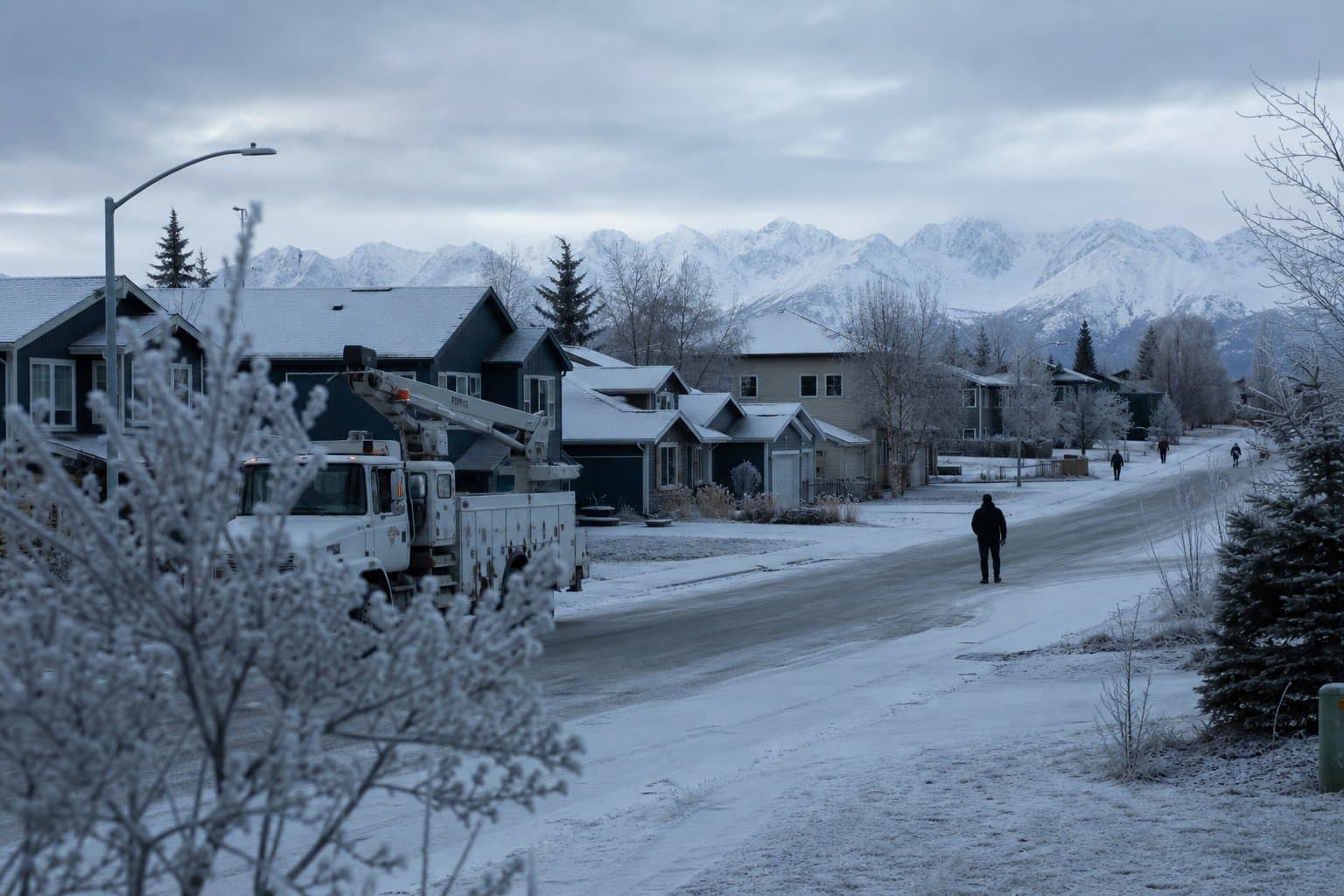
Alaska's bicameral legislature — 20-member Senate and 40-member House — meeting in Juneau from January to May each year. Sets the state budget, oil and gas policy, school funding, and the annual Permanent Fund Dividend calculation.
120 4th St, Juneau, AK 99801, USA
Video Clips
Browse all clips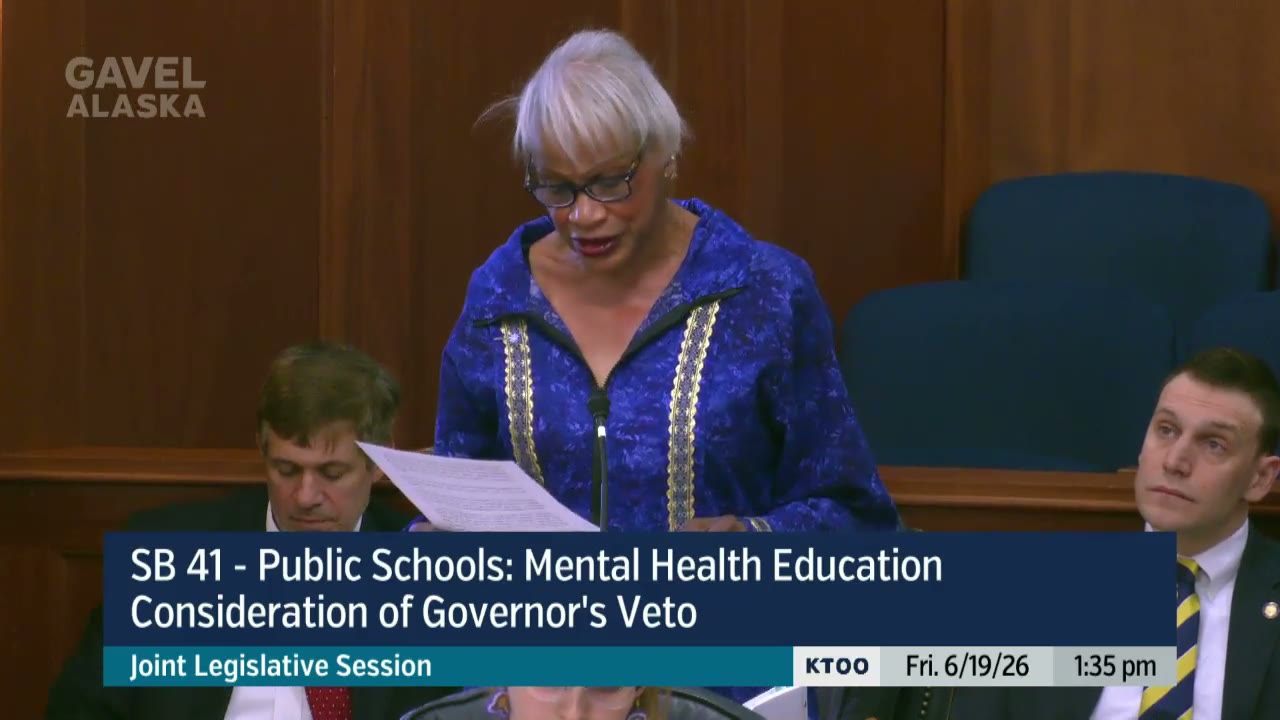
Elvi Gray-Jackson
“That is simply, simply not what SB 41 would do. The bill wouldn't create a state takeover of local classrooms.”Alaska Legislature: MISC-20260619-1230
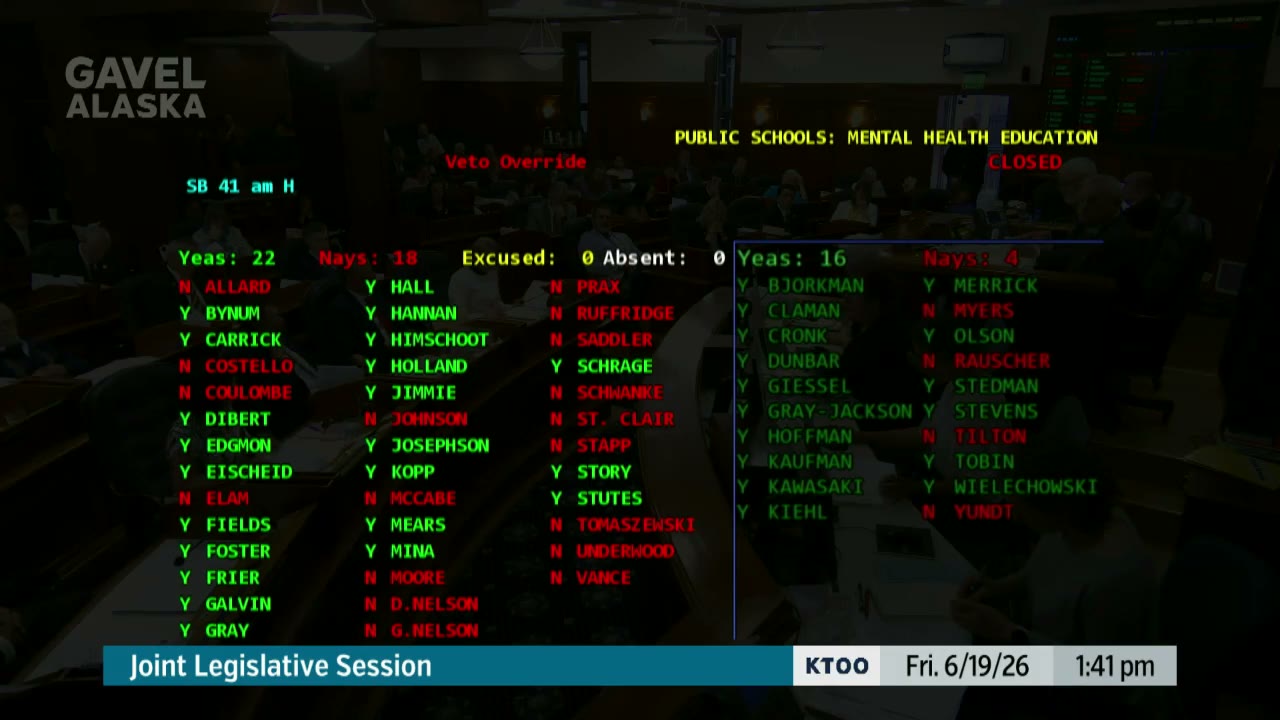
Gary Stevens
“38 Yeas, 22 nays. And so by a vote of 38 yeas and 22 nays, the joint legislative session has failed to override Senate Bill 41.”Alaska Legislature: MISC-20260619-1230
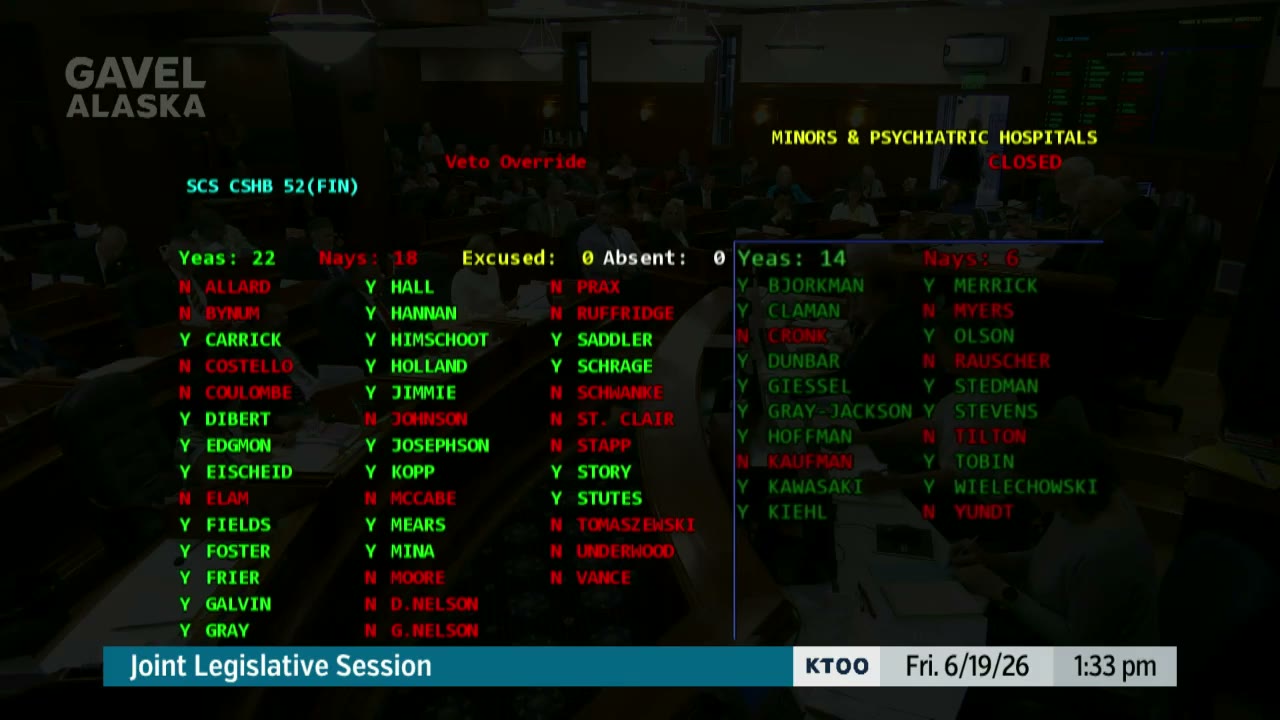
Gary Stevens
“36 Yeas, 24 nays. Thank you. The joint legislative session has failed to override the governor's veto of House Bill 52.”Alaska Legislature: MISC-20260619-1230

Elvi Gray-Jackson
“Alaska has the highest suicide rate in the nation. In many rural communities, suicide rates are nearly 4 times that average, the national average. Teaching our students how to recognize mental health challenges, seek help, and support one another is one of the most basic and meaningful steps we can take to address this crisis.”Alaska Legislature: MISC-20260619-1230
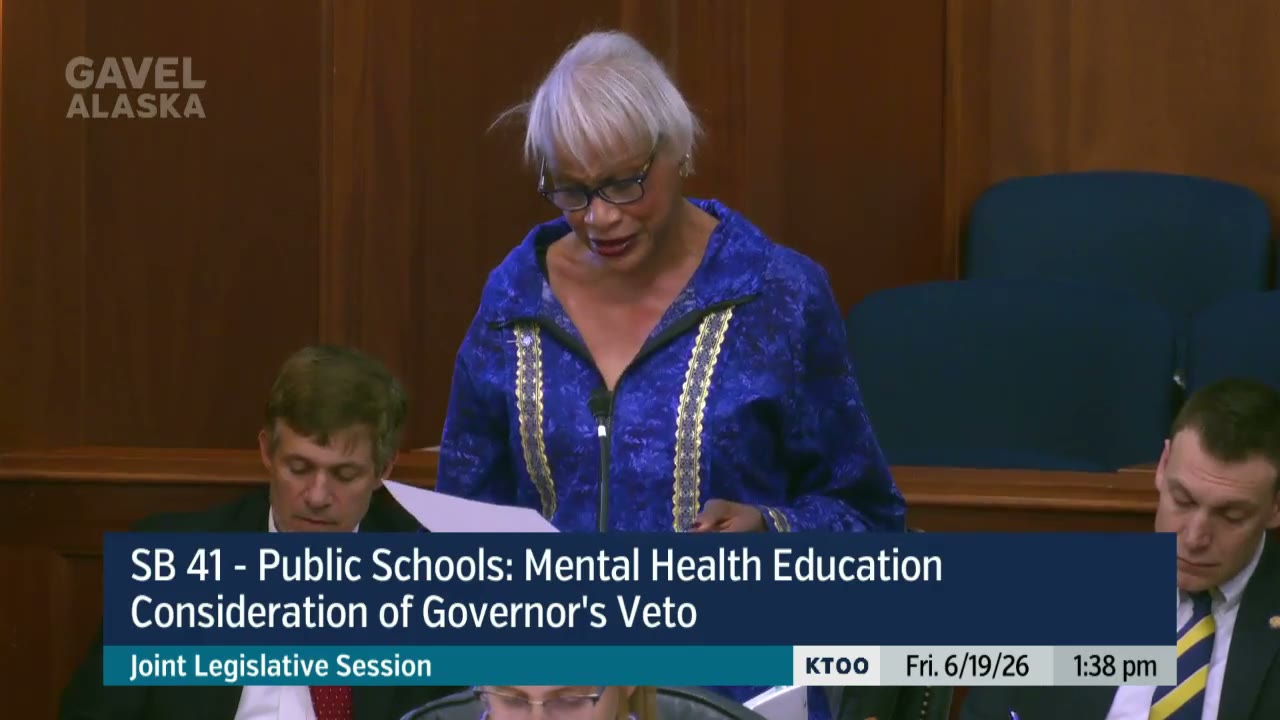
Elvi Gray-Jackson
“our children are watching. They are watching. They are hoping that we hear their voices and understand their pleas for help. They're looking to us for leadership, compassion, and action.”Alaska Legislature: MISC-20260619-1230
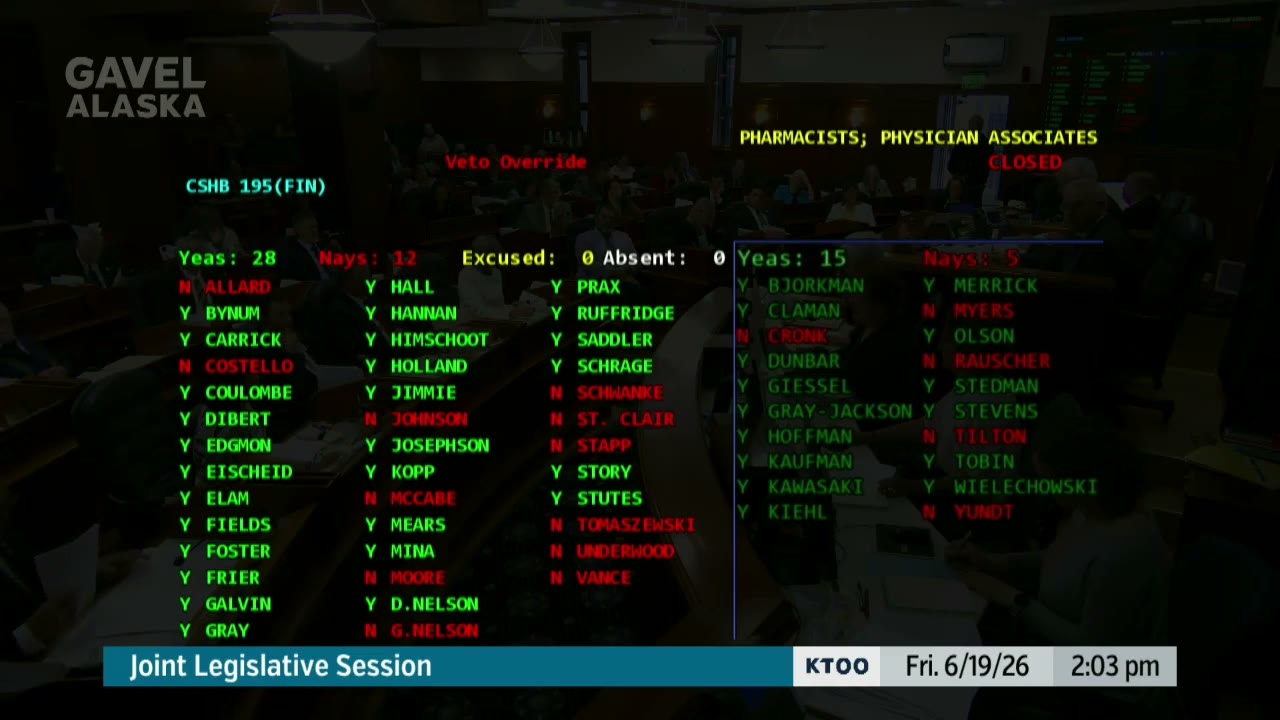
Gary Stevens
“by a vote of 43 yeas and 17 nays, the joint legislative session has overridden the governor's veto of CSRA House Bill 195 Finance.”Alaska Legislature: MISC-20260619-1230
Alaska Permanent Fund hits $91.9 billion with a 12.4% return
Alaska Permanent Fund annual report 2026: fund worth $91.9 billion, 12.42% return, record earnings; trustees back a constitutional amendment for one protected endowment.
 by Walter AlaskaNews11h ago2 min read
North Slope crude runs $15 above Alaska's spring forecast, budget group says
Daily tracking by Alaskans for Sustainable Budgets puts fiscal 2027 North Slope crude at $90 a barrel against a $75 state forecast, a gap worth about $970 million if futures hold. Production is running about 50,000 barrels a day below forecast.
by Walter AlaskaNews14h ago2 min read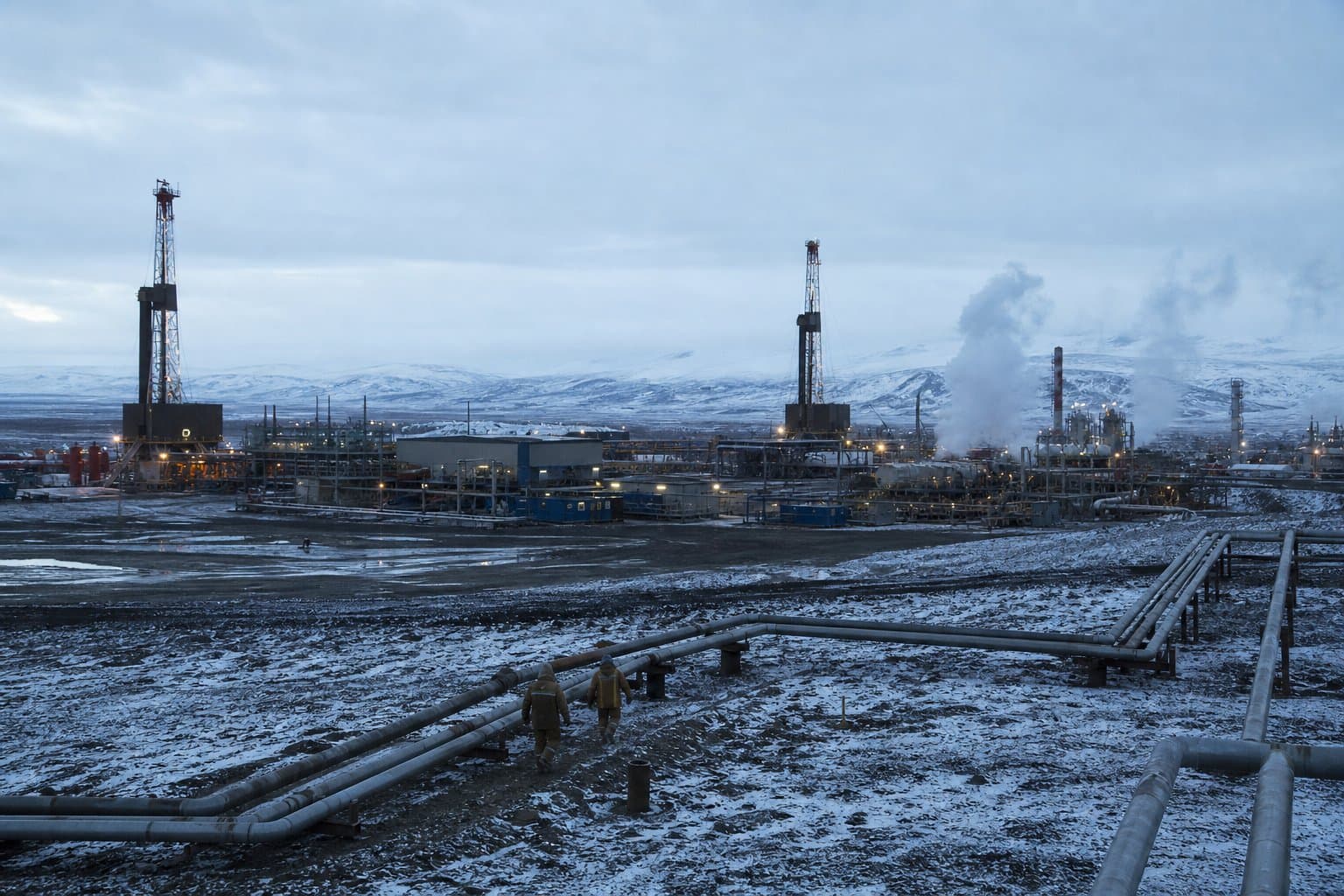
None of Anchorage's district projects got state money this year, city tells Assembly committee
Anchorage's district-level capital requests went unfunded in the 2026 legislative session as the Assembly begins its 2027 program. The port received $15 million.
by Walter AlaskaNews3d ago3 min read
Prince William Sound faces a winter without ferry service as the Aurora is overhauled
Prince William Sound ferry: Aurora overhaul leaves Valdez, Cordova and Whittier with little or no winter service; state plans docks in Cordova, Tatitlek and Chenega.
by Walter AlaskaNews4d ago2 min read
Lawmakers press state on Safer Seward Highway project's size and funding as DOT reopens comment
Safer Seward Highway project: lawmakers question the four-lane plan's size and funding as DOT reopens its environmental comment period and cites crash data.
by Walter AlaskaNews4d ago3 min read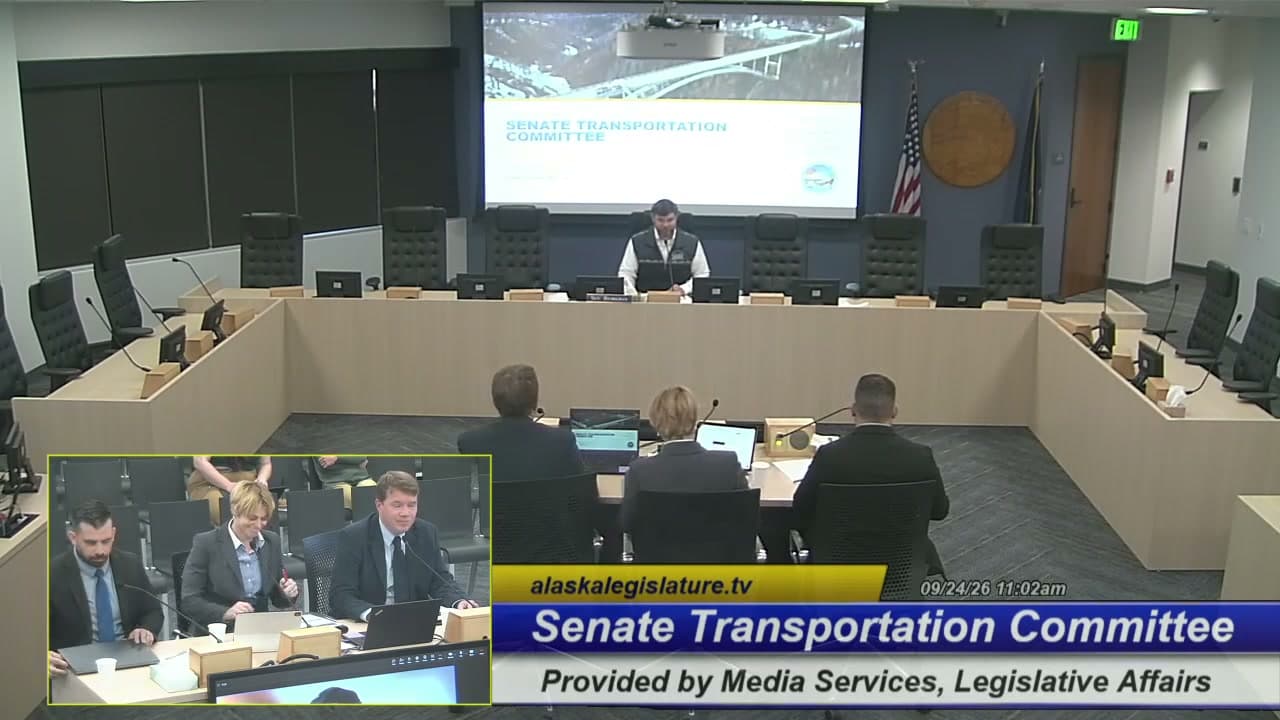
Permanent Fund has $5.7B uncommitted after reserving next draw, inflation transfer
Alaska's Permanent Fund had $5.7 billion uncommitted after reserving its fiscal 2028 draw and fiscal 2027 inflation transfer.
by Walter AlaskaNews1w ago1 min read
Anchorage's school funding gap has shrunk to about $6 million
Anchorage projects a school funding gap of about $6 million for fiscal 2027, down from $12 million, after the Legislature capped the local contribution increase at 4 percent.
by Walter AlaskaNews1w ago2 min read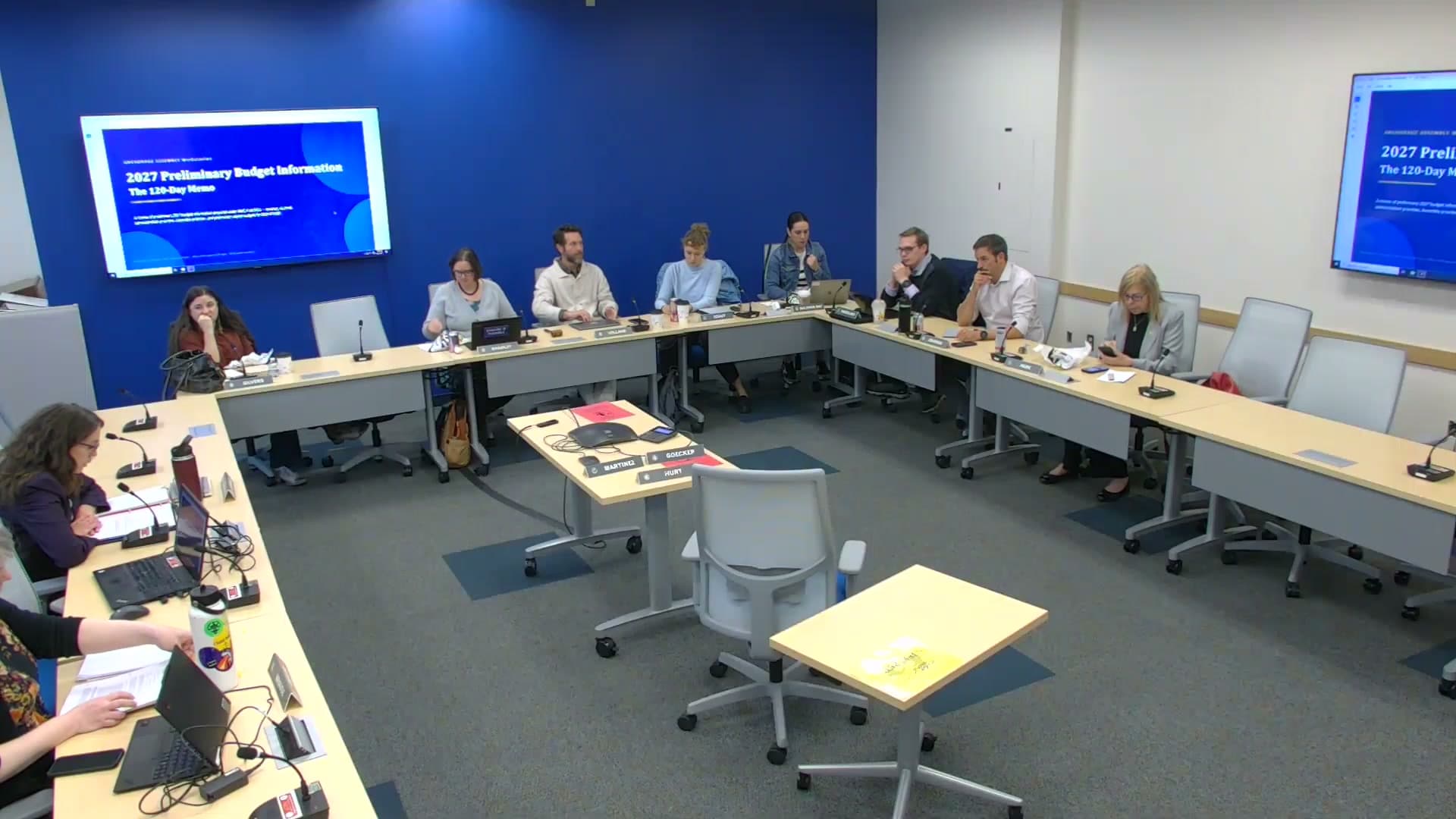
Kenai Assembly asks state to ban cloud seeding, on consent agenda
The Kenai Peninsula Borough Assembly asked the state to ban weather modification after a California company cloud-seeded over the borough without notifying officials.
by Walter AlaskaNewsadded 1w ago3 min read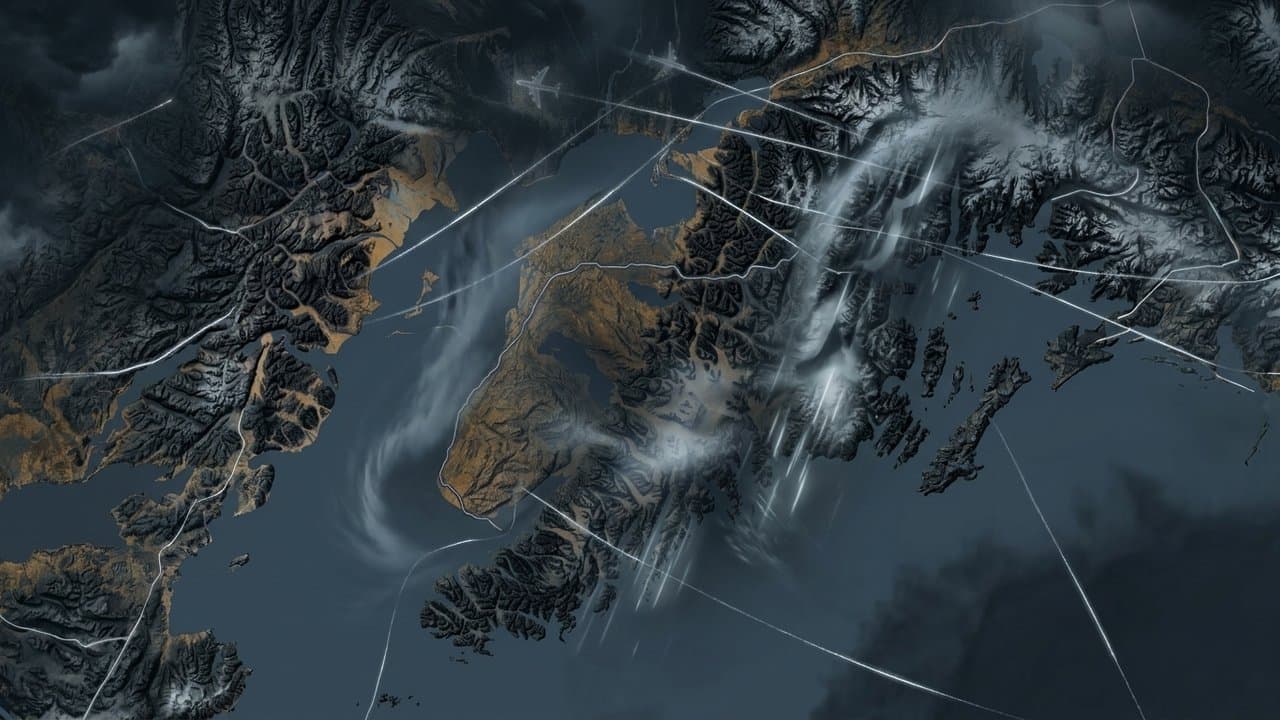
Southcentral is 3 Bcf short this winter, and producers told lawmakers the gas runs out in 2029
ENSTAR has told Alaska lawmakers it is 3 billion cubic feet short of gas this winter, and the storage that could cover it is already committed to ENSTAR under a contract being renegotiated. Producers told a joint committee Cook Inlet cannot cover Southcentral demand past 2029.
by Walter AlaskaNews2w ago2 min read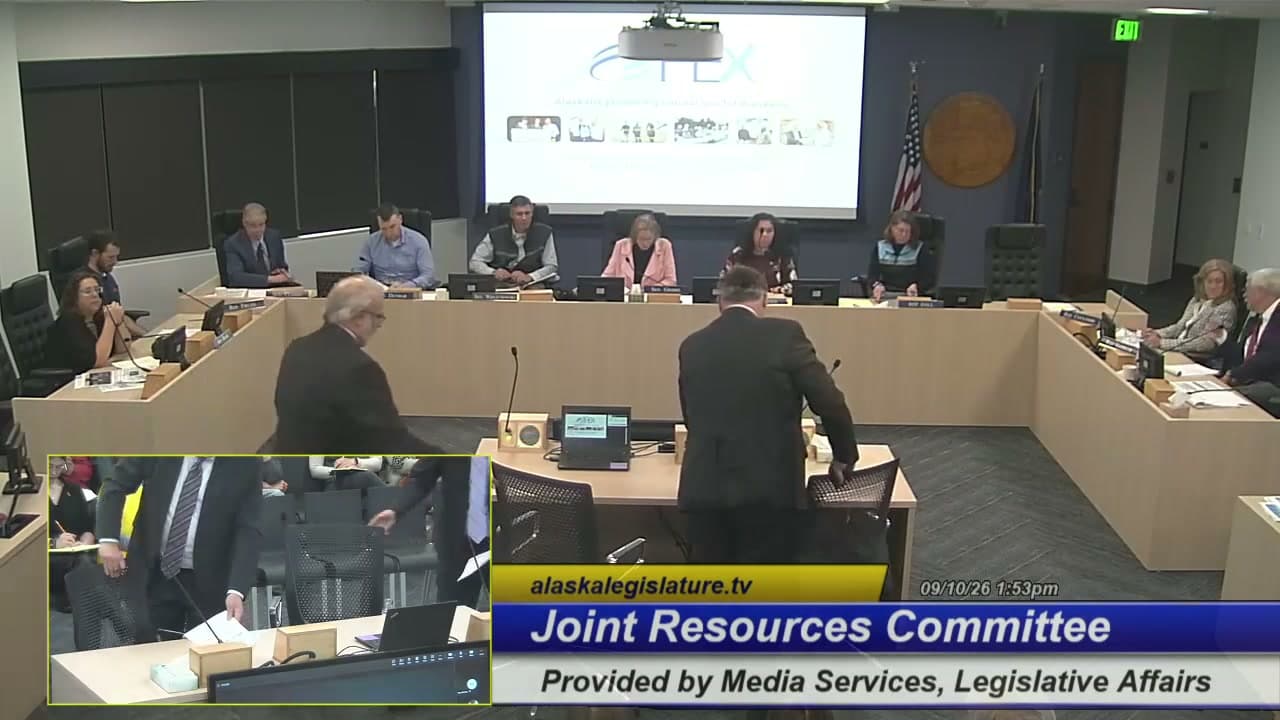
The Legislature will spend $50,000 defending the seizure of a pilot's plane
The Alaska Legislative Council voted to spend up to $50,000 on an amicus brief defending the state's aircraft forfeiture law before the U.S. Supreme Court.
by Walter AlaskaNews2w ago2 min read
Southcentral's gas storage is two-thirds full with winter coming
Southcentral Alaska's two commercial natural gas storage fields are about 68 percent full heading into winter, with roughly 16 billion cubic feet of space empty.
by Walter AlaskaNews2w ago2 min read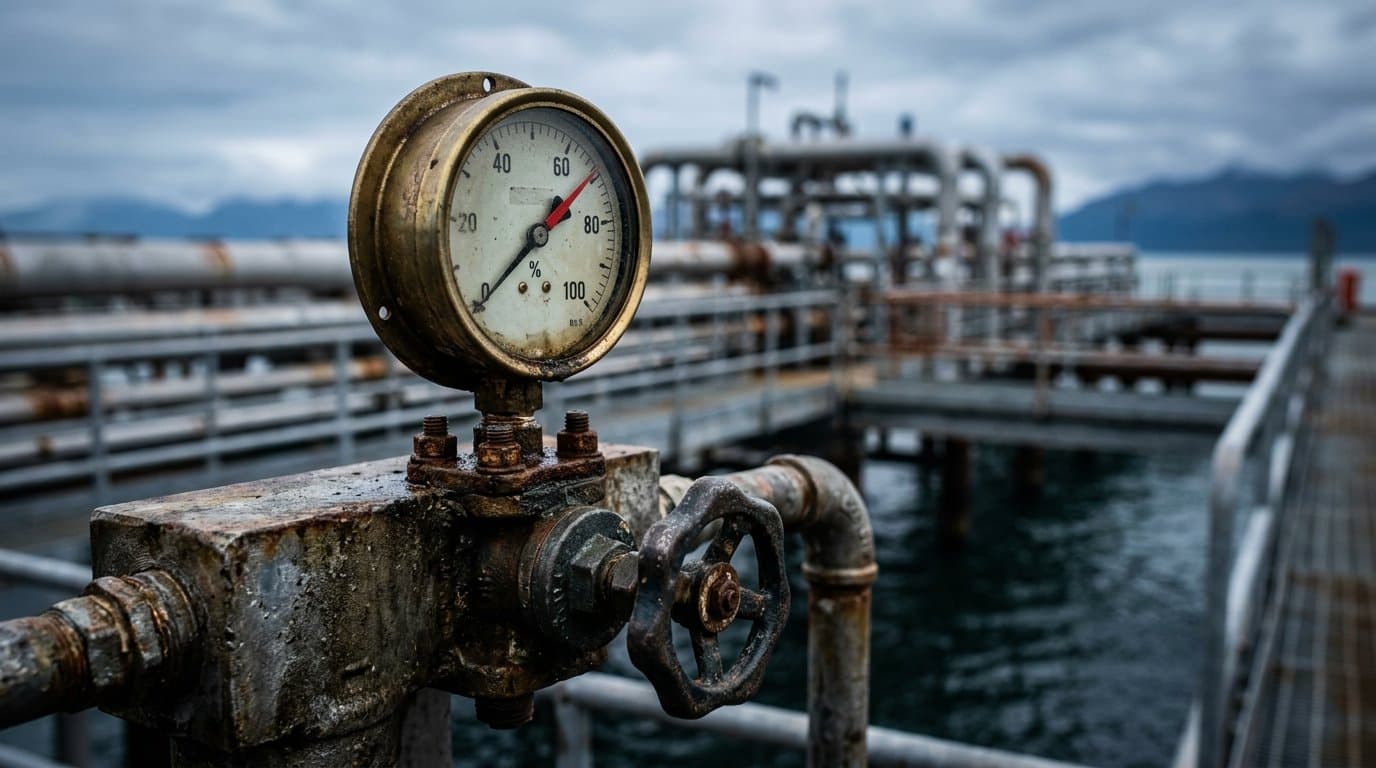
Three Alaska governor candidates agree on the problems, diverge on government's role
Jonathan Kreiss-Tomkins, Treg Taylor and Dave Bronson agreed on Alaska's problems but diverged on solutions at a Last Frontier Republican Club forum Tuesday.
by Walter AlaskaNews2w ago7 min read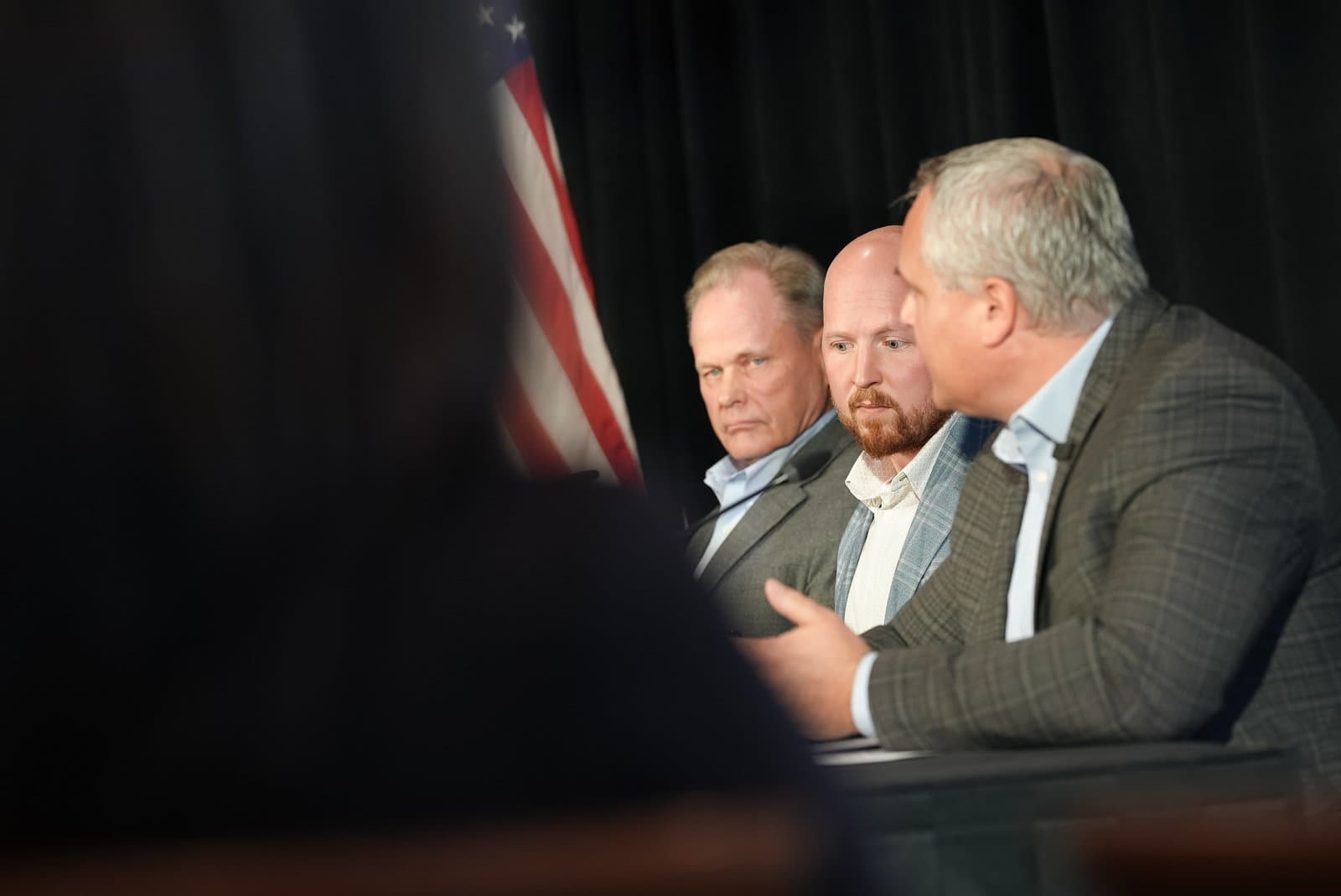
Five Alaska legislators and candidates amend financial disclosures in two days
Five sitting Alaska legislators and 2026 candidates filed six amended Public Official Financial Disclosures with APOC on Monday and Tuesday, adding two Anchorage houses, two nonprofit board seats, a spouse's last name and corrected income dates.
by Walter AlaskaNews2w ago2 min read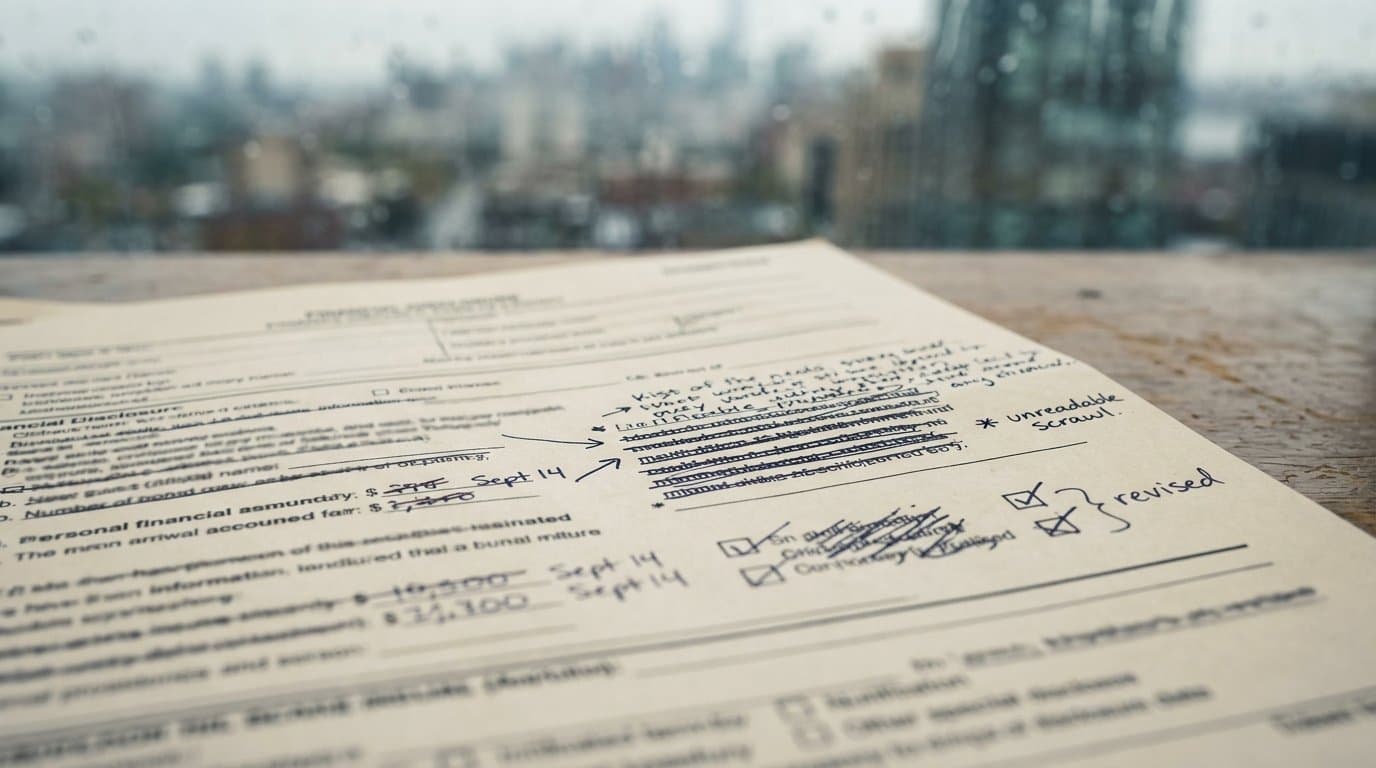
Alaska's youngest students are improving in math and reading. Older grades aren't.
Alaska's 2025-2026 AK STAR results, released Thursday, show math and reading proficiency rising in grades 3-5 while grades 6-9 hold near 29 to 32 percent. Commissioner Deena Bishop called achievement in the higher grades relatively flat.
by Walter AlaskaNews3w ago2 min read
The Permanent Fund earned $8.2 billion and none of it went into protected principal
The Alaska Permanent Fund closed FY26 at $91.9 billion with $8.19 billion in statutory net income, and no inflation-proofing transfer for a second year.
by Walter AlaskaNews3w ago2 min read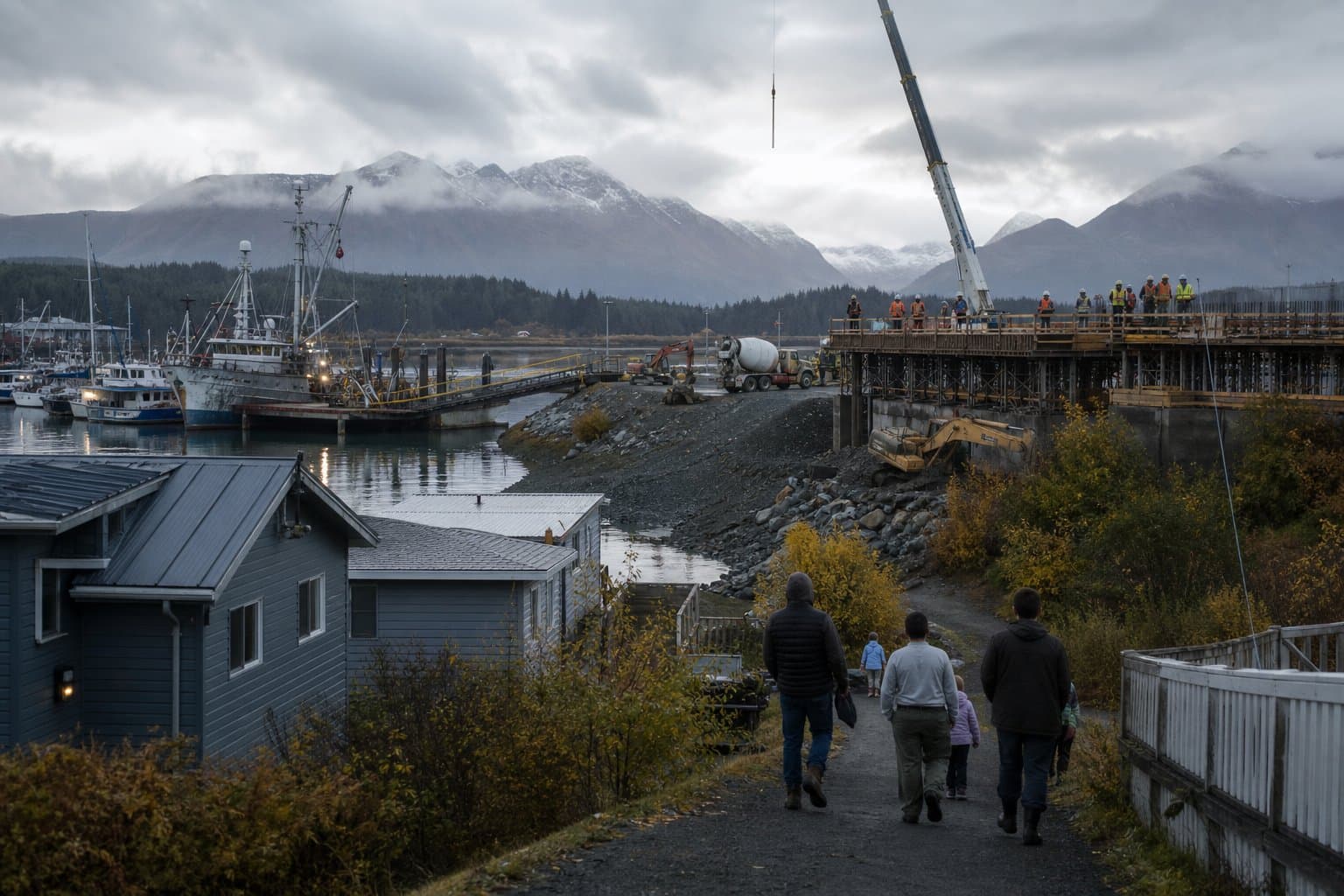
Districts learned about $115 million after school had already started
Anchorage's superintendent says state leadership told districts on Aug. 31 that the full $115 million for schools is available, about $32 million of it for Anchorage. The Department of Revenue has not published the determination, and the money sits behind a $127 million dividend payment.
by Walter AlaskaNewsadded 3w ago2 min read
Dunleavy vetoed a faculty seat on the board that governs the University of Alaska
Governor Mike Dunleavy vetoed House Bill 10, which would have added a tenured faculty member to the University of Alaska Board of Regents, though the measure passed both chambers with 44 combined votes, four more than a two-thirds override would require.
by Walter AlaskaNewsadded 3w ago2 min read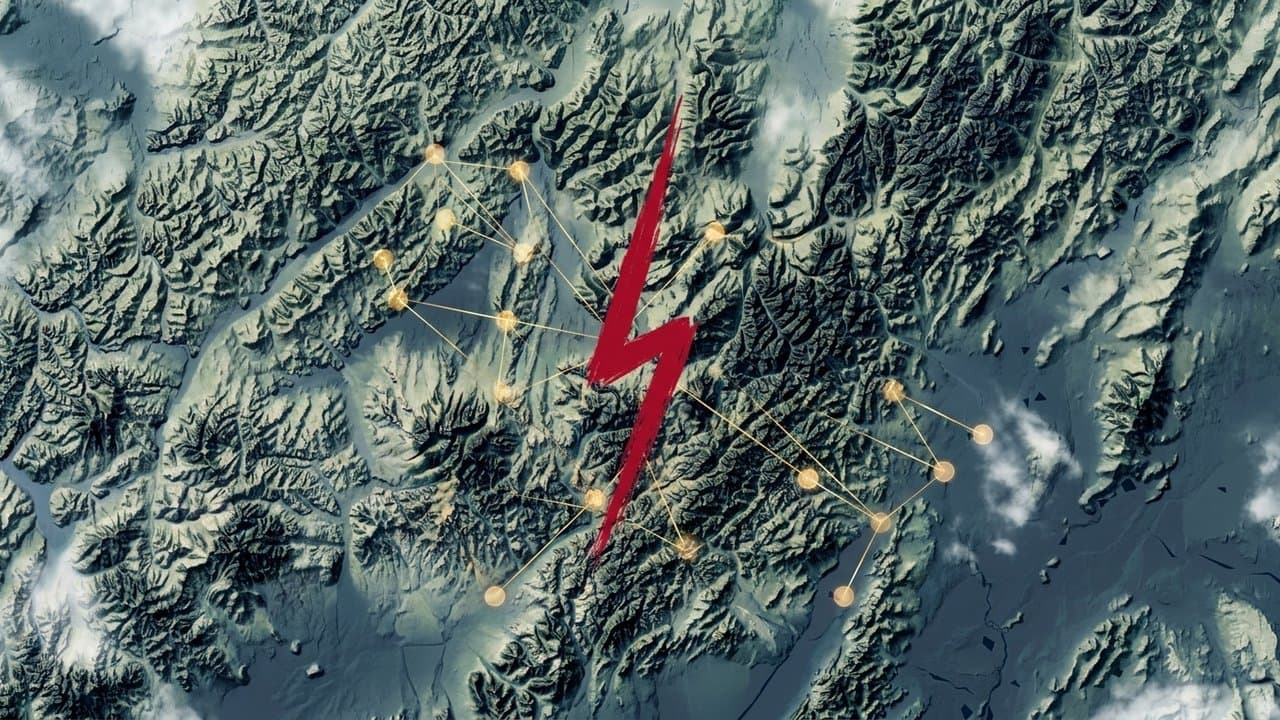
Wright and Dunleavy insist the Alaska LNG project is alive
In one of his last public appearances at the Alaska Oil and Gas Association conference in Anchorage on Thursday, Gov. Mike Dunleavy said the state's oil and gas property tax is too high for gas line investors, and told the audience to press candidates on energy policy before the election.
 by Bill AlaskaNews1mo ago3 min read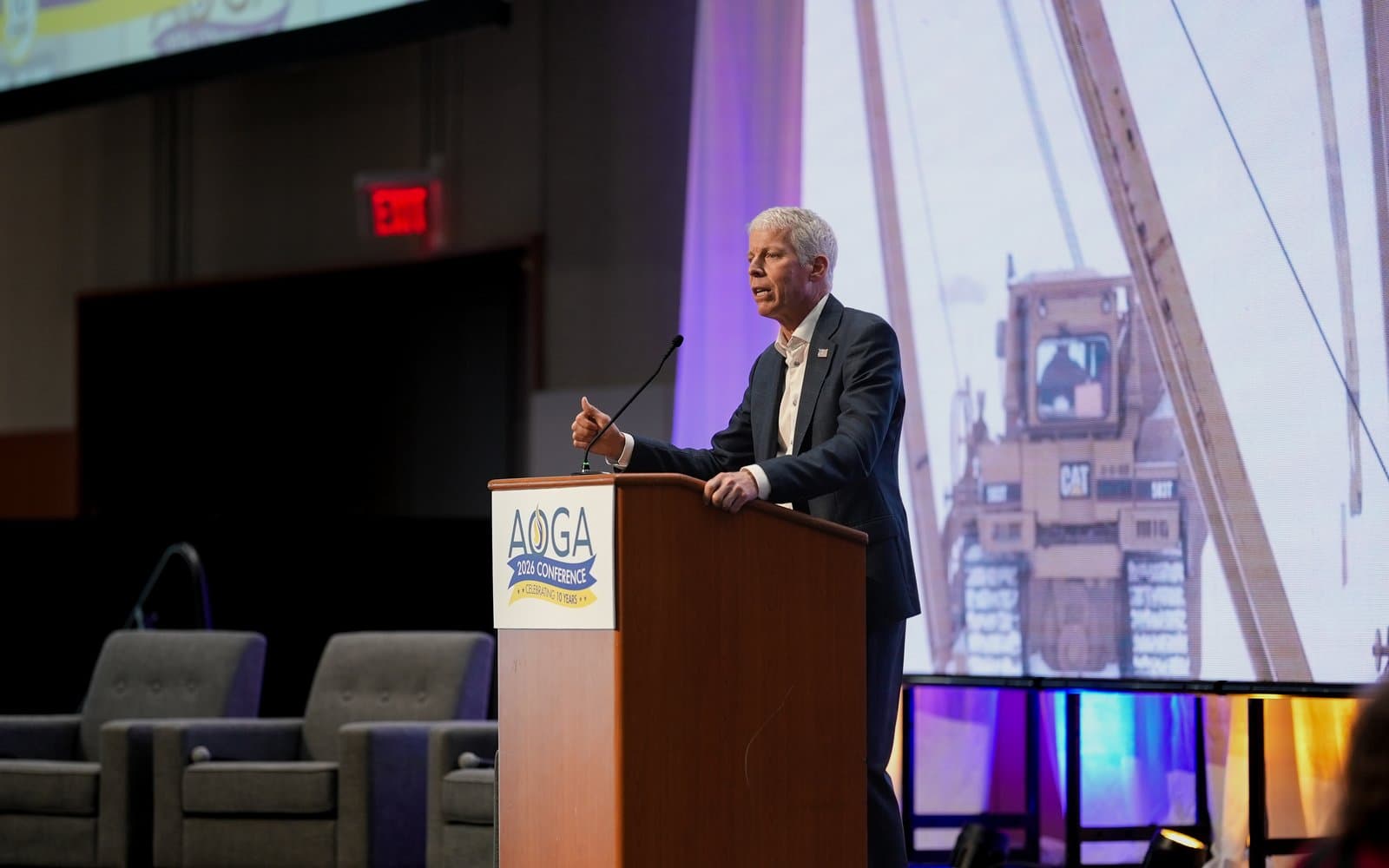
Former Rep. Carl Morgan, mayor of Aniak and Kuskokwim Native leader, has died
Gov. Mike Dunleavy announced Tuesday the death of former Rep. Carl Morgan of Aniak, who served in the Alaska State House from 1999 to 2004. Flags will be lowered statewide on a date set with Morgan's family.
by Walter AlaskaNews1mo ago1 min read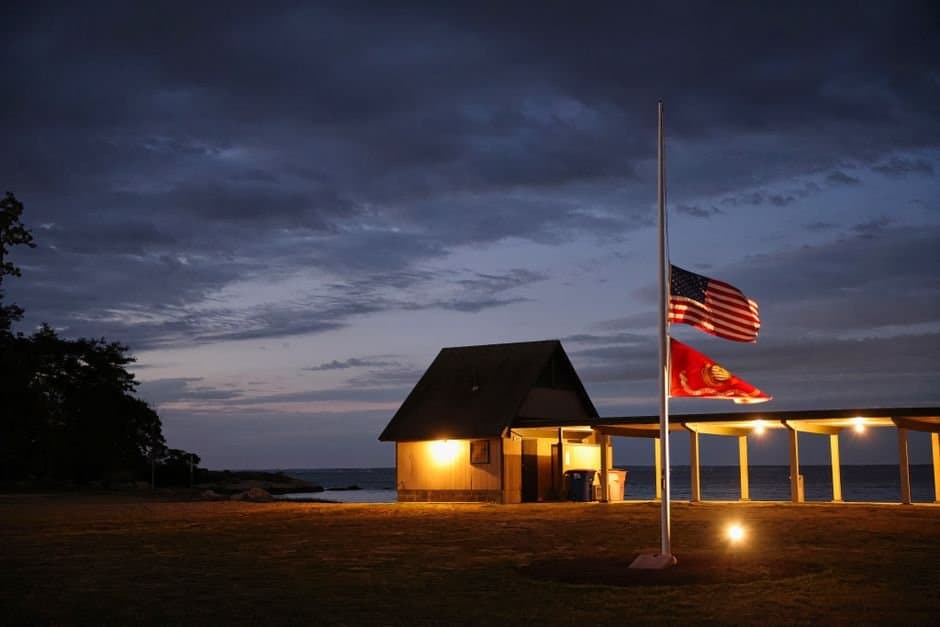
Alaska Legislative Council approves $851,400 for KTOO's Gavel Alaska coverage
The Alaska Legislative Council approved a contract worth up to $851,400 with KTOO Public Media to continue Gavel Alaska coverage of legislative proceedings.
by Walter AlaskaNews1mo ago1 min read
Alaska lawmakers weigh whether to keep boards licensing dentists and barbers
The Alaska Legislative Budget and Audit Committee released final sunset audits Thursday for the boards licensing dentists, chiropractors, barbers and hairdressers, plus the Statewide Suicide Prevention Council, and sent preliminary audits of the Board of Marine Pilots and Marijuana Control Board to those agencies for response.
by Walter AlaskaNews1mo ago2 min read
The Alaska House gavels in and out again, taking no action in the special session
The Alaska House of Representatives met for minutes Tuesday in Juneau, took no action on natural gas taxation, and adjourned by unanimous consent to another technical session set for Friday at 10:30 a.m.
by Walter AlaskaNewsadded 1mo ago1 min read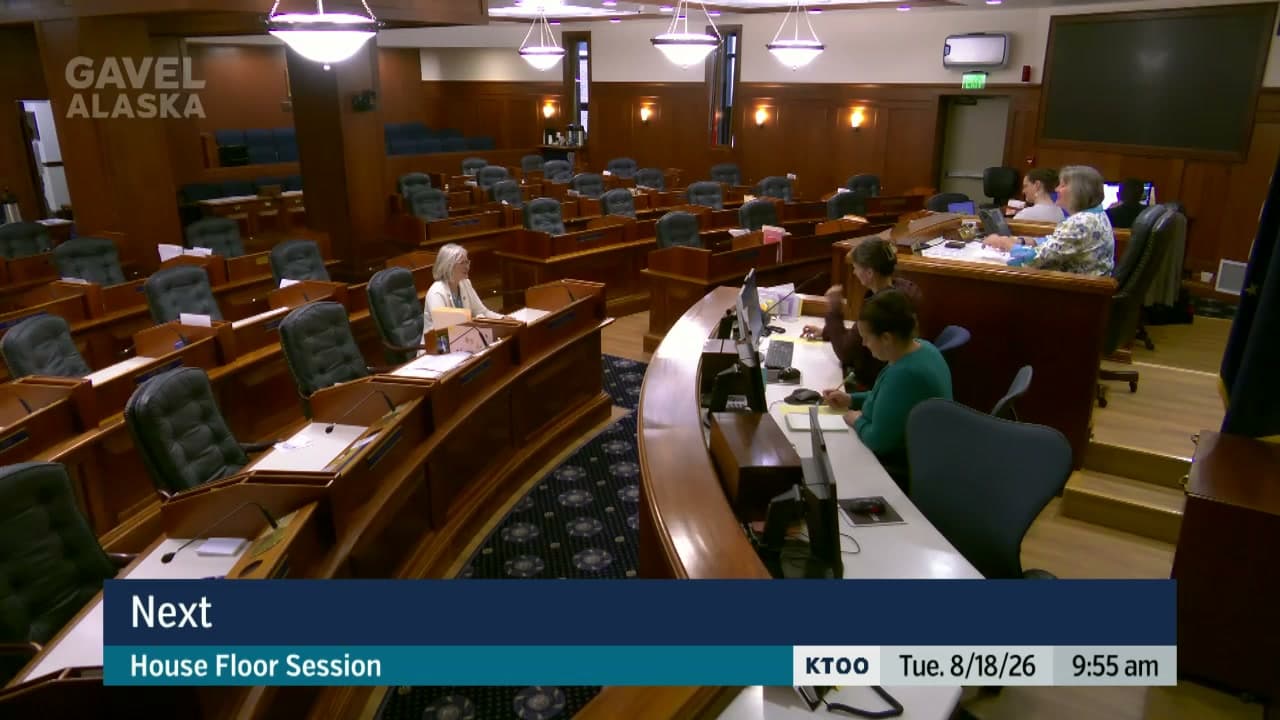
Alaska's audit watchdog gets a new leader, inheriting a fisheries probe and a new power over the governor
Mark Lundahl takes over as Alaska's acting legislative auditor Aug. 31, inheriting a Board of Fisheries special audit and new access to state oil and gas tax records.
by Walter AlaskaNews1mo ago2 min read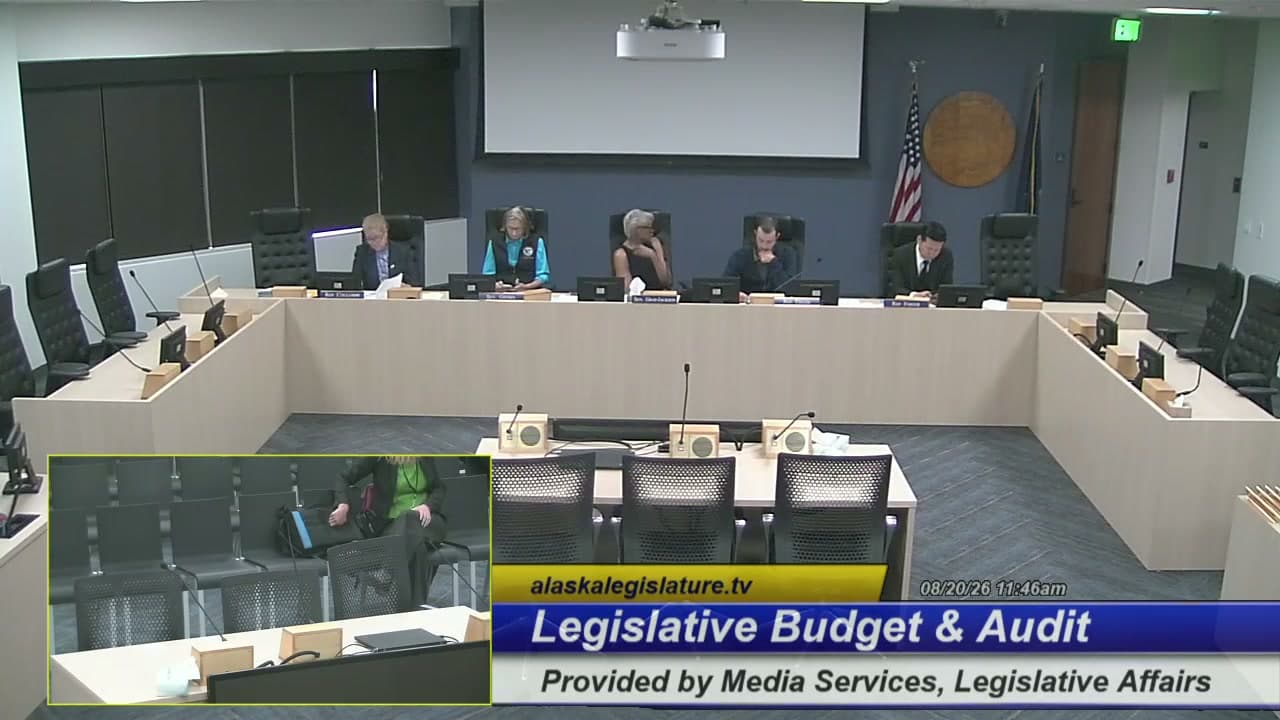
Gas tax package still off the Senate floor as the special session nears its limit
The Alaska State Senate met Monday for a technical session, waived roll call and other opening business, took up no bills or resolutions, and adjourned until 2 p.m. Friday, August 21.
by Walter AlaskaNews1mo ago1 min read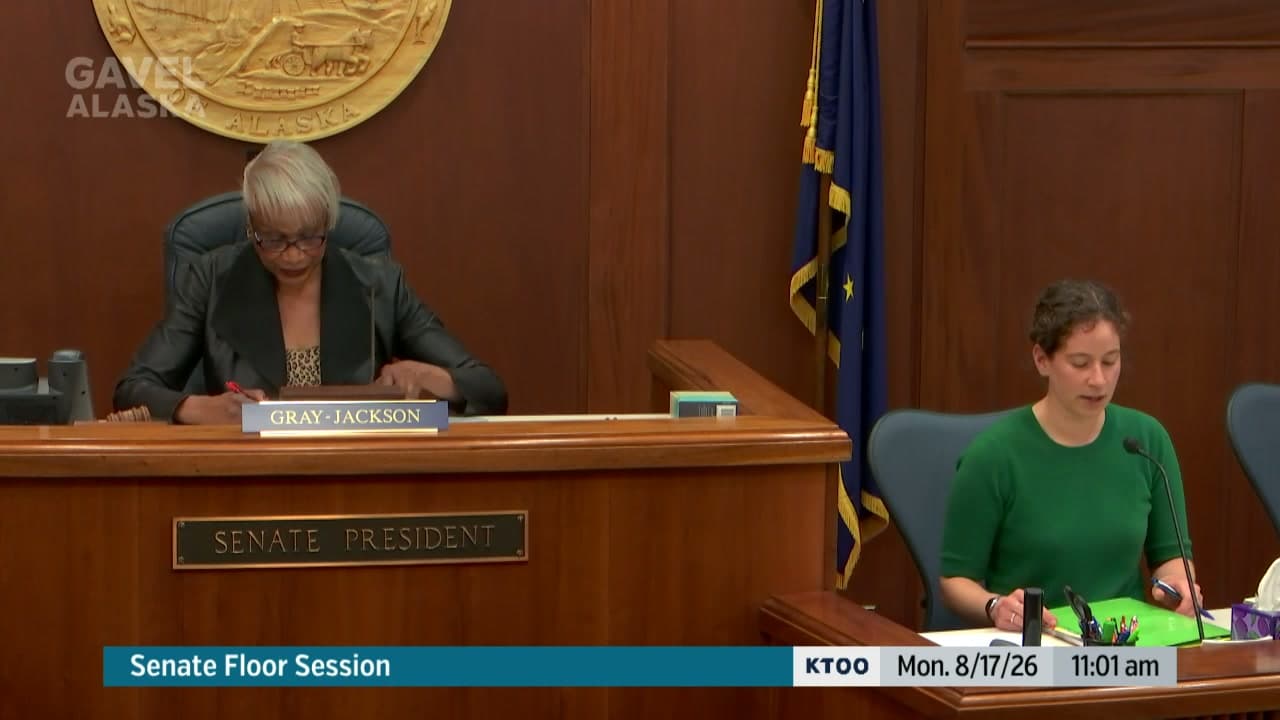
1,900 Alaskans flagged as 'inactive non-citizen' can still vote Tuesday
About 1,900 Alaska voters remain flagged as "inactive non-citizen" three days before the Aug. 18 primary. Division of Elections Director Carol Beecher told lawmakers the flags will not be cleared in bulk because precinct registers are already printed and mailed.
by Walter AlaskaNews1mo ago2 min read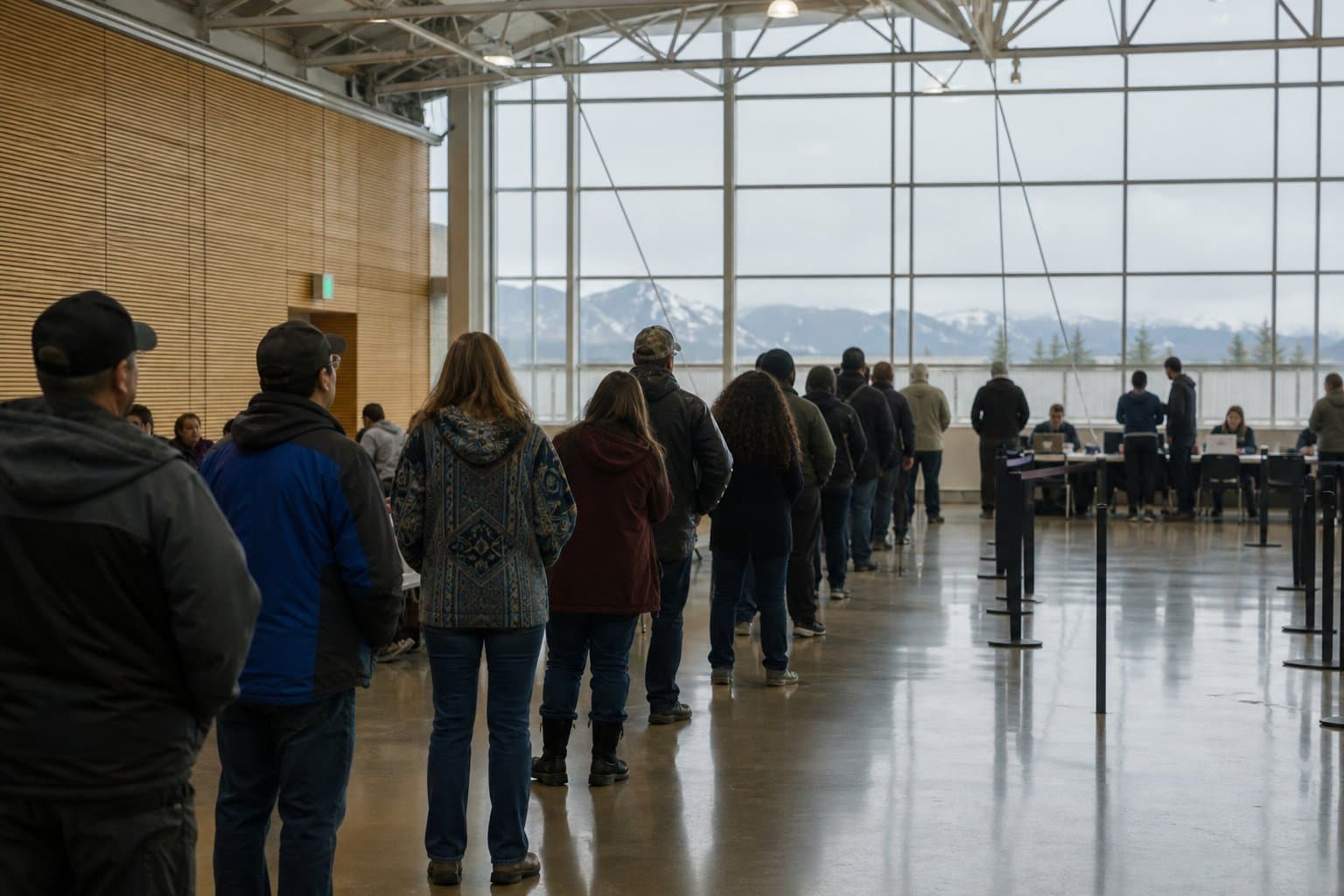
Dunleavy says he is ending gas line special session, blames legislative leaders
Gov. Mike Dunleavy said Friday he is ending the special session on the Alaska LNG gas line, saying legislative leaders declined to work on his bill. Southcentral utilities warn of a winter gas shortfall, and the Alaska State House and Senate Resources committees were scheduled to hold a joint gas supply briefing Aug. 20.
by Walter AlaskaNews1mo ago3 min read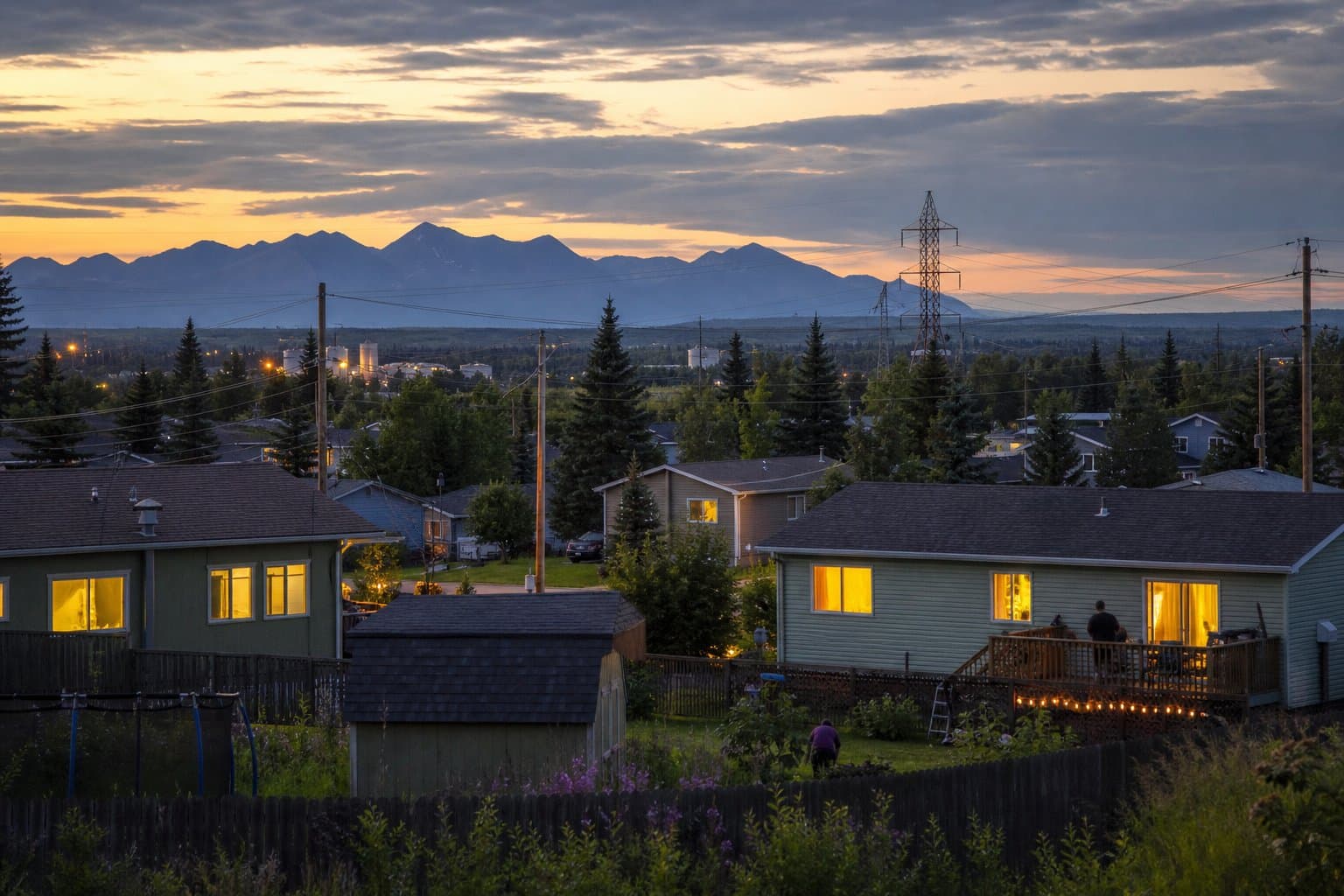
Dunleavy's LNG bill would swap a graduated S corp tax topping 9.4% for a flat 2%
Governor Mike Dunleavy transmitted a compromise Alaska LNG tax and oversight bill Wednesday, lowering the disputed S corporation income tax to a flat 2%, delaying it to 2030, and dropping a cut to state education aid for boroughs receiving gas line tax revenue.
by Walter AlaskaNews1mo ago3 min read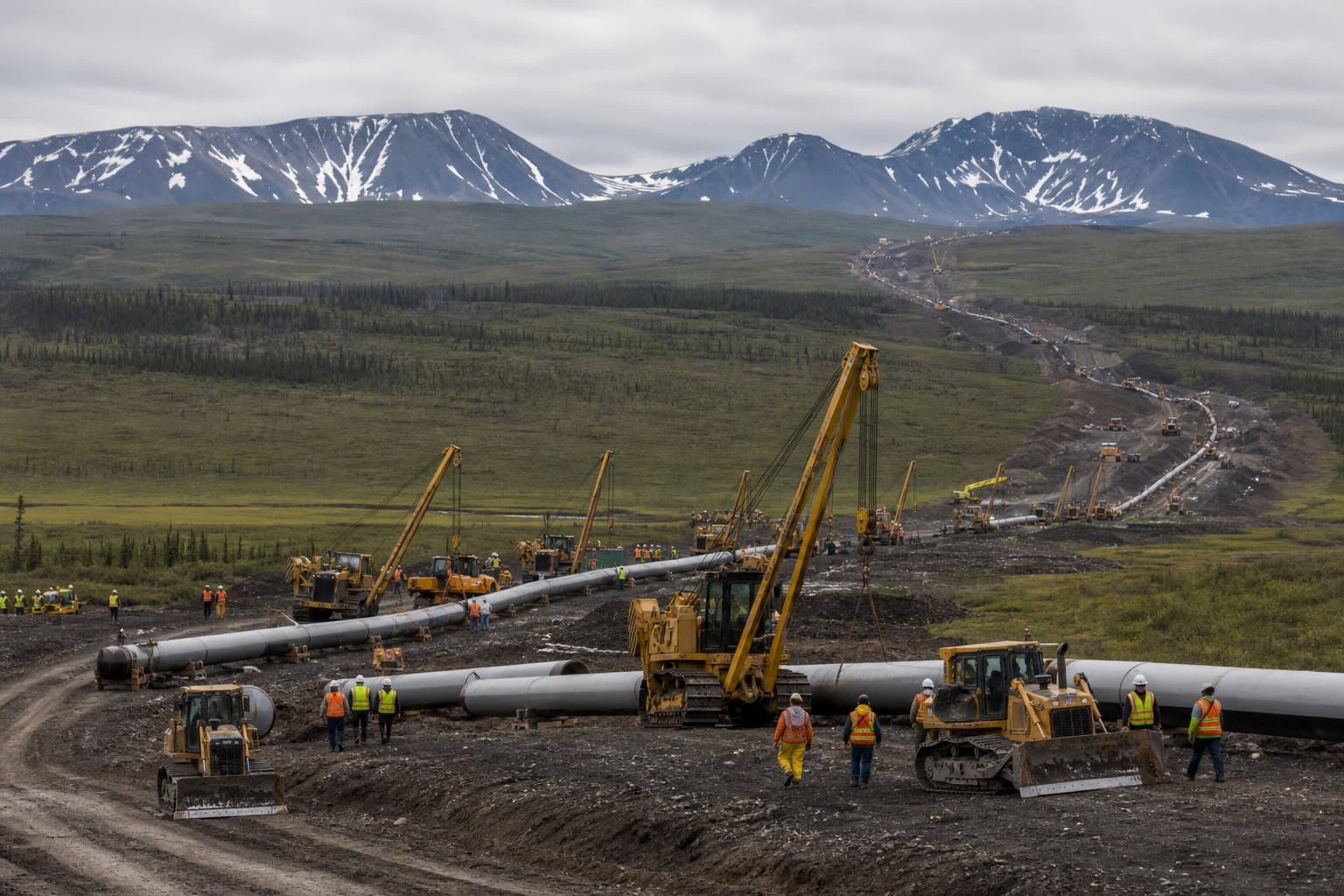
Dunleavy vetoes hunting residency bill and university fee bill
Gov. Mike Dunleavy vetoed a bill tightening residency rules for hunting, trapping and sport fishing and a bill requiring the University of Alaska to itemize student fees. Both veto messages were read into the Alaska State Senate record Tuesday during a technical session with no vote.
by Walter AlaskaNews1mo ago2 min read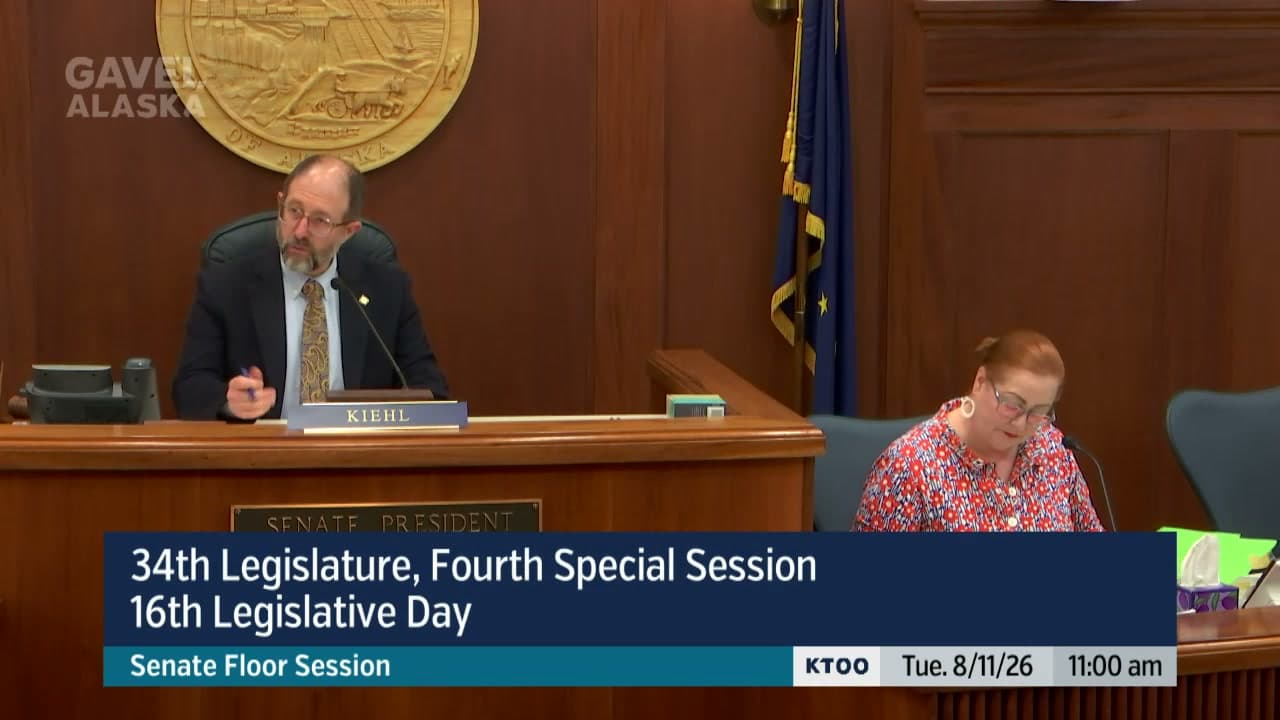
Senate majority to regulators: reconsider the rejected gas storage project, and make BlueCrest produce
At a press availability Monday, Alaska Senate majority members said they are sending a letter asking the Regulatory Commission of Alaska to reconsider its denial of Enstar's Kenai gas storage petition. They also called on the governor to get BlueCrest's undeveloped Cosmopolitan lease into production.
by Walter AlaskaNews1mo ago3 min read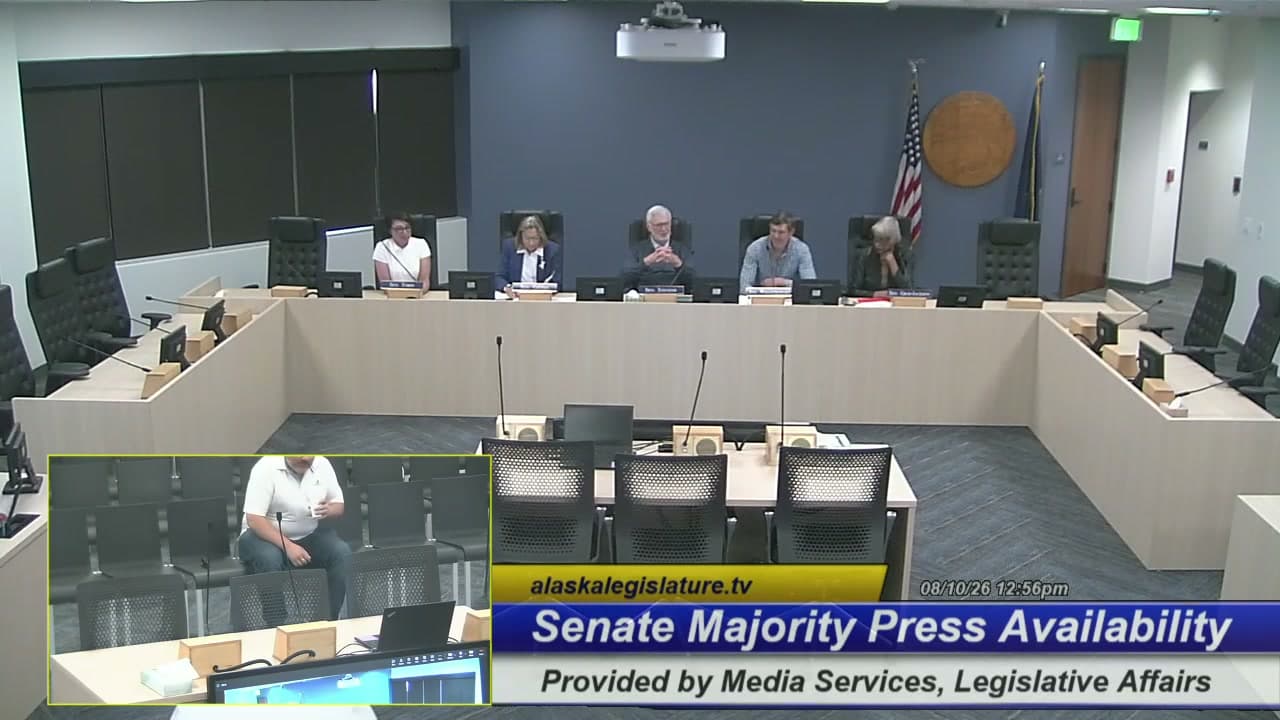
Alaska Senate Majority says gasline tax break waits on Glenfarne financial numbers
The Alaska Senate majority says it won't commit to the gas pipeline tax break without detailed financials from Glenfarne and Gov. Dunleavy, as cost estimates range from $44.5B to $70B.
by Walter AlaskaNews1mo ago4 min read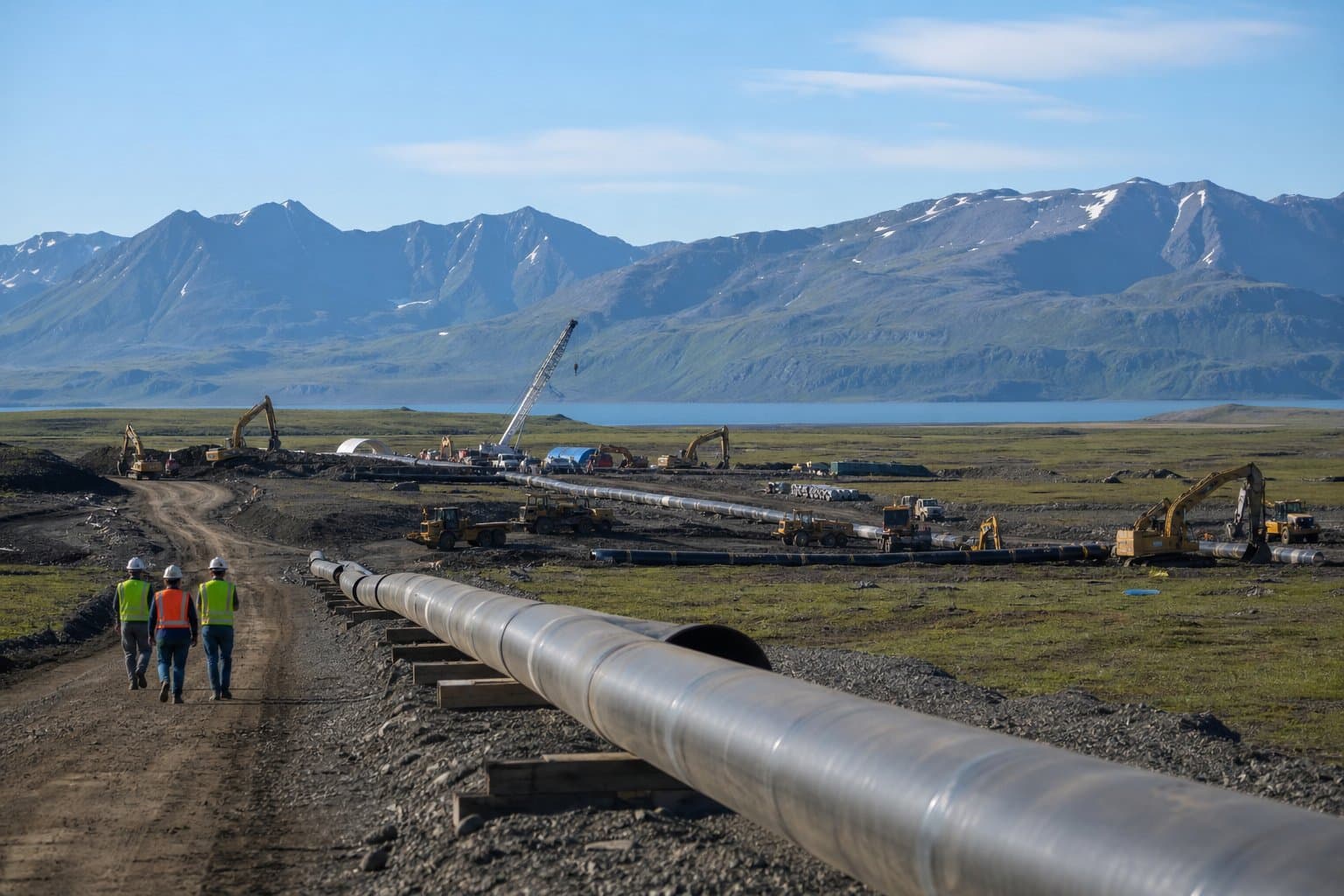
Alaska Senate Majority sets Anchorage press availability on stalled gas session
Alaska's fourth special session on gas pipeline taxation has produced no votes in two weeks, as Cook Inlet gas supply is projected to run short by the mid-2030s.
by Walter AlaskaNews1mo ago2 min read
The Alaska House gaveled in and out in minutes, its special session going nowhere
The Alaska House of Representatives met for minutes Friday in Juneau, took no votes, and adjourned by unanimous consent until Tuesday, Aug. 11, at 10:30 a.m. for another technical session. The fourth special session on natural gas taxation remains stalled.
by Walter AlaskaNews1mo ago1 min read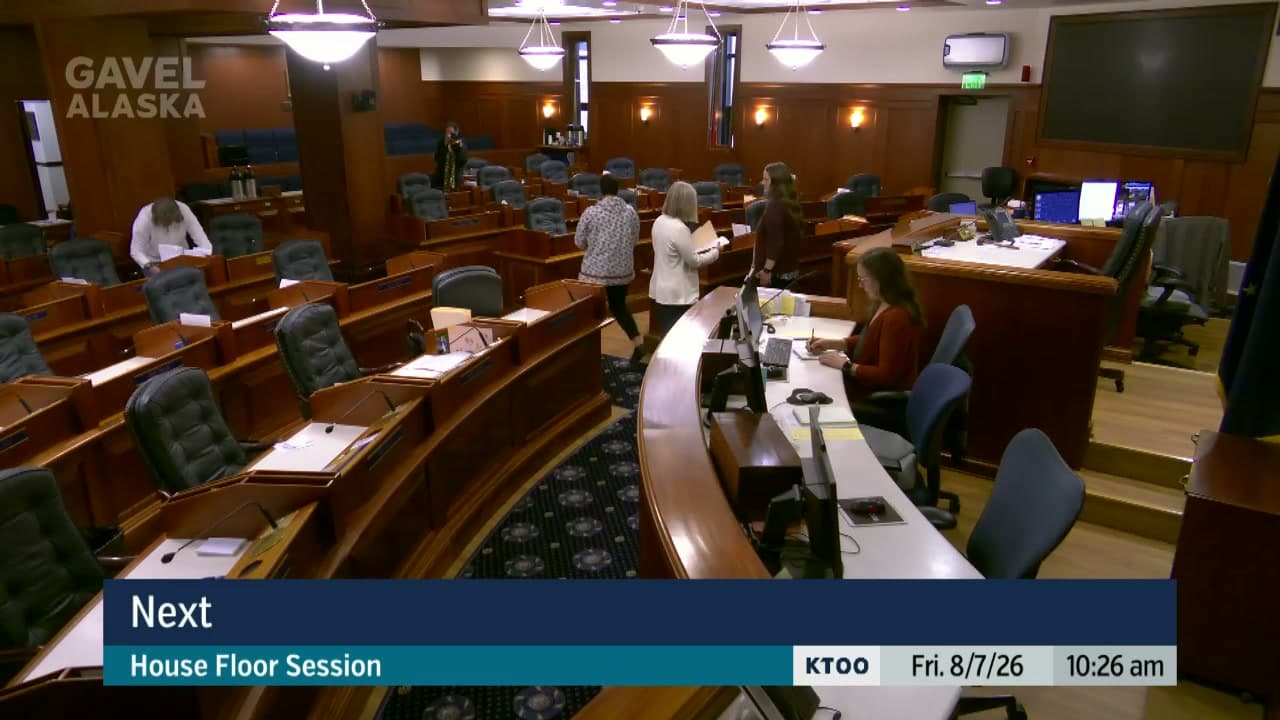
Hilcorp says opposing the tax isn't opposing the gas line
Hilcorp senior vice president Luke Sargey told the Alaska Gas Line Caucus on Thursday that the company opposes a targeted income tax on Hilcorp, not the gas line, while Glenfarne and business groups urged lawmakers to pass the property tax bill without added taxes.
by Walter AlaskaNews1mo ago3 min read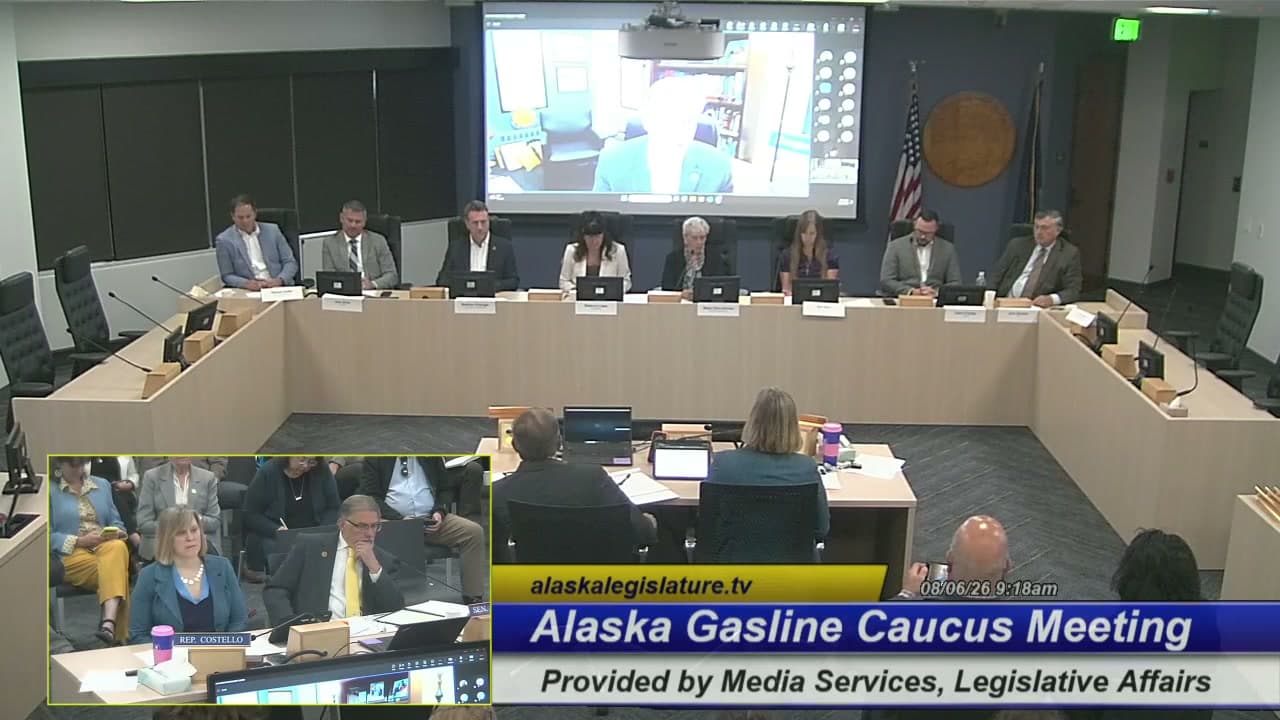
Enstar tells Alaska Gas Line Caucus it could be 18 days short of gas this winter
Enstar president John Sims told the Alaska Gas Line Caucus on Thursday the utility could be 3 billion cubic feet short this winter, equal to 18 midwinter days serving no customers. MEA's Tony Izzo said his gas is contracted for only 2 years and 7 months.
by Walter AlaskaNews1mo ago3 min read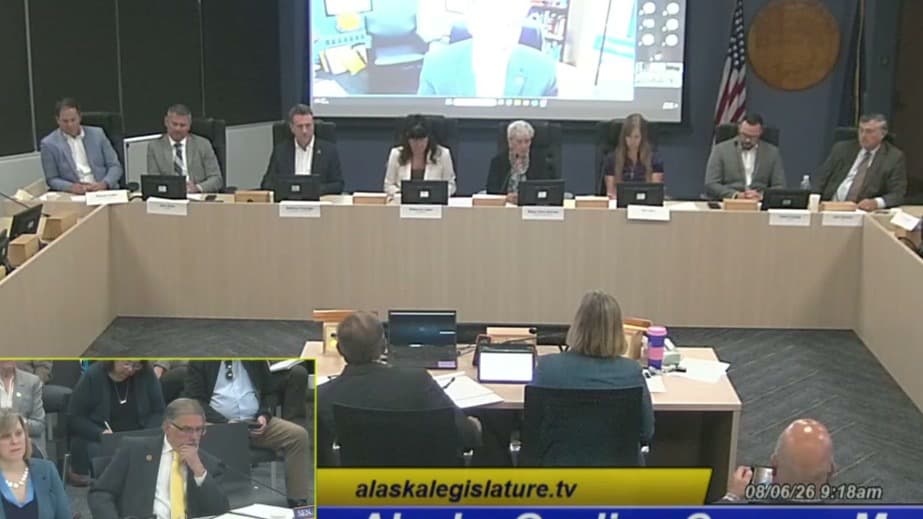
Alaskans split over ranked choice repeal at state ballot measure hearing
Sponsor Bethany Markham urged a yes vote to end ranked choice voting at Wednesday's state-required hearing in Juneau. Opponent Scott Kendall called the measure a Trojan horse that also closes primaries and repeals dark money rules. Alaskans vote Nov. 3.
by Walter AlaskaNews1mo ago3 min read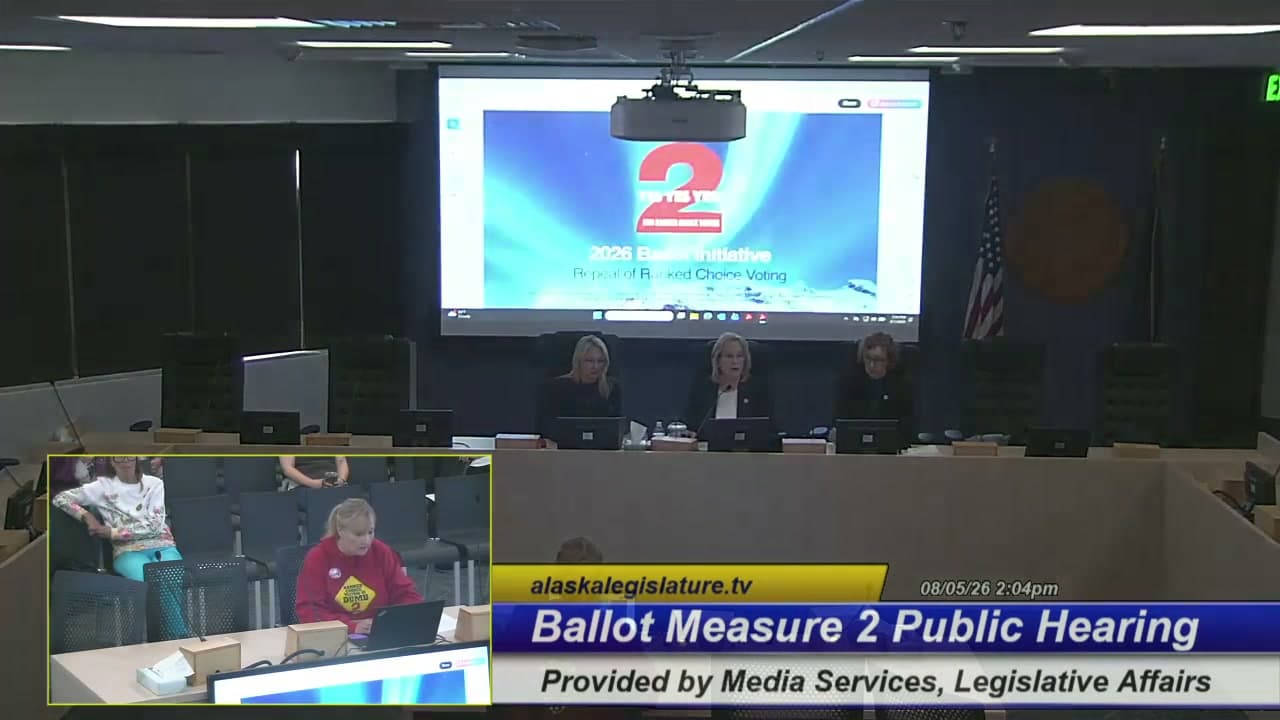
A one-word change to Alaska's voting law could foreclose a path for American Samoan residents
Alaska's Ballot Measure 3 would specify only citizens can vote. Supporters call it a safeguard; opponents say it forecloses a path for American Samoan U.S. nationals to vote locally.
by Walter AlaskaNews1mo ago2 min read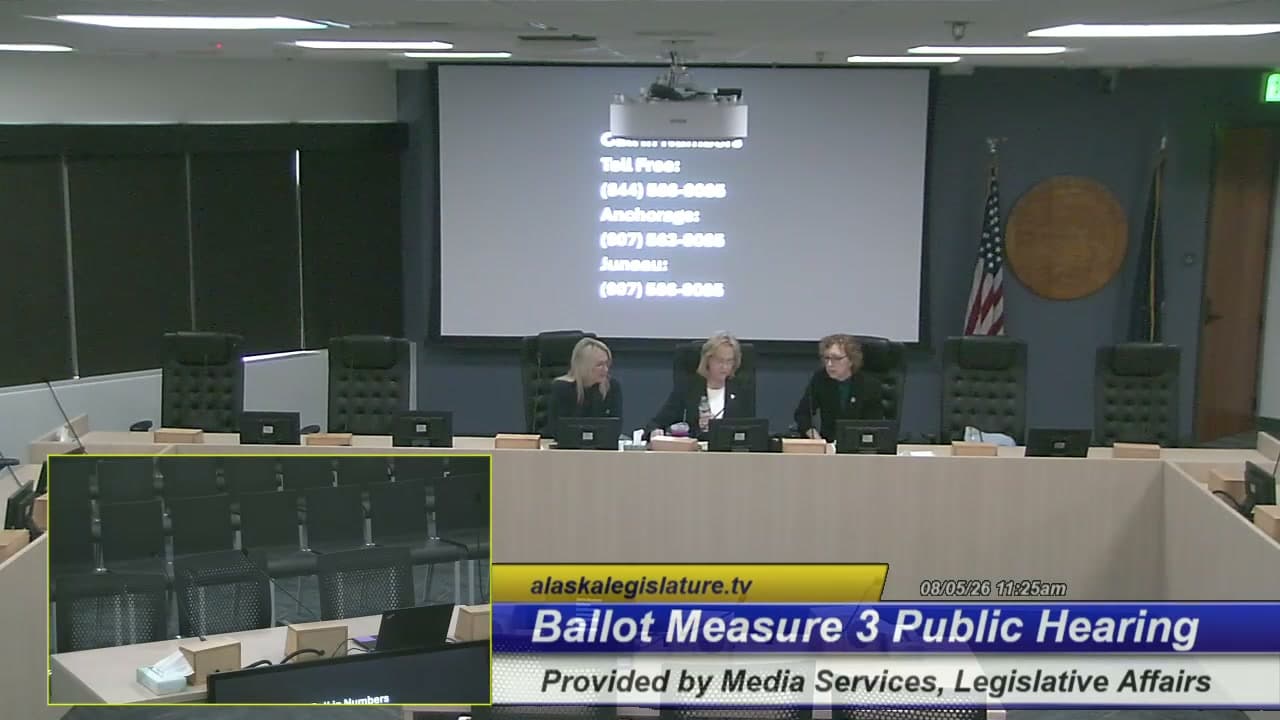
Two former colleagues split over whether Ballot Measure 1 curbs big money or just reroutes it
At a state hearing Wednesday, Rep. Calvin Schrage defended Ballot Measure 1's caps on campaign donations while former Rep. Ben Carpenter argued they would push money into unlimited independent expenditure groups. Alaskans vote Aug. 18.
by Walter AlaskaNews1mo ago2 min read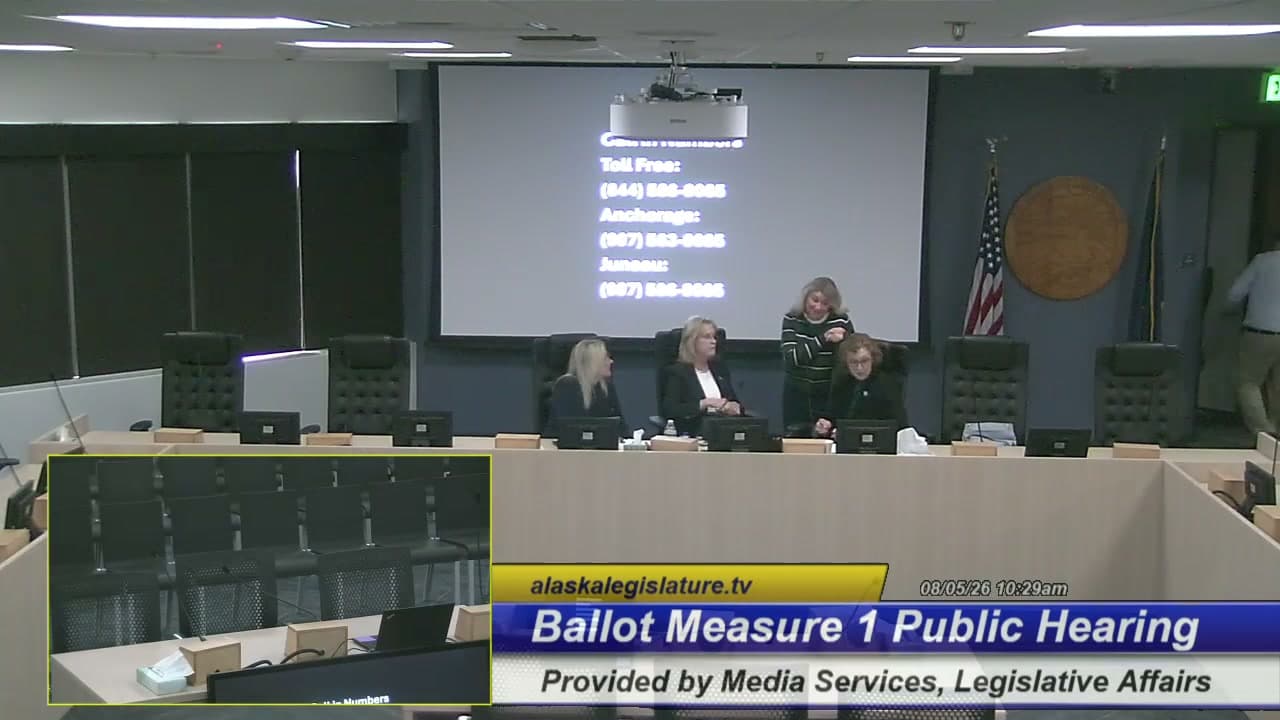
Legislators to hear the case for a gas line as the effort stalls
Mayors, utility executives and pipeline developers will present to the Alaska Gasline Caucus on Thursday, Aug. 6, at the Anchorage LIO, months after the Alaska State House deadlocked 19-19 on the gas line bill.
by Walter AlaskaNews1mo ago2 min read
Governor's disaster declaration unlocks state aid for Talkeetna flooding
A July 25 disaster declaration authorizing state public assistance for the Matanuska-Susitna Borough over Talkeetna flooding was read into the Alaska State Senate record Tuesday during a technical session.
by Walter AlaskaNews1mo ago1 min read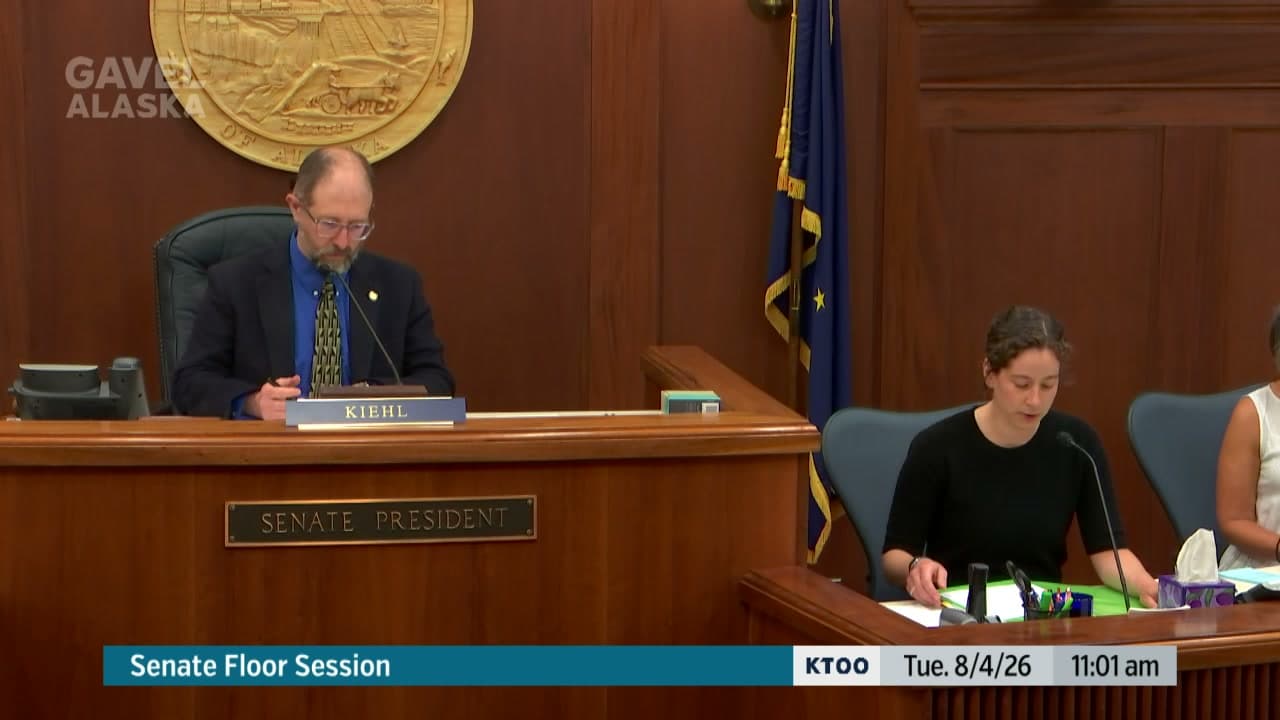
ENSTAR says Cook Inlet output has fallen to a fifth of its 1990s peak, with its firm contract ending in 2033
At a Commonwealth North forum in Anchorage on Friday, June 5, ENSTAR president John Sims said Cook Inlet now produces 60 to 70 billion cubic feet a year, down from more than 300 Bcf at its early-1990s peak, and that the firm Hilcorp contract carrying Southcentral expires in 2033.
by Bill AlaskaNewsadded 1mo ago3 min read