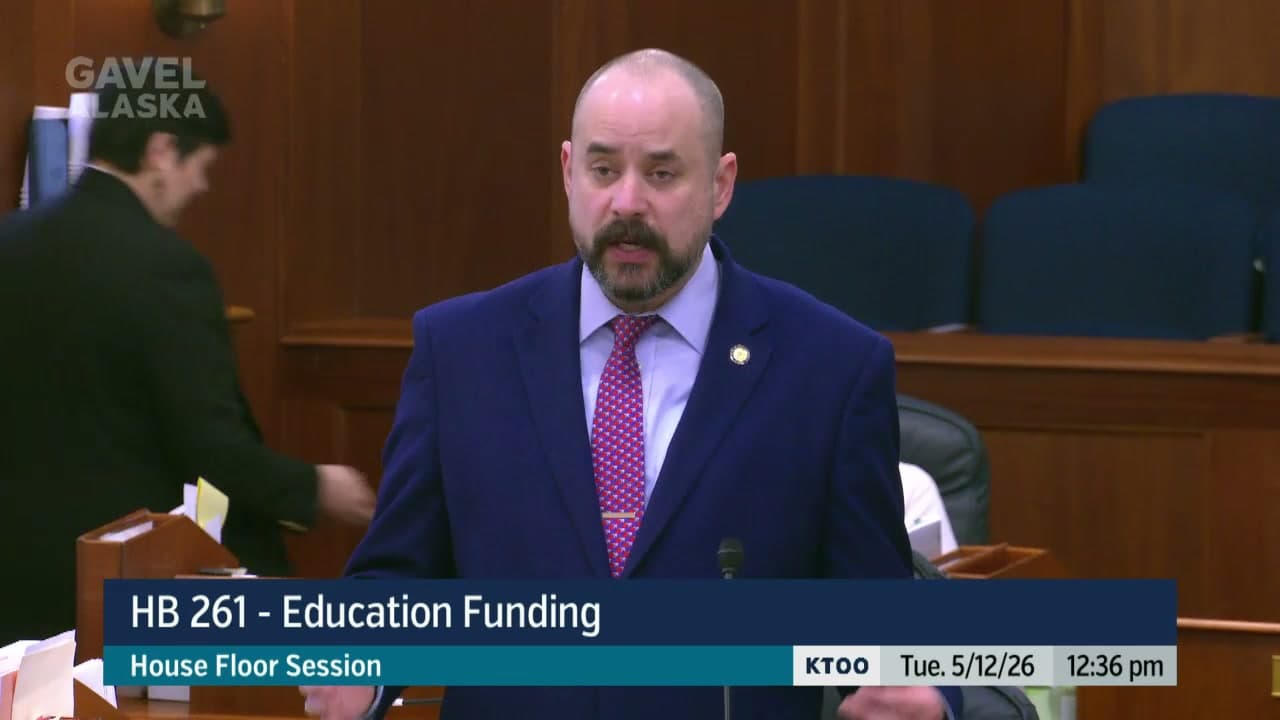
Alaska House passes education funding reform despite split votes on transparency
The Alaska House of Representatives passed a major education funding reform bill Tuesday, implementing a three-year enrollment averaging system to stabilize school funding and address what supporters call the annual "pink slip" problem for teachers.
House Bill 261 passed 31-9 after floor debate focused on funding stability, teacher contract timing, and enrollment averaging. The bill includes provisions to cap required local contributions at 2 percent of property value while increasing funding for reading and career and technical education. The legislation also removes the over-5% enrollment-drop hold harmless provision going forward, though districts currently receiving hold harmless funding will be grandfathered in and then tapered out.
"Alaska's education funding process is broken," said Representative Andi Story, the bill's sponsor. "School communities routinely do not learn their final funding levels for the upcoming school year until late May, after critical staffing and program decisions must be made."
Story said the backward budgeting forces districts into guesswork, creates annual instability, and contributes to outward migration of teachers and families. The bill uses multi-year averaging of student counts, a practice used in 26 other states, to smooth volatility and improve budget predictability.
The bill was prefiled in January and underwent multiple hearings in the House Education Committee throughout February and March before advancing to House Finance in April. The House Education Committee reported the bill out on a 4-1 vote with two no recommendations. The House Finance Committee held several hearings and received public testimony before sending it to the floor.
Representative Andi Story said Tuesday the body adopted two significant amendments: one limiting required local contribution by municipalities to 2 percent of full and true property value, and another increasing funding for the READS Act and career and technical education by raising the CTE factor.
Representative Schwanke argued the bill addresses a symptom rather than the root cause. "Parents are walking away from our brick-and-mortar public schools because they are not happy with what's happening," Schwanke said. "They're walking into charter schools. They're overflowing with applications."
Representative Ruffridge offered a different analysis, pointing to the shift from brick-and-mortar schools to correspondence programs. "We have a flaw in our foundation formula that has not been addressed," Ruffridge said, noting that correspondence students are funded at significantly less than brick-and-mortar students.
Representative Jeremy Bynum supported the bill despite concerns about some provisions. "This bill doesn't really take care of the problem of treating our teachers like ad hoc employees on these year after year, single year contracts," Bynum said. "I hope that at some point in the future we'll be able to solve that problem."
The bill now moves to the Senate. If enacted, it would give districts their student count number by July 1, avoiding unexpected budget changes in October when teacher and staff contracts have already been set for the year. Districts currently receiving hold harmless funding for enrollment drops over 5% will see that protection tapered out under the new three-year averaging system.
Earlier in the same floor session, the House debated amendments to Senate Bill 41, a separate mental health education bill. Two amendments requiring school boards to hold public meetings and post mental health curriculum materials online both failed on 20-20 tie votes, exposing divisions over parental rights and local control in schools.
Representative Sarah Vance argued that mental health education is "brand new educational material" that requires community buy-in from the start. "We want people to be a part of the introduction of this process so that they can be on board as it's being introduced and considered a part of a curriculum," Vance said.
Representative Dan Saddler supported the amendments, saying parents deserve the opportunity to review and approve new curriculum through their elected school board representatives. "Public schools are responsible to the citizens of their local district, and the people with the most interest are clearly parents who have the most vested interest in their students," Saddler said.
But Representative Alyse Galvin opposed the amendments as too prescriptive, arguing that districts should determine their own engagement methods. "Each and every one does it differently," Galvin said, citing her work with schools across Alaska. "Whether they put something on a website, that might be very appropriate for some communities. For others it might be, let's gather around a meal and let's talk about what our children are going to be exposed to."
The body did adopt an amendment to Senate Bill 41 requiring that mental health curriculum guidelines be medically and scientifically based and cannot include political, ideological, or advocacy-oriented content unrelated to student mental health. Senate Bill 41 was held to the next day's calendar after the amendment debate.
This article is based on a public meeting — HFLR-20260512-1030 ().
AI-assisted. How we use AI Transcript byLucas Brown
Stay informed. Support what matters.
Free, permanent access to local news you can verify. Subscribe to support Alaska News and go ad-free.
Related Coverage
House Finance Advances Education Funding Bill Despite Fiscal Concerns
Alaska News · 4mo ago
Senate panel advances bill to stabilize Alaska school funding with enrollment averaging
Alaska News · 4mo ago
Alaska House Weighs $113M Education Funding Overhaul
Alaska News · 5mo ago
Alaska House Passes Required Local Contribution Cap for Schools
Alaska News · 4mo ago
House Finance considers multi-year school funding averaging bill
Alaska News · 5mo ago
Comments
Sign in to leave a comment.
No comments yet. Be the first to share your thoughts.