Gas tax hike could net Alaska $590M over pipeline life, analysis shows
The Alaska Senate Resources Committee heard Tuesday that raising the state's gas production tax could generate hundreds of millions of dollars while protecting in-state consumers from price increases.
Dan Stickel, chief economist with the Department of Revenue, told the committee that each 1 percentage point increase in the North Slope gas production tax would generate roughly $17 to $20 million per year once exports begin in 2033. Over 30 years, a single percentage point increase would bring in about $590 million in cumulative additional state revenue.
The analysis assumes the Alaska LNG project proceeds as planned, with gas sales beginning in 2029 and full export production starting in 2033. The projections are based on a $1.50 per thousand cubic feet gas purchase price on the North Slope and assume gas prices will increase with inflation at 2.5 percent annually.
In-state prices protected by tax ceiling
Under the department's modeling, tax increases would not affect in-state gas prices because of an existing 17.7-cent per thousand cubic feet tax ceiling that applies to gas used within Alaska. At the assumed $1.50 purchase price, the tax ceiling represents a lower effective tax rate than the current 13 percent gross value tax.
Sen. Forrest Dunbar asked whether the tax ceiling meant in-state consumers would be protected from price increases. Stickel confirmed that under the modeling assumptions, in-state gas prices would not be affected.
Stickel cautioned that while the tax changes would not directly affect project economics through in-state gas pricing, they could have indirect effects. An increase in the upstream tax rate could potentially influence the price that gas producers are willing to accept when selling to the pipeline developer.
Senators question upstream value protections
Senators questioned whether the state is adequately protecting upstream value and capturing royalties and taxes. Sen. Bill Wielechowski asked how confident officials are that the state has protected itself on the upstream side. He expressed concern that gas could be valued at a low amount on the North Slope, potentially resulting in lower production taxes and royalties.
Sen. Cathy Giessel noted that the Tax Division currently values North Slope gas sales at about $2.99 to $3 per thousand cubic feet, significantly higher than the $1 per thousand cubic feet used in some project estimates.
Next steps
The committee did not take action on the gas tax rate during Tuesday's hearing. The analysis was presented as part of ongoing discussions about Senate Bill 280, which addresses property tax treatment and other fiscal terms for the proposed Alaska LNG project.
The committee moved to amendments after the presentation. Sen. Josh Myers offered an amendment to exempt spur lines from standard property taxes, arguing that without the exemption, Fairbanks customers could face about $1,000 per year in additional costs. The committee set the amendment aside for further consideration.
An amendment by Sen. Mike Rauscher to remove provisions extending corporate income tax to pass-through entities failed on a 2-4 vote. Sen. Dunbar opposed the amendment, noting it would transfer up to $460 million per year in the outer years from the state to corporations.
The committee is scheduled to continue work on amendments Wednesday morning, when it will hear from consulting firm Gaffney Klein and may open public testimony if time allows.
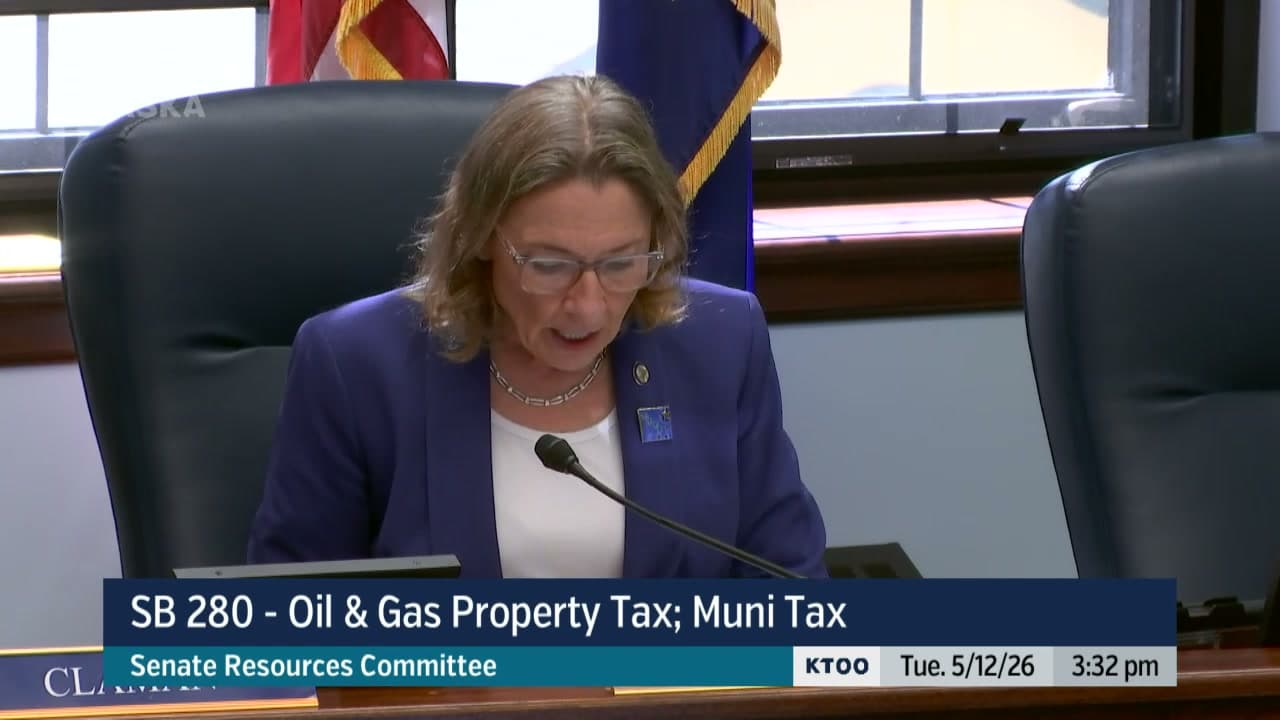
This article is based on a public meeting — Senate Resources, 5/12/26, 3:30pm ().
AI-assisted. How we use AI Transcript byLucas Brown
Stay informed. Support what matters.
Free, permanent access to local news you can verify. Subscribe to support Alaska News and go ad-free.
Related Coverage
Senate panel advances gas pipeline tax overhaul with $610M revenue target
Alaska News · 5mo ago
Senate Finance hears $18 billion revenue trade-off for Alaska LNG tax break
Alaska News · 3mo ago
Alaska Senate panel hears gas line bill with $900M annual tax break
Alaska News · 4mo ago
Department of Revenue presents Senate Finance with Alaska LNG breakeven modeling across cost and tax scenarios
Alaska News · 3mo ago
House panel hears tax proposal for Alaska LNG project
Alaska News · 4mo ago
Comments
Sign in to leave a comment.
No comments yet. Be the first to share your thoughts.