Dunleavy says Alaska gas pipeline depends on property tax overhaul
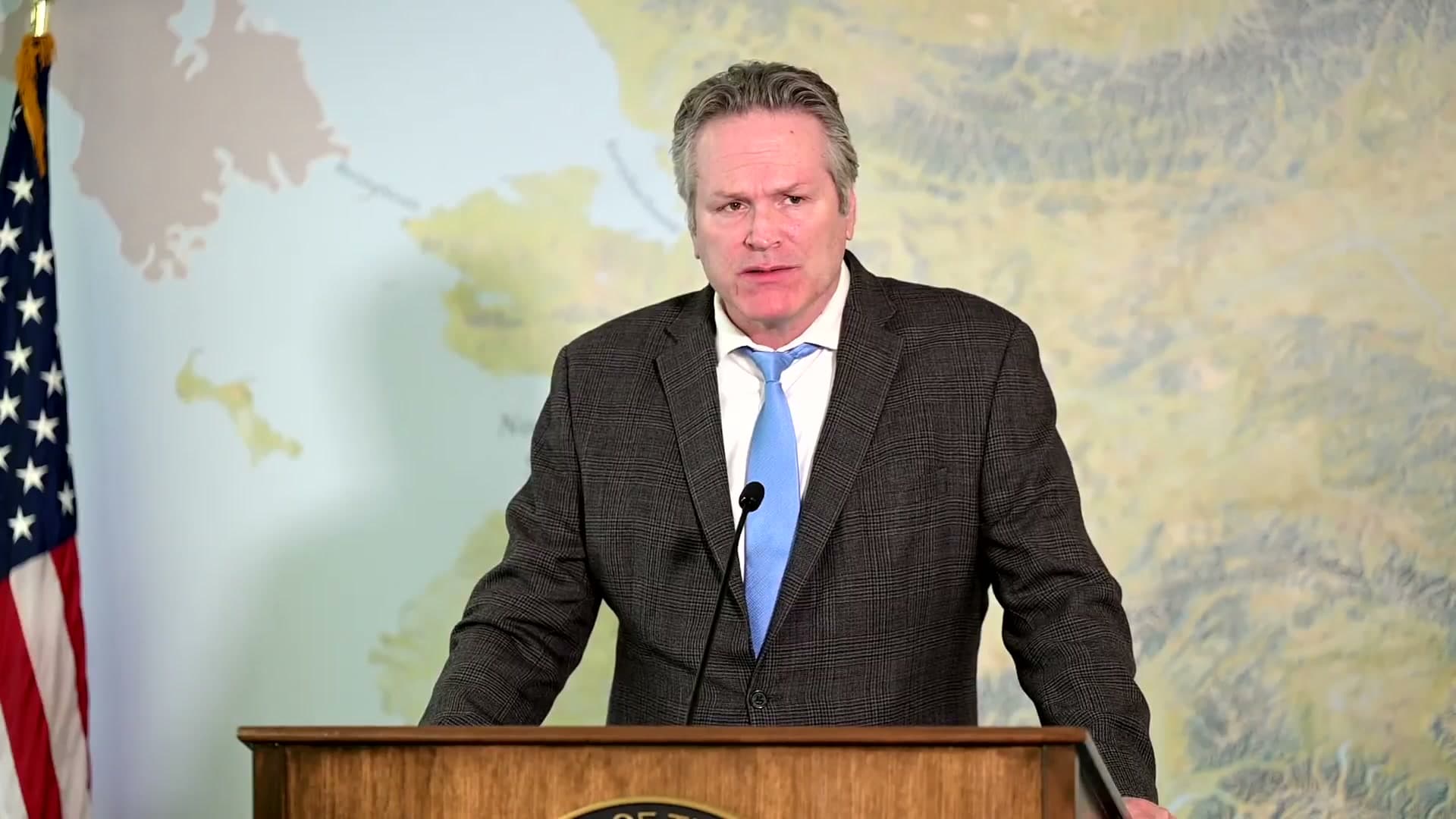
Governor Mike Dunleavy called Monday for the Alaska Legislature to pass a payment-in-lieu-of-taxes bill within three weeks. He warned that the current property tax structure makes what he described as the largest project in state history unfinanceable.
The governor framed the proposed tax overhaul as crucial to advancing a $44 billion to $50 billion liquefied natural gas pipeline from the North Slope to the Kenai Peninsula. Without the change, he said, Alaska cannot compete with lower-cost states like Texas for the investment needed to build the 800-mile project. Local governments warn the proposal could sharply reduce their property tax base.
"If you were to say to me, Dunleavy, what's the most important thing that can happen in this session? It's this PILT by far, bar none," Dunleavy said. "This would be the largest project in Alaska history, probably the largest in the Arctic, in the Pacific."
Dunleavy introduced legislation in March to replace Alaska's 20-mill property tax on oil and gas infrastructure with a volumetric throughput tax. His original proposal set the rate at 6 cents per thousand cubic feet of gas after the project reaches full capacity.
A House Resources Committee substitute circulated in late April would set a combined alternative volumetric tax of 20 cents per 1,000 cubic feet for gas moving through the export-project components, roughly triple Dunleavy's proposed rate. The draft sets 5 cents for gas treatment or carbon capture, 5 cents for pipeline transportation and 10 cents for liquefaction. It also added requirements for a spur line to Fairbanks and community benefit agreements. The higher rate and conditions were proposed to address concerns from local governments, which stand to lose up to 90 percent of their property tax revenue under the governor's plan.
The governor said Monday that a rate "much above" 6 cents would make the project unfinanceable. "If you go above, much above that, you're probably not going to get a project that's financeable," he said. "Somebody comes in with a 20-cent throughput tax, it's not going to be financeable."
The conflict over tax rates reflects a central tension in the legislative debate. Local governments depend on property tax revenue from oil and gas infrastructure. The governor's proposal would sharply reduce those receipts. Legislators have debated alternatives including higher throughput taxes and impact payments of up to $800 million to offset infrastructure costs borne by local communities.
Dunleavy argued that Alaska's current property tax is among the highest in the nation and puts the state at a severe disadvantage. "If you were to compare the price and the cost of building an 800-mile pipeline in Alaska versus an 800-mile pipeline in Texas, the cost is nearly half as much in Texas," he said.
Texas benefits from interstate highways, large permanent labor pools, and proximity to pipe manufacturing, he said. Alaska faces higher costs for shipping equipment and materials north.
The governor warned that without the pipeline, Alaska faces imported gas costing $15 to $18 per unit and electricity rates on the Railbelt climbing to 35 to 45 cents per kilowatt hour within five to 10 years. "Without a gas line and importing gas, the legislature is going to have to work on an urban power cost equalization program in the tune of $2 to $5 billion to build renewables and batteries and wind and solar and to import gas," Dunleavy added.
Dunleavy cited geopolitical instability in the Persian Gulf as creating an opportunity for Alaska. Conflict in the region has disrupted global energy markets, he said. Asian allies are looking for secure, long-term gas supplies. "The window is not going to stay open for Alaska forever," he said.
The governor also pointed to federal support from the White House as evidence that the moment will not last. "You're not going to get the President of the United States behind a project like this" indefinitely, he said.
On May 1, the Regulatory Commission of Alaska raised the base rate for the state's Power Cost Equalization program by nearly 10 percent, from 20.38 cents to 22.11 cents per kilowatt hour. The increase reflects rising electricity costs in Anchorage, Fairbanks, and Juneau, which drive the weighted average used to calculate subsidies for rural communities.
Fairbanks now pays 31.6 cents per kilowatt hour, up from lower rates when the city received natural gas from Southcentral Alaska. The city now generates 54 percent of its power from oil.
Dunleavy said the legislature has about three weeks remaining in the session to pass a bill. He did not rule out calling a special session if lawmakers fail to act or send him a bill he considers unworkable. "If the bill doesn't work, it's not going to work," he said. "And if the question is, will the bill be vetoed if it doesn't work, why would I put a bill into law if it doesn't work?"
The governor said his administration has staff working 15-hour days with legislators on the bill. He acknowledged differences of opinion within each chamber and each caucus but said the goal must be to create a bill that investors will finance. "You can create a bill that, you know, is your dream bill, but if investors don't want to go near it, you don't have a project," he said.
Dunleavy emphasized that the bill would change only the property tax, not royalties, severance taxes, or other potential taxes. "This is helping finance a massive, massive project, a massive pipe in order to get gas to Alaska," he said. "This has no negative, there's no negative impact on royalty if this bill passes. As a matter of fact, there's a positive impact."
The governor said the pipeline would create thousands of jobs during construction and operation, lower energy costs for schools and hospitals, and generate $900 million to $1 billion in royalties and severance taxes for the state treasury. He also said the project could reopen the Agrium fertilizer plant in Kenai and attract data farms and other businesses.
"This will be a job creator like no other," Dunleavy said. "This, this, this project in many respects will be bigger than the Trans-Alaska Oil Pipeline. But going back to this PILT, we have to make it economical."
The legislature is scheduled to adjourn in late May.
This article is based on a public meeting — Press Conference: LNG Project ().
AI-assisted. How we use AI Transcript byLucas Brown
Stay informed. Support what matters.
Free, permanent access to local news you can verify. Subscribe to support Alaska News and go ad-free.
Related Coverage
Dunleavy warns of 45-cent power without gas-line tax deal
Alaska News · 4mo ago
Dunleavy to Call Special Session on Gas Line Property Tax Within Hour of Adjournment
Alaska News · 4mo ago
Alaska House passes new tax structure for Alaska LNG pipeline aimed at attracting investors
Alaska News · 3mo ago
Wright and Dunleavy insist the Alaska LNG project is alive
Alaska News · 1mo ago
Energy consultant tells House Finance that property tax makes Alaska LNG unfinanceable
Alaska News · 4mo ago
Comments
Sign in to leave a comment.
No comments yet. Be the first to share your thoughts.