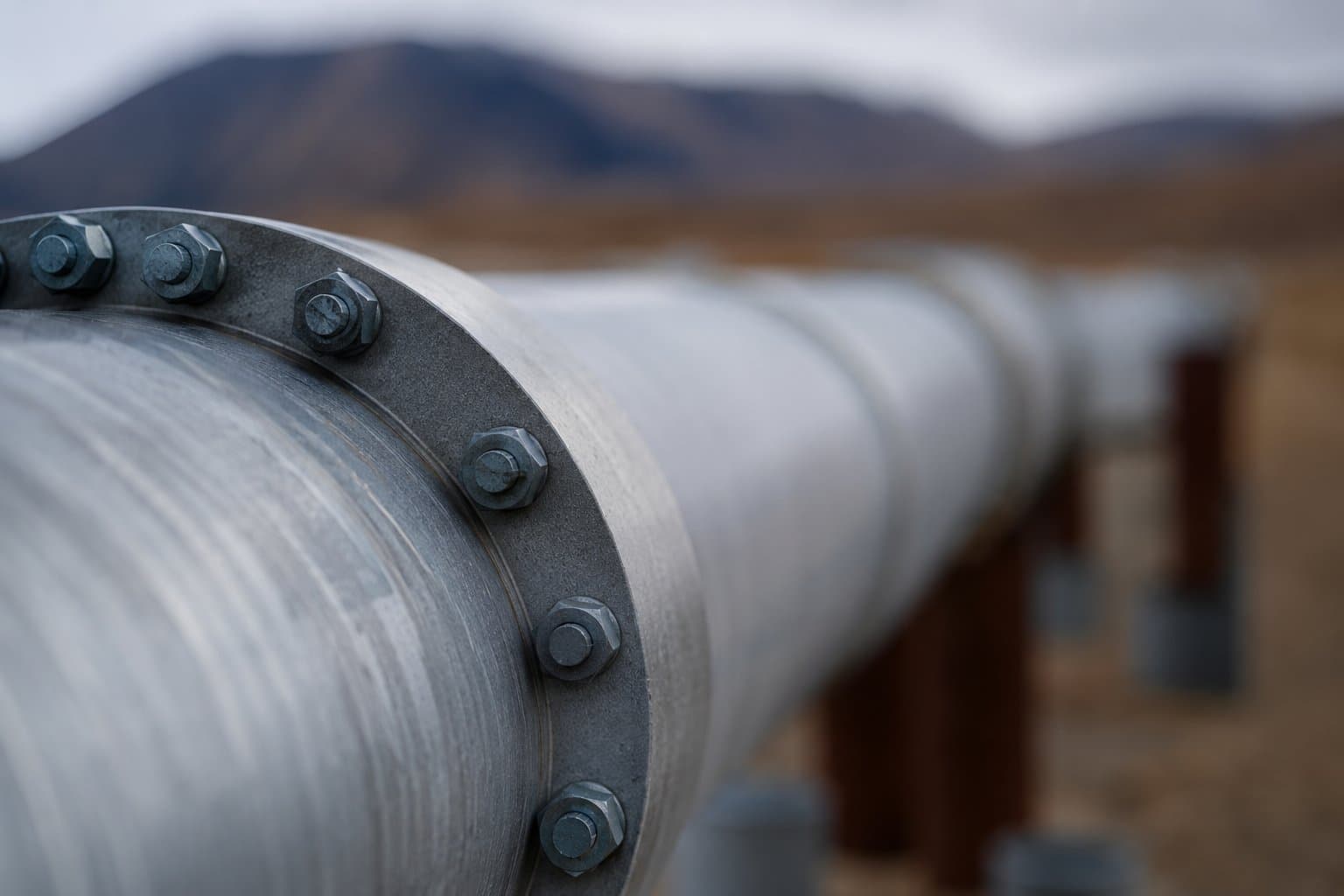
Photo by Cale Green
Gas Line Developer Warns Tax Hike Would Delay Project, Jeopardize 2029 Deadline
The developer of Alaska's proposed natural gas pipeline warned Wednesday that version T of House Bill 381, which sets a 15-cent-per-thousand-cubic-feet volumetric tax on gas moving through the pipeline, would force Glenfarn Alaska LNG to reconsider its timeline for a final investment decision. The governor's original bill proposed a 6-cent rate.
A final investment decision, known as FID, is when a company commits to financing and building a major project. For the Alaska gas line, FID would trigger billions in construction spending and lock in the 2029 completion target.
"If version T of the bill were passed, it would cause a delay of FID," Adam Prestidge told the House Finance Committee. "When we look at FID right now, that's something we anticipate in the coming months, certainly this year."
Prestidge said Glenfarn largely supports the bill but raised what he called "triple stacking" of taxes as his central objection. He argued that the bill's structure would layer the 15-cent volumetric tax on top of separate property tax arrangements that the North Slope Borough and Kenai Peninsula Borough could negotiate with the developer.
"Irrespective of intent, the practical impact of the way this is structured would stack each of these taxes on top of each other," Prestidge said.
Calvin Zullo, staff to Representative Frier on the House Resources Committee, disputed that interpretation. He said the intent was not to stack taxes but to allow the developer to negotiate lower mill rates with the two boroughs that would have municipal property taxes applied to gas treatment plants and LNG facilities.
Legislative drafting attorney Emily Nauman, appearing online, addressed the drafting questions directly. She explained that sections 4 and 5 include exemptions allowing negotiated tax arrangements with municipalities. She clarified that references to the Fairbanks spur line in two different sections of the bill both point to the same spur line definition. One establishes it as an eligibility requirement for the alternative volumetric tax. The other makes it a condition for the tax law to take effect.
The developer also raised concerns about language allowing municipalities to take equity stakes in the project in exchange for tax reductions. Prestidge said that provision would not work from a project development standpoint.
"It takes real cash dollars to pay for the labor, the pipe, machinery to actually build the project," he said. "Giving away equity for free just dilutes all the other equity investors and essentially ruins the economic model."
Prestidge told the committee that if the LNG export facility reaches final investment decision within four years of pipeline construction completion, delivered gas prices to Alaskans would fall in the $5 to $6 range.
"So long as the LNG facility FIDs anytime in the next 4 years before completion of construction of the pipeline, then gas delivered to Alaskans will be in the $5 range, $5, $6," he said.
But if only the Phase 1 pipeline moves forward without the export facility, Prestidge estimated gas prices would land in the mid-teens. That would still be competitive with existing Cook Inlet contracts and imported LNG forecasts, but substantially higher than the full project scenario. He explained that the 15-cent rate would double the tax on Phase 1 and put Phase 2 in jeopardy.
"The way to look at that is 15 cents on Phase 1 would still be a doubling of the tax on the project," Prestidge said. "The remaining tax on Phase 2 obviously puts Phase 2 in jeopardy, and what you end up putting at risk then is the probability of, or how quickly could we bring the remaining portions of the project online that would have the effect of lowering, dramatically lowering, the cost of gas on the project, the cost of gas delivered on the pipeline."
The developer said Glenfarn based its project assumptions on the governor's 6-cent volumetric tax, which the company views as equivalent to a 2-mill property tax rate and competitive with similar pipeline projects. Doubling that rate to 15 cents would require the company to reassess financing and customer contracts already in late-stage negotiations.
"When we viewed the governor's bill with the 6 cents per MCF day, per MCF on the pipeline, we viewed that as fair in terms of industry comparisons to other projects, probably a little bit higher than what some of our competing projects pay to export LNG out of Canada," Prestidge said. "A significant change from that would require significant reexamination of how we take the project forward."
Representative Galvin questioned whether the 6-cent rate represented a firm requirement or a negotiating position, noting that Governor Dunleavy had recently mentioned a 10-cent rate in public remarks. Prestidge did not directly address the discrepancy but emphasized that the 6-cent assumption underpins the project's financing discussions and customer negotiations.
The developer also flagged technical drafting issues, including a community impact fund provision that could be read to require every equity investor to deposit $40 million rather than just the lead developer. Prestidge said Glenfarn supports the community impact fund concept, which the developer proposed, but wants the language tightened to avoid unintended consequences for multiple equity investors.
Prestidge also requested that the bill's outside date be extended from Jan. 1, 2056, to 2060 to align with the project's 30-year gas sales agreements and debt structure.
The committee did not take action on the bill Wednesday. Co-Chair Foster said the gas line hearings would move to the top of each day's agenda for the remainder of the session, with presentations from the Department of Revenue and consulting firm Gaffney Klein still pending.
The House Finance Committee will reconvene Thursday at 9 a.m. to hear public testimony on unrelated bills before returning to the gas line tax measure.
This article is based on a public meeting — HFIN-260513-1330 ().
AI-assisted. How we use AI Transcript byLucas Brown
Stay informed. Support what matters.
Free, permanent access to local news you can verify. Subscribe to support Alaska News and go ad-free.
Related Coverage
Gas-line developer warns Alaska's Senate terms could drive it off
Alaska News · 3mo ago
House Finance begins review of Alaska LNG tax bill with competing rate proposals
Alaska News · 4mo ago
Senate panel debates $1B tax break for Alaska LNG amid cost secrecy
Alaska News · 4mo ago
Energy consultant tells House Finance that property tax makes Alaska LNG unfinanceable
Alaska News · 4mo ago
House panel hears gas line tax bill with 15-cent volumetric fee
Alaska News · 4mo ago
Comments
Sign in to leave a comment.
No comments yet. Be the first to share your thoughts.