Alaska House rejects optional school district healthcare pooling plan
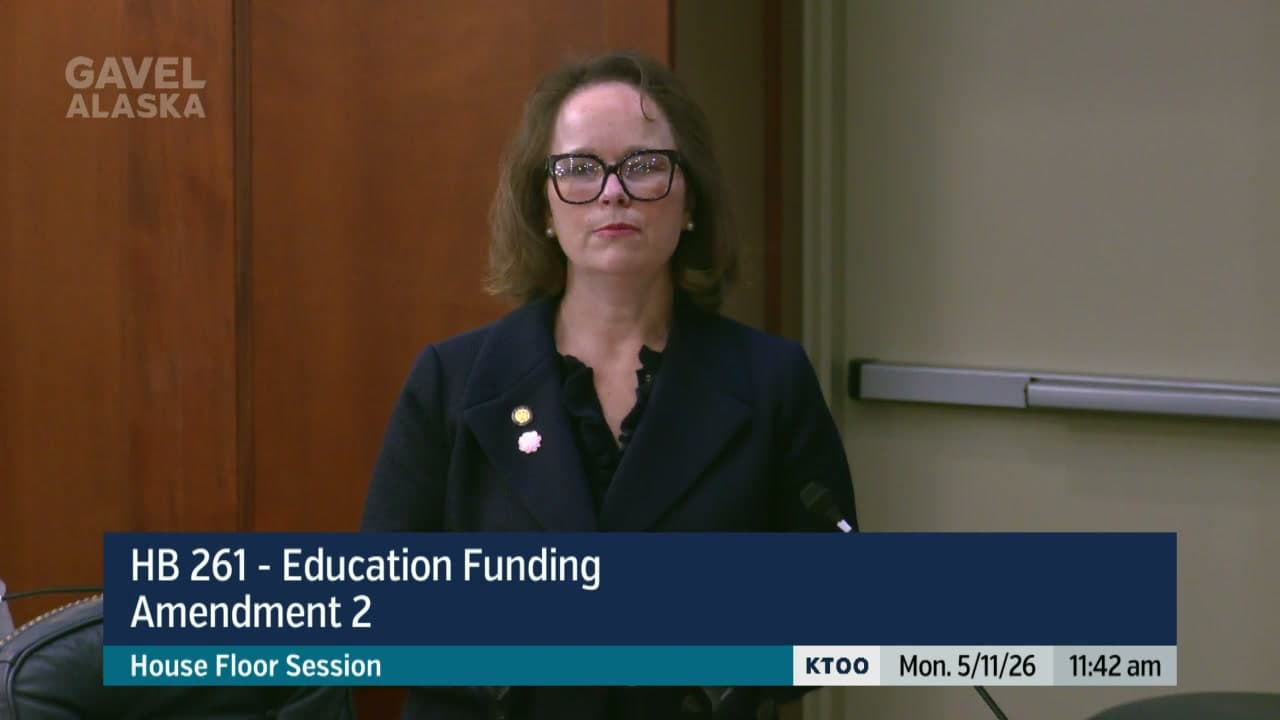
The Alaska House rejected Monday an amendment that would have allowed school districts to join the state's healthcare program, a proposal supporters said could save several major districts a combined $31 million to $42 million annually.
The amendment to House Bill 261 failed 19-21 after lawmakers debated whether optional participation would create adverse risk pools that could drive up costs for existing state employees. The proposal would have permitted school districts, municipalities, and the University of Alaska to opt into AlaskaCare, the state's healthcare program.
Representative Sarah Vance, who sponsored the amendment, distributed estimates showing potential savings of $6 million to $9 million per year for Fairbanks North Star Borough School District, $7 million for Mat-Su, and $8 million to $12 million for Anchorage School District. "This could help fill deficits that our school districts are currently facing," Vance said. "This could help retain teachers and programs that we've all been debating about."
Vance said she had distributed a packet that included a letter of support from the Mat-Su Borough and other municipalities. Representative Kevin McCabe said the Mat-Su Borough School District has supported the concept for years.
Healthcare costs have emerged as a top unpredictable expense driving education budget increases statewide. Representative Alyse Galvin said she has tracked rising education costs for years. "Forever I have been tracking what is causing the rise of costs in education, and healthcare has certainly been the top and the most unpredictable rising costs," Galvin said. "That said, this particular bill has not had a public hearing yet."
Supporters argued the amendment would give districts a tool to lower costs through a larger insurance pool. "All we are doing is putting optional language in there," McCabe said. "Why would we spend our valuable time as a task force to even bother to look at this when we can put it in a bill as optional and let the school districts look at it?"
Several opponents said they supported the concept in principle but opposed adding it to House Bill 261 without a public hearing and further vetting. Representative Andrew Gray said, "This policy needs to be vetted and possibly amended in order to make sure that we don't have any unintended consequences for our smaller districts, for our big districts, for everyone involved."
Representative Andrew Stapp raised concerns about adverse selection, where only high-cost districts would join the pool. Stapp said the concept had merit but needed to be structured to include large anchor districts like Anchorage, Fairbanks, and Mat-Su to make the risk pool work effectively.
Vance said she had requested hearings for the standalone bill multiple times without success. "I made multiple attempts for this bill to be heard," Vance said. "I was promised that it would be taken up under the Education Task Force. It has also not been taken up by the Education Task Force." In her closing remarks, Vance argued the Senate could still ask important questions and conduct analysis if the amendment passed the House.
Alaska News previously reported that legislation to allow school districts to opt into the state healthcare plan has circulated since 2023, when Vance and Senator Shelley Hughes sponsored companion bills that stalled in committee.
The amendment included provisions allowing the Department of Administration to create a tiered system and to allow municipalities or school districts to partner with the state for self-insurance to address concerns about adverse selection. Vance said the draft incorporated recommendations from administrators of the AlaskaCare system and included a requirement for an actuarial analysis before a district could join.
The underlying education funding bill, House Bill 261, remained under consideration after the amendment failed. The bill addresses student count averaging for school funding calculations.
This article is based on a public meeting — HFLR-20260511-1030 ().
AI-assisted. How we use AI Transcript byLucas Brown
Stay informed. Support what matters.
Free, permanent access to local news you can verify. Subscribe to support Alaska News and go ad-free.
Related Coverage
House rejects Galena school funding swap after dramatic rescind vote
Alaska News · 4mo ago
Alaska House Passes Required Local Contribution Cap for Schools
Alaska News · 4mo ago
House Finance Advances Education Funding Bill Despite Fiscal Concerns
Alaska News · 4mo ago
Alaska House passes education funding reform despite split votes on transparency
Alaska News · 4mo ago
Alaska Senate rejects healthcare compact bill in 11-9 vote
Alaska News · 4mo ago
Comments
Sign in to leave a comment.
No comments yet. Be the first to share your thoughts.