Senate panel debates gas pipeline tax structure in 26th hearing
The Alaska Senate Resources Committee held its 26th hearing Monday on Senate Bill 280, the proposed tax structure for the Alaska LNG project. Senators focused on technical questions about where gas would be taxed and how the state would collect revenue. The committee has held 26 hearings since March 13 on the legislation.
The bill would replace traditional property taxes on the proposed $46.2 billion Alaska LNG project with a volumetric tax system: 15 cents per thousand cubic feet for the treatment plant and pipeline, and 25 cents for the liquefaction facility. The Department of Revenue estimates the alternative volumetric tax would generate $620 million annually once full export operations begin in 2033, with 81 percent shared with municipalities. However, prior coverage and fiscal analysis found the volumetric tax swap could reduce municipal revenue compared with current property tax, a roughly 90 percent local revenue cut.
Alaska News previously reported that the Senate panel advanced the gas pipeline tax overhaul with a $610 million revenue target and that the House panel heard a competing tax proposal for the Alaska LNG project. The governor's original proposal called for a 6-cent volumetric tax, while the House Resources Committee drafted a 20-cent rate.
Much of Monday's hearing centered on defining the "point of production," where gas ownership transfers and taxation begins. Ryan Fitzpatrick, commercial manager for the Division of Oil and Gas at the Department of Natural Resources, explained that for royalty purposes, the point of production is when gas is severed from the lease or unit boundary.
"For the purposes of royalty, when DNR takes royalty, it does take it at the point of production for the purposes of our leases," Fitzpatrick said. "That's defined as the point in which the oil or gas is severed from the lease or unit."
Senator Bill Wielechowski pressed for clarity on whether gas treatment costs could be deducted before taxation. "My big concern is, is that the point of production is somehow occurring after the gas treatment plant, and that there's going to be an enormously expensive project, and the state value would be diminished tremendously," Wielechowski said.
Fitzpatrick explained that whether gas processing occurs inside or outside the unit boundary determines how royalties are calculated. If processing happens within the unit, the dry gas leaving the treatment plant would be valued separately from natural gas liquids. If processing occurs outside the unit, the wet gas would be valued at the lease boundary.
Dan Stickel, chief economist with the Department of Revenue, told the committee his agency assumes gas would be sold to the project developer at the inlet to the gas treatment plant at Prudhoe Bay, with Point Thompson gas traveling through a feeder pipeline. The department models a $1.50 per thousand cubic feet purchase price from upstream producers to the midstream developer.
The bill includes provisions limiting utility rate impacts. It prohibits cost overruns from being passed to Alaska utility customers and caps gas purchase prices charged to utilities at $12 per thousand cubic feet after pipeline completion and $5 per thousand cubic feet after LNG export operations begin. Those caps would not be adjusted for inflation.
The bill includes three additional revenue streams beyond the volumetric tax. A one-time community impact fee would generate $739 million at $1 million per mile of pipeline installed during construction. An infrastructure maintenance surcharge of 30 cents per barrel on all Alaska oil production would raise $51 to $62 million annually for Dalton Highway maintenance. A new pass-through entity tax on oil and gas companies not currently subject to corporate income tax could generate $60 million annually in the late 2030s.
"In the 2040s and 2050s, we're looking at the hundreds of millions of dollars," Senator Forrest Dunbar said, referencing the long-term revenue potential from the pass-through entity tax.
Under the volumetric tax, the state would distribute half of municipal revenue on a per capita basis to communities statewide and half to communities along the pipeline route. The state would retain the portion for the unorganized borough section of the pipeline.
The Department of Revenue is requesting four new positions and $1.25 million in capital costs to implement the new tax systems, a reduction from the 11 positions requested in an earlier version. The positions would administer the alternative volumetric tax, community impact fee, pass-through entity tax, and provide commercial analysis for state ownership decisions.
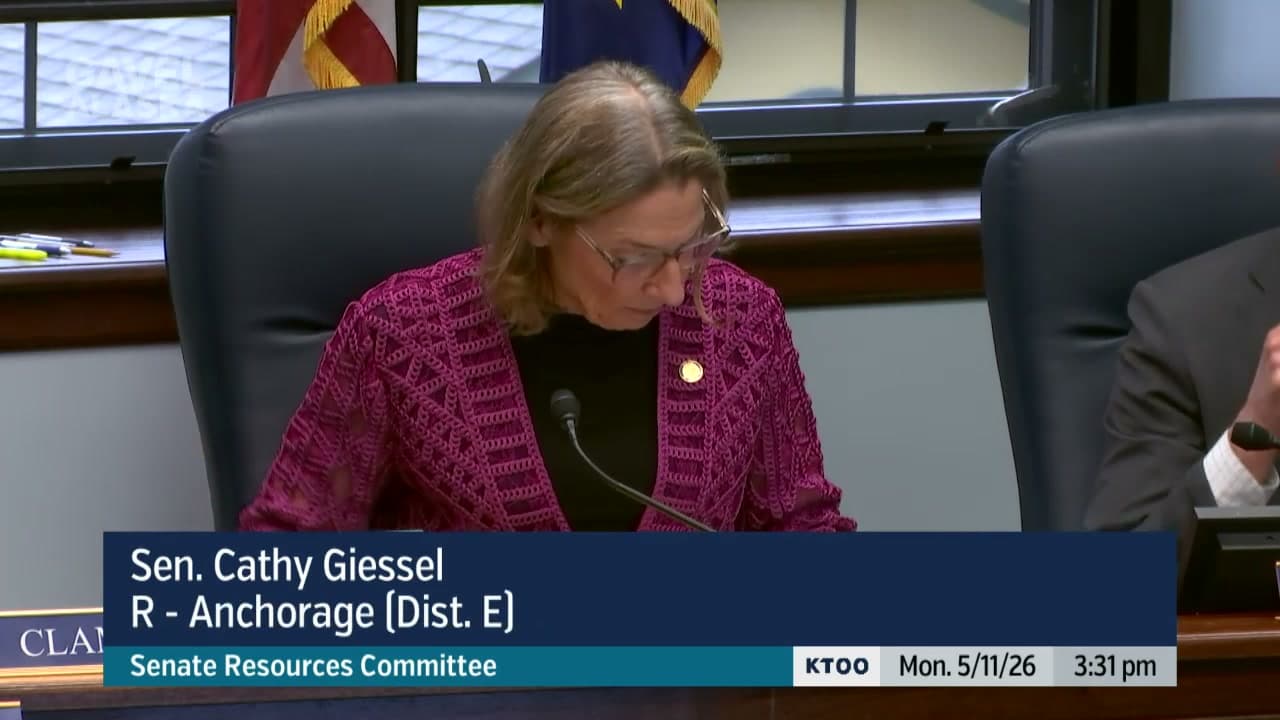
Committee Chair Cathy Giessel emphasized the complexity of the legislation and the committee's responsibility to protect state interests. "While we have named AGDC in this bill as having fiduciary responsibility, we ourselves do to the people of Alaska to make sure that we get the maximum value for our resources and that we don't relinquish our taxation authority," Giessel said.
Several senators raised concerns about potential oil production losses at Prudhoe Bay if gas is removed from the reservoir. Senator Rauscher referenced a 2015 BP study showing potential liquid losses of 300 million barrels. Stickel said the department worked with the Alaska Gasline Development Corporation on that assumption and felt comfortable with a zero liquid losses estimate given how much later in field life the project would begin.
Giessel said the committee would meet twice daily for the rest of the week at 9 a.m. and 3:30 p.m. in an effort to meet the governor's timeline for passing the legislation. "We're not going to do that at the risk to Alaskans for passing bad legislation," she said.
The committee will meet at 9 a.m. Tuesday to hear two House bills before resuming discussion of Senate Bill 280. The bill must begin construction by 2028 and commence operations by 2032 or the property tax exemptions would revert to current law.
This article is based on a public meeting — SRES-260511-1530 ().
AI-assisted. How we use AI Transcript byLucas Brown
Stay informed. Support what matters.
Free, permanent access to local news you can verify. Subscribe to support Alaska News and go ad-free.
Related Coverage
Senate panel examines regulatory questions on gas pipeline tax plan
Alaska News · 5mo ago
Senate panel weighs municipal concerns over Alaska LNG tax structure
Alaska News · 4mo ago
House panel hears tax proposal for Alaska LNG project
Alaska News · 4mo ago
Senate panel advances gas pipeline tax bill after 36 hearings
Alaska News · 4mo ago
House Finance begins review of Alaska LNG tax bill with competing rate proposals
Alaska News · 4mo ago
Comments
Sign in to leave a comment.
No comments yet. Be the first to share your thoughts.