Alaska Senate panel advances autonomous vehicle restrictions despite industry opposition
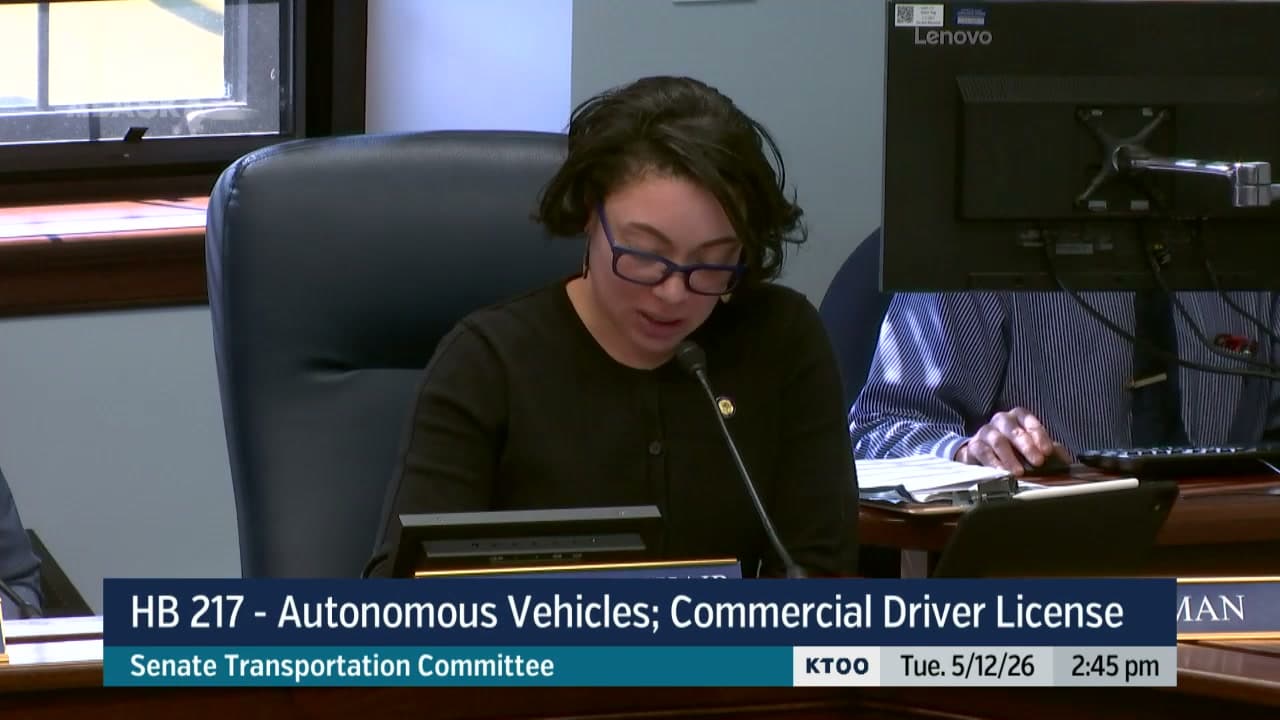
The Alaska Senate Transportation Committee advanced a bill Tuesday requiring human safety operators in commercial autonomous vehicles, despite strong opposition from technology industry representatives who warned the measure would make Alaska a national outlier.
The committee substitute for House Bill 217 prohibits autonomous vehicles registered in Alaska from transporting commerce or goods unless the transport is for personal, non-commercial use, has a gross weight of 10,000 pounds or less, and is designed to transport not more than 16 passengers, including the driver. Commercial autonomous vehicles over that weight must have a human safety operator physically present who can monitor and intervene in the vehicle's performance. The bill also establishes accident liability rules, presuming the human safety operator liable unless clear evidence points to software, hardware, or modifications as the cause.
The bill now moves to the Senate State Affairs Committee, though no hearing date was announced.
Representative Ashley Carrick, chair of the House Transportation Committee and the bill's sponsor, defended the measure as a reasonable guardrail for Alaska's unique conditions during the committee's second hearing on the legislation. "Our weather and road conditions can change at a moment's notice, and autonomous vehicles may be able to function with little to no issue in states like California, but Alaska does look different," Carrick said. She emphasized the bill would keep road users safe and help preserve jobs in Alaska's trucking industry.
Carrick also clarified that the current committee substitute covers personally owned autonomous vehicles. "The current draft of this bill would require the person to be present as a human safety operator," she said, using the example of someone sending their Tesla to the grocery store without being in the vehicle.
Griffin Sukeo, staff to Representative Carrick, explained the committee substitute's key provisions to the Senate panel. "An autonomous vehicle registered in the state may not engage in the transport of commerce or goods unless the transport is for personal, non-commercial use and has a gross weight of 10,000 pounds or less and is designed to transport not more than 16 passengers, including the driver," Sukeo said.
The bill drew testimony from multiple technology industry representatives who warned that Alaska would become a national outlier if the measure becomes law. Blake Calvert, public affairs manager at Kodiak AI, an autonomous trucking developer, told the committee the restrictions would effectively ban the technology.
"HB 217, which, as previously noted, would make Alaska the first and only state in the country to ban autonomous trucks," Calvert said.
Calvert pointed to workforce challenges in Alaska's trucking industry as a reason to allow autonomous vehicle development. "According to the Alaska Trucking Association's 2025 Fast Facts, the qualified driver shortage in Alaska was the number 2 issue facing the trucking industry in the state," he said.
Other industry representatives echoed concerns that the bill would send a message that Alaska is closed to innovation. Robert Singleton, senior director of policy and public affairs at Chamber of Progress, testified that no other state has enacted a human driver requirement for commercial autonomous vehicles. He argued the technology could improve road safety, noting that 90 percent of car crashes are caused by preventable human error.
Rose Feliciano, testifying on behalf of TechNet from Seattle, said the bill goes beyond establishing safety guardrails. "As drafted, the bill would effectively stop autonomous vehicle development in Alaska before the technology even has the opportunity to be explored, tested, or adapted to Alaska's unique conditions," she said.
Kurt Augustine, senior director of state affairs for the Alliance for Automotive Innovation, testified from Sacramento that the restrictions would disproportionately impact vulnerable populations. "This restriction would effectively ban the deployment of driverless ride-hailing services as well, a move that could disproportionately impact vulnerable populations, including individuals with disabilities, older adults, and rural citizens who stand to benefit most from the increased independence, delivery of goods, and the specialized mobility that fully autonomous technology provides," he said.
During questioning, Senator Kiehl asked one industry witness about the bill's impact on robotaxis and passenger vehicles. The witness acknowledged he had not seen the most recent committee substitute language.
The Alaska Department of Transportation raised separate concerns about the bill's technical language. Benjamin Glenn, the department's emerging technologies coordinator, told the committee the bill uses outdated definitions that may unintentionally prohibit safe use cases.
"The framework currently with the vehicle weight definition may accidentally prohibit some of the safest and most practical early Alaska use cases that we could get into to test and deploy autonomous vehicles, like the Veterans Affairs shuttles or university commuter shuttles," Glenn said.
Glenn also noted the bill's definitions of autonomy levels are based on 10-year-old concepts that do not align with modern Society of Automotive Engineers standards. He said some Level 4 autonomous vehicles are designed without the ability for human intervention, which conflicts with the bill's requirement for a human safety operator.
Carrick pushed back against characterizations that the bill would halt innovation. "We're not preventing autonomous vehicles from operating in Alaska. We're simply providing a reasonable guardrail on specific types of transport," she said. "This bill does not halt any innovation of autonomous commercial vehicles or other autonomous vehicles in Alaska. We're simply setting a reasonable parameter regarding this new technology in our state."
The measure also prohibits autonomous vehicles from transporting passengers unless the vehicle weighs 10,000 pounds or less and is designed to carry no more than 16 passengers, including the driver. The committee advanced the bill with individual recommendations and attached fiscal notes.
This article is based on a public meeting — STRA-260512-1330 ().
AI-assisted. How we use AI Transcript byLucas Brown
Stay informed. Support what matters.
Free, permanent access to local news you can verify. Subscribe to support Alaska News and go ad-free.
Related Coverage
Senate panel advances bill requiring humans in autonomous commercial vehicles
Alaska News · 4mo ago
Alaska House passes bill requiring human operators in commercial autonomous vehicles
Alaska News · 4mo ago
Alaska bill would require human operators in autonomous freight trucks
Alaska News · 4mo ago
Alaska considers ban on driverless commercial trucks amid safety debate
Alaska News · 5mo ago
Autonomous vehicle bill advances despite state warnings on outdated standards
Alaska News · 4mo ago
Comments
Sign in to leave a comment.
No comments yet. Be the first to share your thoughts.