Alaska Senate Passes Right-to-Repair Bill for Consumer Electronics
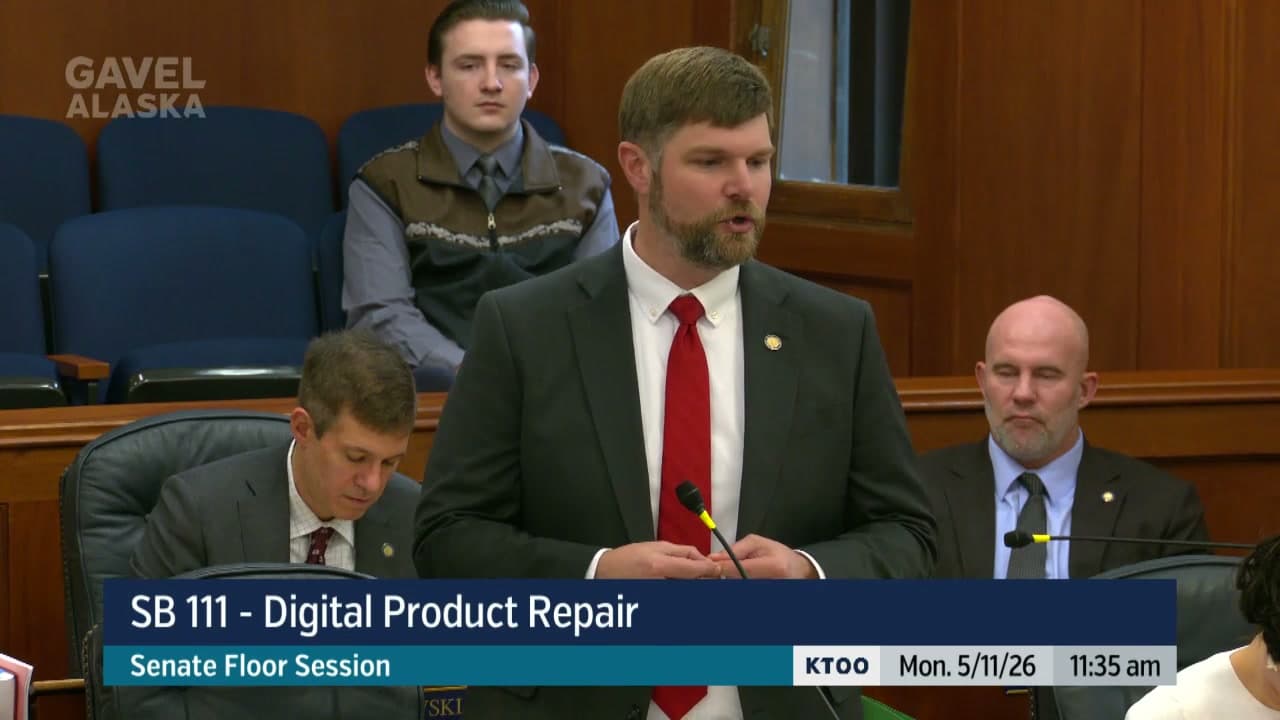
The Alaska Senate voted Monday to require manufacturers to provide repair access for consumer electronics, advancing legislation that supporters say will keep money in Alaska and reduce electronic waste.
Senate Bill 111 passed 15-5 after debate over digital locks and security exemptions. The bill requires manufacturers to provide parts, tools, and repair information to consumers and independent repair shops for consumer electronics like phones and personal computers.
Alaska News previously reported that the Senate Labor and Commerce Committee narrowed the bill's scope to consumer electronics after concerns from powersports dealers. The committee removed snowmachines, watercraft, and other heavy equipment from the legislation. The bill joins similar efforts in more than a dozen states including Arizona, Illinois, Hawaii, Colorado, Indiana, Missouri, Maine, Michigan, New Jersey, Oklahoma, Ohio, Pennsylvania, Rhode Island, and Washington during the legislative session.
The Senate adopted one amendment exempting fire alarms, life safety systems, intrusion detection systems, and physical access control equipment from the bill's requirements. Senator Mike Cronk, who sponsored the amendment, said those systems are specifically designed around security, restricted access, and system integrity.
Senator Forrest Dunbar, the bill's sponsor, supported that narrow exemption but opposed a broader amendment that would have removed language prohibiting manufacturers from using digital locks to prevent repairs. The second amendment failed eight to 12.
Dunbar said broad security exemptions have been used in other states to undermine repair protections. In Oregon, a similar exemption was used to exempt electronic toothbrushes, he said. The Federal Trade Commission has found scant evidence that the ability to maintain and repair products makes them less secure, according to Dunbar.
During debate on the first amendment, Dunbar sought to clarify the legislative record that the exemption was intended to be narrow and not sweep in ordinary household devices. "The bill already exempts the large business-to-business and industrial security systems. This is only for consumer electronics, this bill. And so what this would potentially do is exempt even the smallest little fire alarm that you might put in your own house. I want to make sure that's not the intent here," Dunbar said. Cronk confirmed that was not the intent.
Dunbar framed the bill as protecting a basic principle. "When you buy something, you should own it and have the right to repair it," he said. "This bill is unfortunately necessary because this idea, this principle, which was once accepted as common sense, has been increasingly violated by certain out-of-state consumer technology and manufacturing companies."
He cited testimony from an Eagle River repair shop where customers reported their Amazon Kindles stopped working after the company remotely disabled devices made before 2012. There was nothing mechanically wrong with the devices, but the repair shop could do nothing, Dunbar said.
The bill is supported by hundreds of Alaskans who sent postcards and nearly 1,000 who signed a petition, Dunbar said. Google also wrote in support, contradicting claims that right-to-repair makes devices insecure.
A senator said the bill signals to manufacturers that citizens in Alaska have a strong interest in being able to fix the things they buy. The senator noted the bill does not apply to powersports equipment like snowmachines, which were removed after concerns from small businesses.
Senator Mike Cronk voted against the final bill, warning that modern devices contain sensitive financial, personal, and biometric information. Cronk recounted getting stranded when a non-original voltage regulator caused his snowmachine to throw error codes and enter limp mode. He had traveled about 30 miles out before the breakdown left him 14 miles from the road, requiring a seven-hour walk back to the highway.
"Alaska is a relatively drop in the bucket compared to the markets here, and I don't really want to be punishing the manufacturers for being up here and maybe even removing products from us," Cronk said.
Dunbar responded that manufacturers have not removed products from other states that enacted similar laws. It would be an incredible public relations nightmare for a company that did that, he said.
After final passage, the Senate also adopted the bill's effective date clause by unanimous consent.
The bill now moves to the House. If enacted, it would prohibit manufacturers from using software or hardware features to prevent diagnosis, maintenance, or repair of consumer electronic devices. Manufacturers would be required to provide the same documentation, parts, and tools to independent repair providers and product owners that they provide to authorized service networks.
This article is based on a public meeting — SFLR-20260511-1100 ().
AI-assisted. How we use AI Transcript byLucas Brown
Stay informed. Support what matters.
Free, permanent access to local news you can verify. Subscribe to support Alaska News and go ad-free.
Related Coverage
Alaska Senate Passes Right to Repair Bill for Consumer Electronics
Alaska News · 4mo ago
Alaska Senate Advances Right-to-Repair Bill for Consumer Electronics
Alaska News · 4mo ago
Alaska's Right-to-Repair Bill Navigates National Debate on Consumer Access
Alaska News · 5mo ago
Alaska right-to-repair bill draws fire over broad scope and safety concerns
Alaska News · 5mo ago
Alaska House passes bill aimed at software vendor lock-in
Alaska News · 4mo ago
Comments
Sign in to leave a comment.
No comments yet. Be the first to share your thoughts.