House Finance approves pharmacist prescription bill after rejecting nurse compact
The House Finance Committee voted Thursday to advance a bill allowing pharmacists to prescribe basic antibiotics without requiring patients to visit urgent care, but rejected an amendment that would have added Alaska to a national nurse licensure compact.
The committee approved House Bill 195 after voting 8-3 against the nurse compact amendment. The bill lets pharmacists prescribe medications for conditions like strep throat and urinary tract infections directly, rather than requiring patients to see multiple providers.
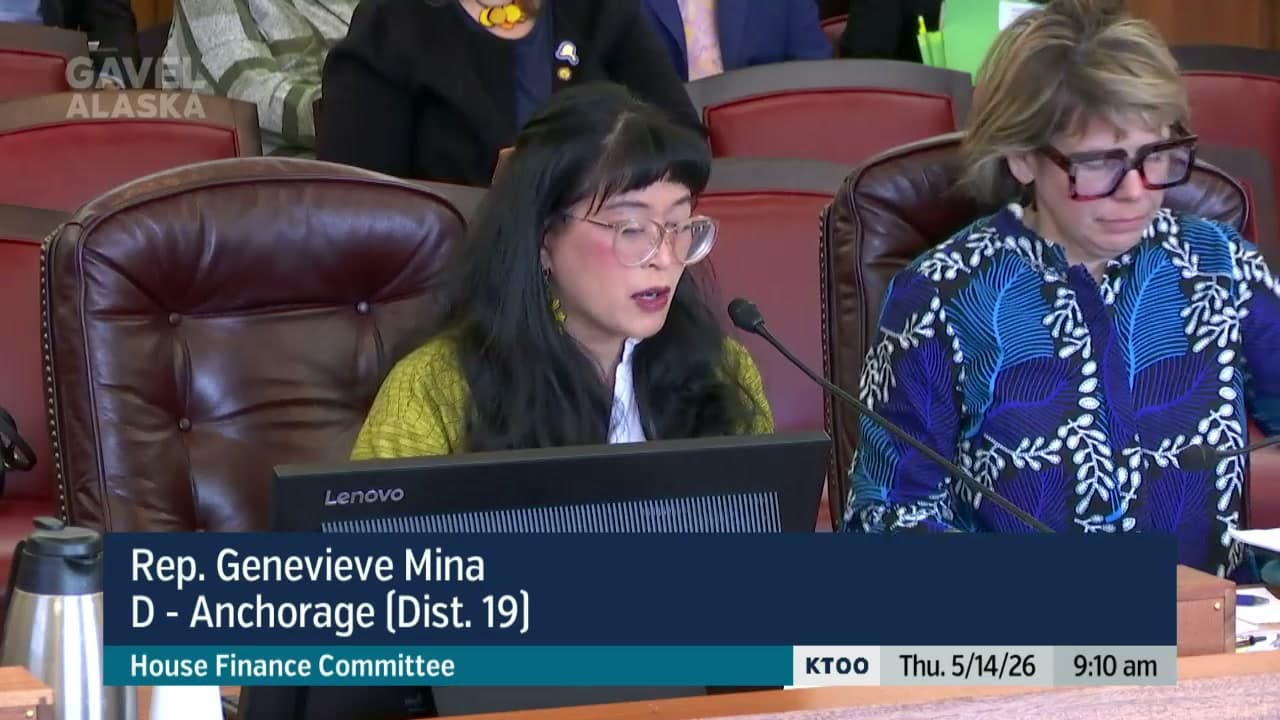
Representative Genevieve Mina, who sponsored the bill, said the measure clarifies language from a 2022 law that updated pharmacist practice authority but left key terms vague. That earlier legislation, House Bill 145, created a path for pharmacists to practice at the top of their education and training but did not define what "other patient services" would mean in practice.
"What this bill would actually do is make it easier for a family or a person who is trying to get basic antibiotics for strep throat or a UTI to be able to get those medications directly from a pharmacist rather than having to go to urgent care," Mina said.
The bill also aims to expand limited primary care in rural areas and increase access to substance use disorder treatment, since pharmacists can provide medications for opioid use disorders. The measure is one of five policies Alaska must pass by December 31, 2027 to maintain eligibility for the Rural Health Transformation Program, a federal grant program worth nearly $1.3 billion over five years.
Representative Frank Tomaszewski introduced the nurse licensure compact amendment, arguing it was necessary to protect the federal funding. He said the state has accepted an award of close to $273 million in 2026, with similar amounts expected annually through 2030.
"The state has accepted an award of close to $273 million in 2026, with a similar amount expected in 2027 and for three years after that. That is nearly $1.3 billion in healthcare money," Tomaszewski said.
He warned that if Alaska fails to enact the required compacts, the Centers for Medicare and Medicaid Services will claw back a portion of the funding from general fund dollars.
The compact allows nurses licensed in one member state to practice in any of the 40 other participating states without obtaining additional licenses. Tomaszewski said hospitals and clinics across Alaska have asked for the compact to help fill nursing vacancies.
Mina opposed the amendment, calling it unfriendly and saying the nurse licensure compact should be vetted separately. She noted that legislation on the compact introduced last year by the administration has not received hearings in either chamber.
"This is not a friendly amendment. The Nurse Licensure Compact is a policy that should be vetted in a separate process. It has received a lot of contentious feedback over the years," Mina said.
Representative Alyse Galvin said she would not support the amendment but looked forward to future conversations on the nurse licensure compact issue.
"I will not be supporting this amendment. I will be supporting looking forward to other conversations. I know there is another bill related to nurse licensure that, you know, this is clearly an issue that needs to be resolved by December 2027," Galvin said.
Representative Sara Hannan said her primary concern was that adding the nurse licensure compact to the pharmacist bill would kill the underlying legislation. She said the two policies should stand on their own.
"My concern primarily about this amendment is killing the underlying bill," Hannan said.
Representative Will Stapp said he supported the nurse licensure compact but worried the amendment would jeopardize passage of the pharmacist bill.
The committee did adopt an amendment changing the title of physician assistants to physician associates throughout state law. Tomaszewski introduced the amendment at the request of the Alaska Academy of Physician Associates. Mina called it a friendly amendment and said it was not contentious.
The committee moved HB 195 out as amended with individual recommendations and attached fiscal note. The bill now advances to the House floor for consideration.
This article is based on a public meeting — House Finance, 5/14/26, 9am ().
AI-assisted. How we use AI Transcript byLucas Brown
Stay informed. Support what matters.
Free, permanent access to local news you can verify. Subscribe to support Alaska News and go ad-free.
Related Coverage
House Finance committee debates pharmacist prescribing bill amid abortion concerns
Alaska News · 5mo ago
House Finance hears divided testimony on pharmacist prescribing bill
Alaska News · 5mo ago
House Finance advances pharmacist prescribing bill with drug restrictions
Alaska News · 4mo ago
House Finance hears divided testimony on pharmacist prescribing bill
Alaska News · 5mo ago
Alaska House expands pharmacist prescribing powers in 32-8 vote
Alaska News · 4mo ago
Comments
Sign in to leave a comment.
No comments yet. Be the first to share your thoughts.