Alaska House Passes Required Local Contribution Cap for Schools
The Alaska House of Representatives adopted an amendment capping annual growth in required municipal contributions to schools at 2%. The change shifts an estimated $29 million in education costs from municipalities to the state and drew sharp debate over equity and fiscal policy.
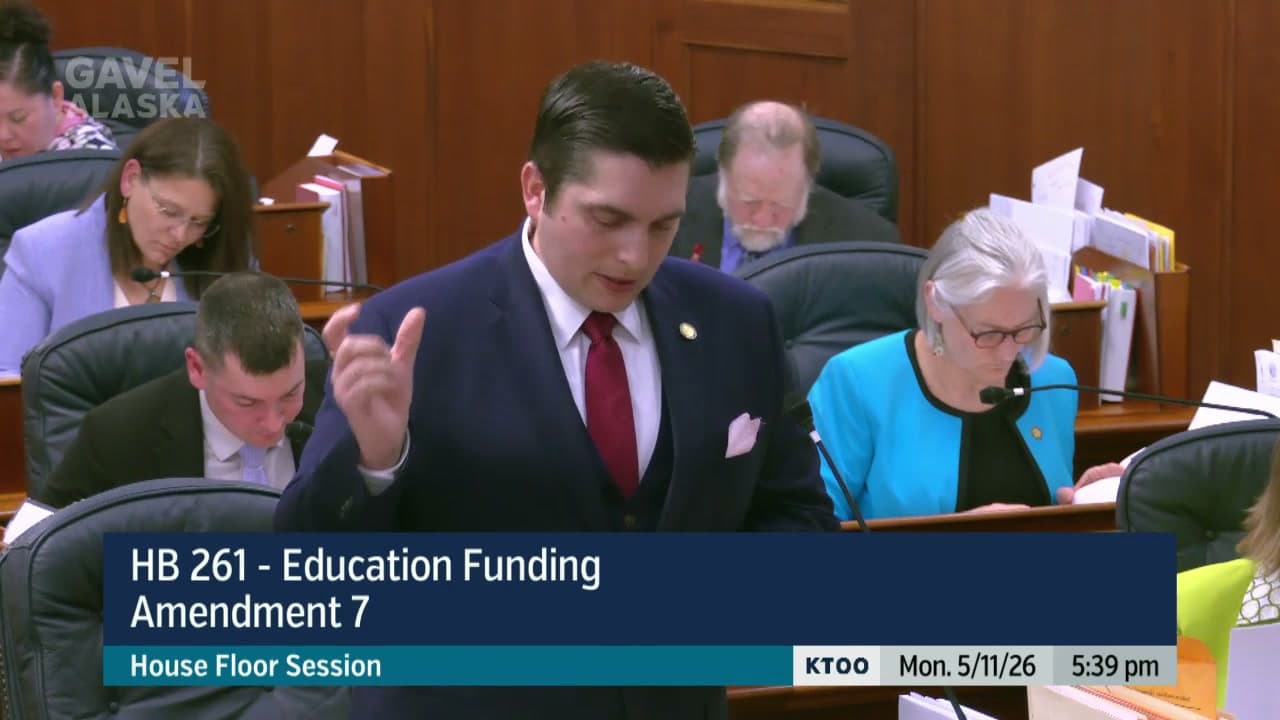
The House adopted Amendment 7 to House Bill 261 by a vote of 24-16 after extensive floor debate. The amendment caps the annual increase in required local contribution at 2%, even when property assessments rise faster. A state representative said the amendment mirrors work in Senate Bill 78, which sets the required local contribution for the preceding fiscal year as a measure of the requirement for a municipality to fund schools at no more than a 2% increase annually.
Alaska's education funding formula requires city and borough school districts to contribute a minimum amount based on property values, currently equivalent to 2.65 mills on real property, capped at 45% of a district's basic need. As property assessments have risen in many boroughs and municipalities, the required local contribution has grown faster than state funding, effectively shifting education costs from the state to municipalities.
"What this is resulting in right now without the amendment passing is local jurisdictions having to either raise property taxes or other versions of taxes to meet that full requirement of the required local contribution, where the state and their funding, if you noticed in the budget this year, for example, the amount of state funding actually, even with a large BSA increase, is going down," a state representative said.
Supporters said the cap prevents unfair cost-shifting to municipalities experiencing rapid property value increases. A state representative estimated the amendment would restore $13.9 million in state support for Anchorage schools by fiscal year 2027, with additional impacts across the state: $412,000 in Bristol Bay, $47,000 in Cordova, $1.4 million in Fairbanks, $4.6 million in the Kenai Peninsula, $917,000 in Kodiak, $3.8 million in Mat-Su, $89,600 in Nome, $1.9 million on the North Slope, and $50,000 in Unalaska. The representative noted that rural communities including Craig, Galena, Haines, Hoonah, Hyderburg, Kake, Klawock, Nenana, Pelican, Petersburg, St. Mary's, Sitka, Skagway, and Yakutat would also be affected.
"It just says that when the property assessments go up, let's say it goes up by 20%, each year the required local contribution cannot go up by more than 2%," a state representative said.
A state representative defended the amendment, noting it addresses a real problem in boroughs with property taxes. "What happens when property values increase by drastic amounts, which is what is happening in many of the boroughs and municipalities that sent letters of support, is it essentially breaks that whole thing apart. And as the required local contribution grows dramatically, because that's a math problem, no matter what, if you still continue to raise the requirement for basic need, which is the formula beginning, the required local contribution eats up all of that. And no matter whether you raise the BSA or not, your requirement shifts completely to your borough," the representative said.
The representative added: "Right now, the ratio is shifting away from the state paying for 65-ish percent to going down, down, down, down, down. Soon, Mr. Speaker, if we go down this same path, those lines will eventually almost intersect where municipalities are required to pay for almost the same amount as the state is."
Supporters noted they had received letters of support from Fairbanks North Star Borough, the Mat-Su Borough, and the Municipality of Anchorage. They also said that Regional Educational Attendance Areas do not pay a required local contribution and therefore are not directly subject to this calculation.
Opponents warned the amendment could harm rural Regional Educational Attendance Areas by increasing state education costs without guaranteed appropriations. A state representative raised concerns about equity and the lack of committee vetting, noting "there's no guarantee that those state funds, by capping the required contribution, will go towards education funding."
"This amendment caps growth in the required local contribution at 2% per year. When property values grow faster than that, the amendment breaks the link between local property values and local education contributions and shifts the difference to the state," a state representative said.
The representative continued: "This amendment to me seems like it would benefit the most fast-growing municipalities, and it may harm rural districts. That's a big concern for me. And how so? By capping what is paid by local municipalities, it's projected to cost the state about $30 million more. And I think as the state pays more money for education, they are going to be less apt to increase the base student allocation at some point."
Another state representative said the amendment does not guarantee property tax relief for residents. "This bill in the other body and now this amendment is being sold in certain respects as a property tax relief, and frankly, it's not. Nothing could be further from the truth. It doesn't cut anyone's taxes. It just lowers what boroughs are required to contribute to schools and shifts roughly $29 million to the state," the representative said.
Some opponents said the proposal should receive fuller committee vetting or be considered by the education funding task force rather than be added on the floor. One state representative said "the amendment is talking about a different bill that's before the other body, and I think it needs more vetting. And I do think I'm very concerned that will have a long-term negative effect on funding for education."
Alaska News previously reported that the Alaska Department of Education proposed regulation changes in 2025 to count all local contributions, including in-kind, against the statutory cap to comply with federal Impact Aid disparity testing. Alaska failed that test in May 2025, risking $81 million in federal education funding. House Bill 212, introduced by Representative Andi Story in April 2025, sought to exempt local funding for non-instructional services from the cap, though session time constraints limited its progress.
House Bill 261, which addresses education funding formulas, was held to the next day's calendar following adoption of the amendment.
This article is based on a public meeting — HFLR-20260511-1630 ().
AI-assisted. How we use AI Transcript byLucas Brown
Stay informed. Support what matters.
Free, permanent access to local news you can verify. Subscribe to support Alaska News and go ad-free.
Related Coverage
Alaska Senate Passes Education Bill With 4% Property Tax Cap
Alaska News · 4mo ago
Alaska House passes education funding reform despite split votes on transparency
Alaska News · 4mo ago
Alaska House passes education package with teacher loan repayment, energy relief
Alaska News · 4mo ago
House Finance Advances Education Funding Bill Despite Fiscal Concerns
Alaska News · 4mo ago
Anchorage School District to receive $37 million from state education funding increase
Alaska News · 4mo ago
Comments
Sign in to leave a comment.
No comments yet. Be the first to share your thoughts.