Oil industry opposes gas pipeline tax bill over bundled oil tax increases
The Alaska Oil and Gas Association opposed a gas pipeline tax bill Friday, arguing that oil tax increases bundled into the legislation could undermine the state's ability to attract future investment.
The Alaska State Senate Resources Committee heard testimony on Senate Bill 280 during its 32nd hearing on the measure. The bill would create tax incentives for a proposed liquefied natural gas pipeline project. It also includes a 30-cent-per-barrel tax on oil production and raises the minimum production tax floor from 4 percent to 6 percent.
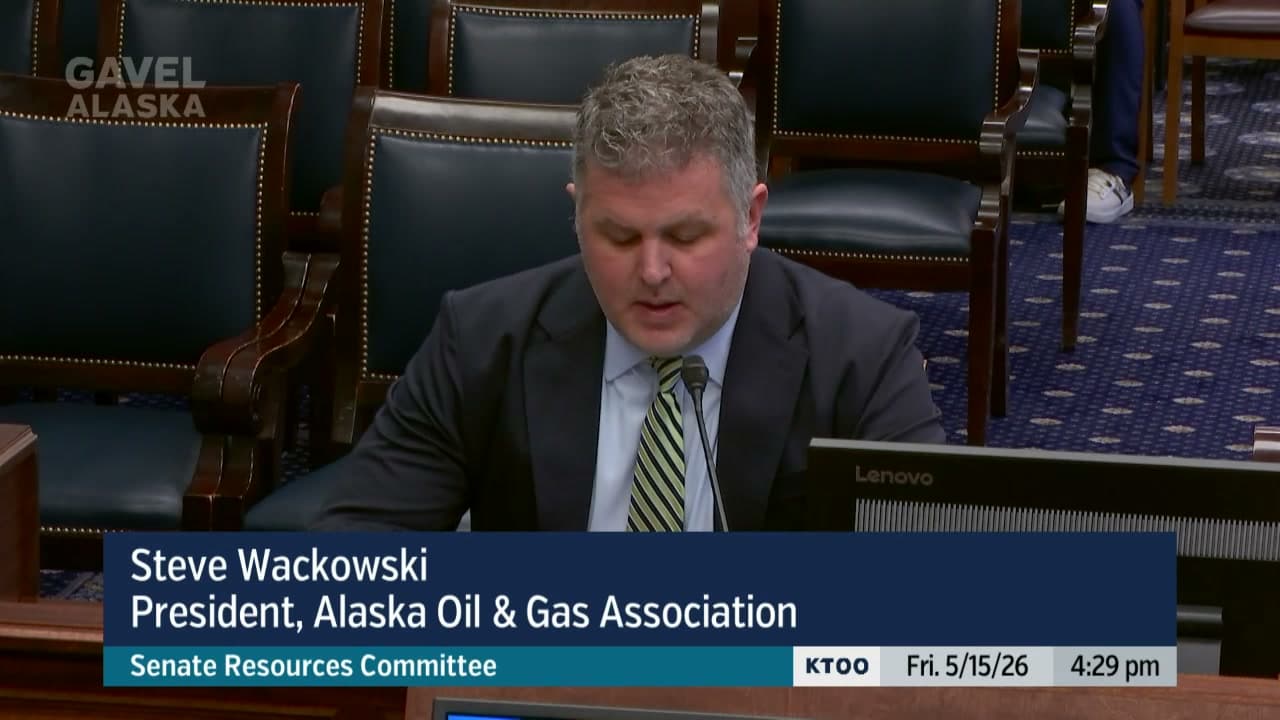
Steve Wackowski, president and CEO of the Alaska Oil and Gas Association, told the committee the oil tax provisions represent major fiscal changes that lack economic analysis. He said the changes could significantly impact future investment, jobs, production, and throughput in the Trans-Alaska Pipeline System.
"This legislation intended to help deliver a gas line for Alaska has now been transformed into a sweeping oil tax increase rushed through the process without meaningful economic analysis," Wackowski said.
The bill would also establish a $200 million community impact program funded by the gas pipeline developer. The program includes a $50 million one-time payment for communities along the pipeline corridor and $30 million in annual payments distributed statewide for five years.
Senator Forrest Dunbar questioned Wackowski about how the industry would address revenue losses caused by gas lease expenditures. Dunbar explained that gas development for the pipeline would generate lease expenditures that reduce oil production tax revenue. An earlier version of the bill attempted to separate gas and oil lease expenditures, but lawmakers removed that provision after industry testimony. The Department of Revenue then suggested the oil tax increases as an alternative way to offset revenue losses from gas development.
"There are significant lease expenditures associated with the gas line project that are associated with producing gas," Dunbar said. "And it is impossible to decouple them from the oil lease expenditures. And so the gas project directly causes us to lose revenue and go negative on our oil revenue side."
Wackowski said the association would need to provide additional information on that issue. He said the Department of Revenue's estimates of lease expenditures for the first phase of the gas project appeared aggressive.
Senator Bill Wielechowski pressed Wackowski on whether the association supports any sections of the 73-section bill. Wackowski said he was not prepared to provide a section-by-section analysis during public testimony. Wielechowski noted that lawmakers removed the lease expenditure provision from the earlier bill version based on industry testimony before turning to the oil tax increases as an alternative.
"We can't work with you if you don't give us ideas on how to fix the problem," Wielechowski said. "We have a cash flow problem in this state. We have a $2 billion structural deficit going forward."
Wackowski defended the industry's position on tax stability. He said Alaska has recently seen renewed momentum with major projects under construction and increasing investment. He urged the committee to keep the bill focused on the gas pipeline and remove the oil tax provisions.
"The very companies expected to invest billions of dollars into future gas and pipeline infrastructure are now being targeted with significant oil tax increases inside the same bill," Wackowski said.
The bill includes a 10-year sunset provision for the alternative volumetric tax structure. After 10 years of commercial operations at the LNG export facility, the tax structure would revert to the existing petroleum property tax.
The committee also discussed an amendment to exempt a gas pipeline spur line to Fairbanks from state taxes. After debate over how to ensure the tax exemption applies only to infrastructure serving residential customers and not industrial facilities, committee chair Cathy Giessel set the amendment aside and directed staff to work with legislative legal services on conforming changes and statutory references.
The committee will continue work on the bill at a hearing scheduled for Saturday morning. The Department of Revenue is expected to testify at that hearing.
This article is based on a public meeting — SRES-260515-1530 ().
AI-assisted. How we use AI Transcript byLucas Brown
Discussed in
Stay informed. Support what matters.
Free, permanent access to local news you can verify. Subscribe to support Alaska News and go ad-free.
Related Coverage
Oil industry opposes tax provisions in Alaska gas pipeline bill
Alaska News · 5mo ago
Gas pipeline bill adds oil tax increase, industry calls process rushed
Alaska News · 4mo ago
Senate panel advances gas pipeline bill with oil tax floor increase
Alaska News · 4mo ago
Gas Line Developer Warns Tax Hike Would Delay Project, Jeopardize 2029 Deadline
Alaska News · 4mo ago
Senate panel examines regulatory questions on gas pipeline tax plan
Alaska News · 5mo ago
Comments
Sign in to leave a comment.
No comments yet. Be the first to share your thoughts.