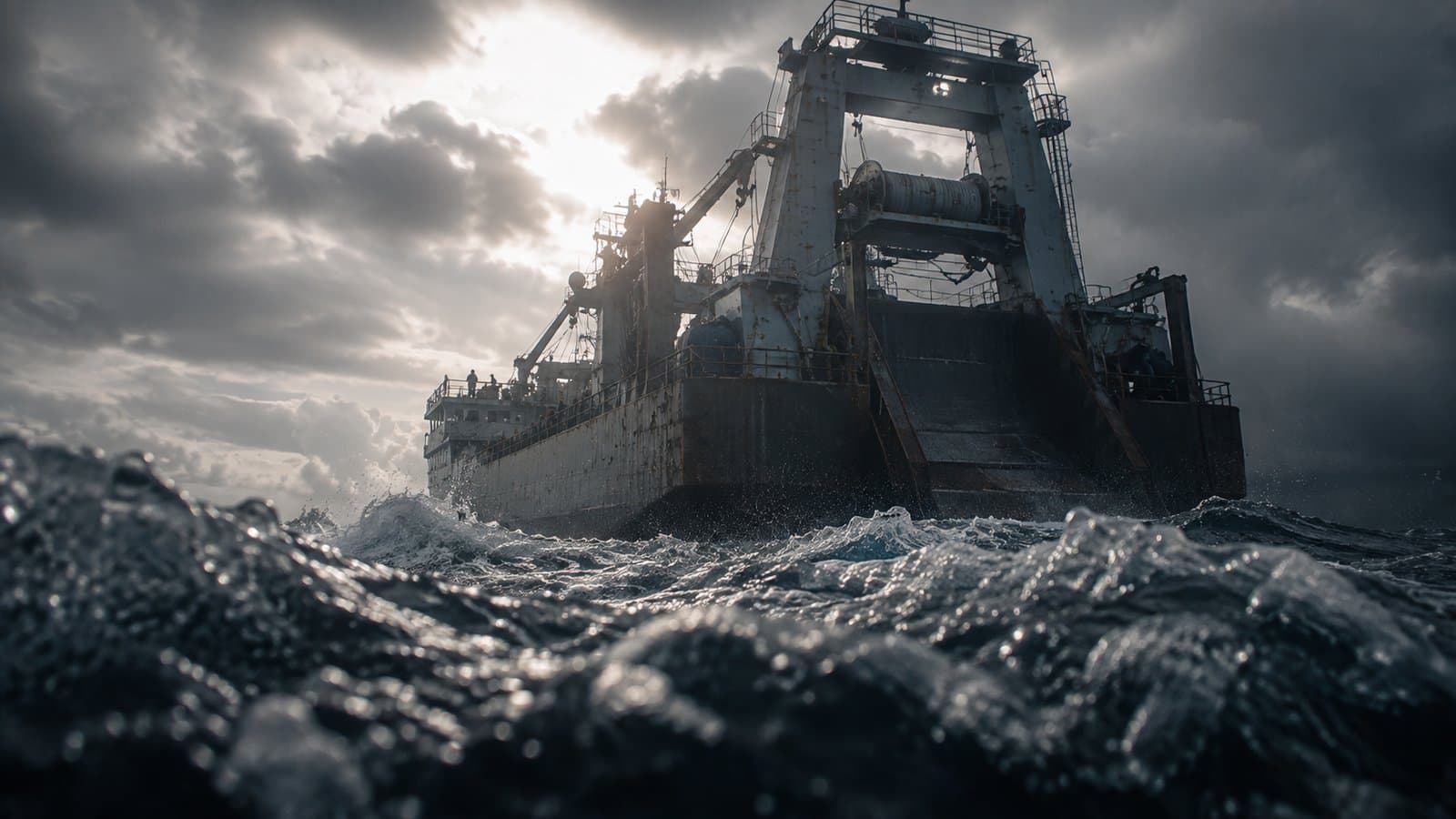
Generated image by Cale Green
Pollock fleet holds an Anchorage job fair days before a bycatch-shaped election
Five days before Alaskans vote, the Bering Sea pollock industry will hold a job fair in Anchorage — an ordinary bit of hiring in a fishery that has become an extraordinary flashpoint in the 2026 campaign, where the salmon its trawlers catch unintentionally has drawn criticism from candidates in both parties.
The At-Sea Processors Association's recruitment event runs from 10 a.m. to noon on Thursday, Oct. 29, at the Anchorage Midtown Job Center, presented through the state Seafood Office. The association represents five companies — American Seafoods, Arctic Storm, Coastal Villages, Glacier Fish and Trident Seafoods — that operate 15 catcher-processor vessels in the Eastern Bering Sea pollock fishery, though the state flyer lists those companies only as potential participants and the openings include both vessel and shore-plant work.
At the center of the political fight is bycatch — the salmon that trawlers hauling for pollock catch incidentally. In 2021, NOAA estimated the Bering Sea pollock fleet's bycatch mortality at about 546,000 chum salmon and roughly 13,800 Chinook. That year coincided with a collapse of Western Alaska's own salmon runs so severe that subsistence fishing on the Yukon was closed all summer, while Kuskokwim families faced sharp restrictions and only limited openings — a crisis that hit hardest in Alaska Native communities where salmon is central to food and culture, and that turned bycatch into a rallying cry.
How much the pollock fleet contributes to those river shortfalls is genuinely disputed, and the science is specific about it. NOAA's genetic sampling has found that most of the chum caught as bycatch is not Western Alaska fish — in 2023, about 69% was Asian-origin, mostly hatchery stock, and roughly 8% was coastal Western Alaska, though the Western Alaska share varies from year to year. Chinook run differently: NOAA estimated that in 2023, about 47% of the Chinook bycatch came from coastal Western Alaska. Federal scientists point to warming ocean and river conditions as the leading driver of the salmon declines, while treating bycatch as an additional, controllable source of mortality — the North Pacific Fishery Management Council has estimated pollock bycatch at under 2% of Western Alaska chum mortality from all sources, even as it noted those are fish that would otherwise return to already-depleted rivers.
NOAA denied emergency petitions in 2022 and 2024 from coalitions of tribal and regional organizations seeking limits that would have effectively closed the pollock fishery. But in February 2026, after four days of testimony from more than 170 people, the federal North Pacific Fishery Management Council voted 8-3 to impose the first mandatory cap on Western Alaska chum caught as bycatch in the Bering Sea pollock fishery: a limit of 45,000 fish, with a required closure of a large area of federal fishing grounds — a migration corridor north of Unimak Pass — if a pollock sector reaches its share between June 10 and Aug. 31. The Council credited the fleet with cutting chum bycatch roughly 95% through voluntary measures over the prior four years. The cap still has to clear federal rulemaking before it takes effect.
The politics have crossed party lines with unusual intensity. Bycatch was a signature issue in Mary Peltola's 2022 U.S. House campaign and remains central to her current Senate run; while in the House in 2024, she introduced two bills addressing trawl zones and bycatch-reduction funding. On the other side of the aisle, Sen. Dan Sullivan, seeking reelection, introduced a bycatch bill in June that he called "the most comprehensive bycatch legislation ever introduced in the Congress," and Republican candidates for governor have taken up the issue as well — a notable turn for a party usually aligned with resource industries. Neither Peltola's bills nor Sullivan's would ban the pollock fleet outright.
The industry points to its economic weight as the debate continues. An industry-commissioned study using 2023 data estimated the broader Alaska pollock sector supports several thousand Alaska jobs and tens of millions of dollars in state and local taxes — figures that cover far more than the five companies at the Oct. 29 fair. What the job fair shows, in a small and concrete way, is an industry continuing to hire even as policymakers weigh new limits on how it operates.
Based on a press release from Alaska Labor.
Drafted with AI. Edited by Cale Green (2 revisions). No full editor review is on record. Who is accountable.
Stay informed. Support what matters.
Free, permanent access to local news you can verify. Subscribe to support Bill AlaskaNews and go ad-free.
Related Coverage
Bering Sea pollock companies are hiring at an Anchorage event
Alaska News · 1w ago
Sullivan and Peltola, fighting over the same salmon
Alaska News · 2mo ago
Pollock official puts bycatch impact on Western Alaska runs at 1.9%
Alaska News · 1w ago
Sullivan's Bycatch Bill Wades Into Alaska's Hardest Fish Fight
Alaska News · 2mo ago
Bronson calls for bottom trawling ban in state waters at Kodiak fisheries debate
Alaska News · 1w ago
Comments
Sign in to leave a comment.
No comments yet. Be the first to share your thoughts.