Video Clips
Quoted moments from Alaska public meetings, hearings, and press conferences.
Speaker B
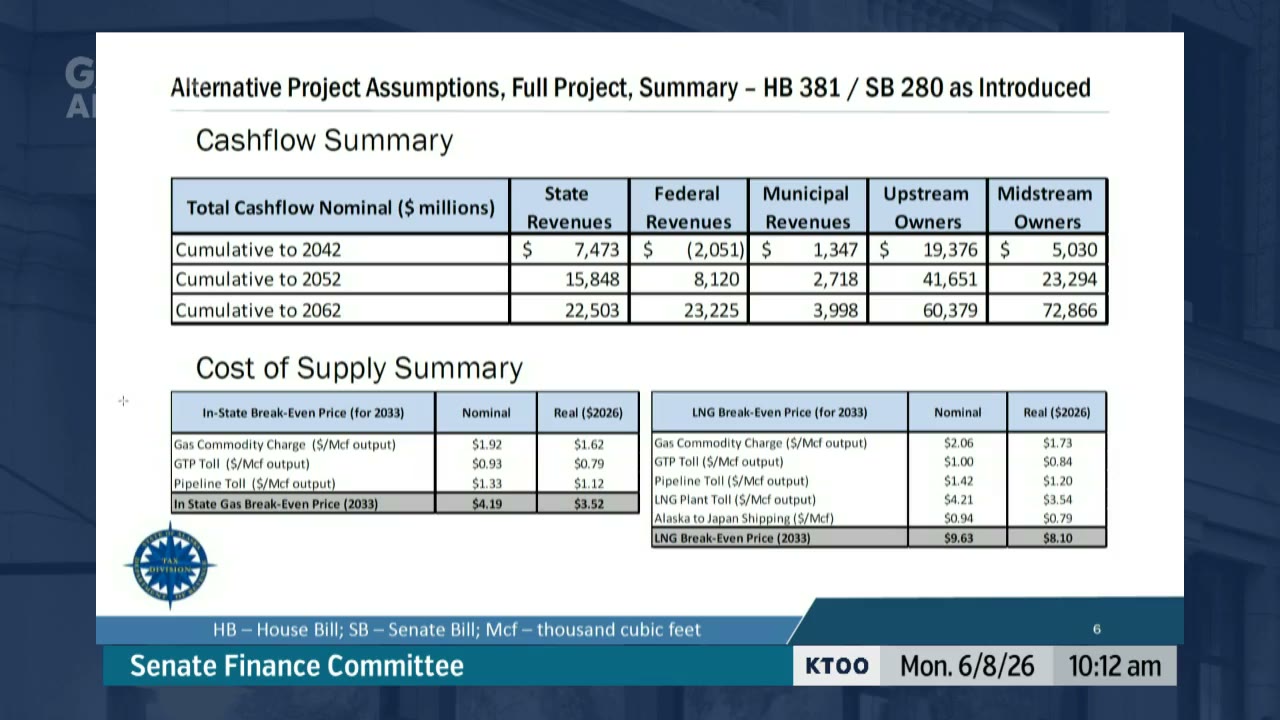
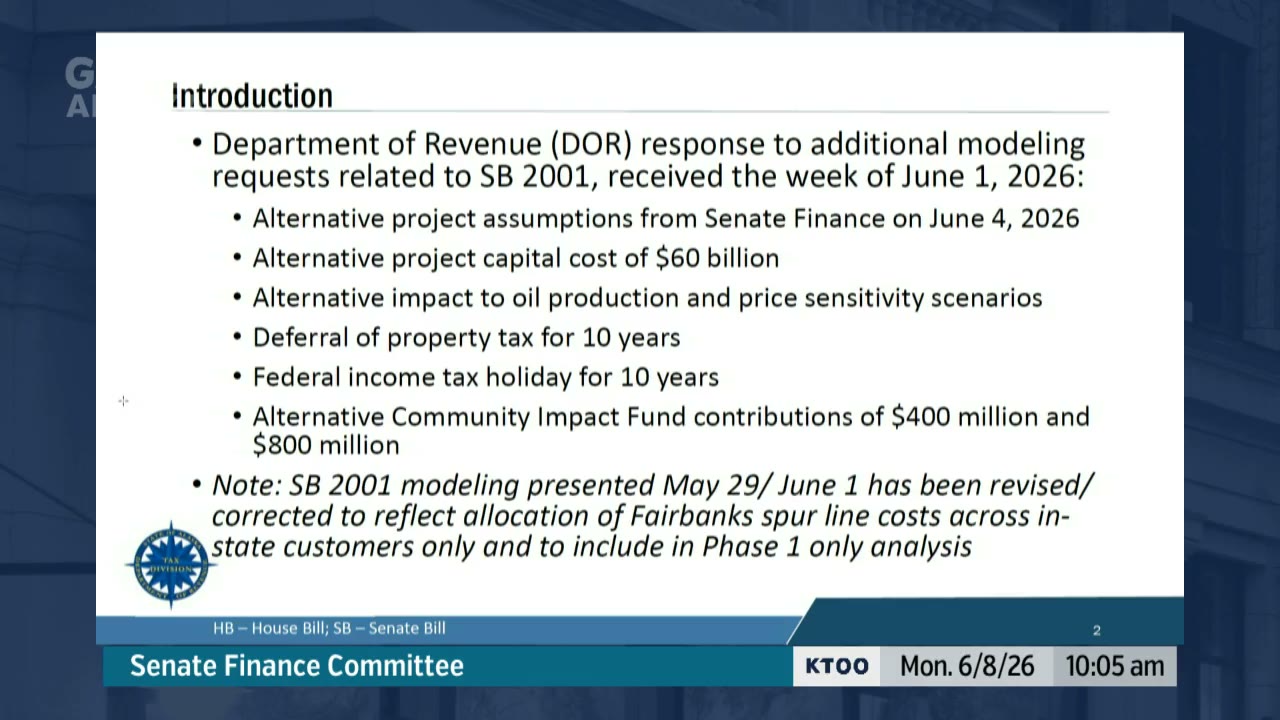
“Under these alternative project assumptions, the breakeven price into the global market to get that 10% return for the investors would be $9.63 per thousand cubic feet. That compares to $8.48 per thousand cubic feet under our baseline analysis... the very LNG breakeven price would be $9.69 per thousand cubic feet, comparing to $8.54 per thousand cubic feet under our baseline assumptions. And so across the board, these, these alternative assumptions increase the required sales price of gas into the global market by a little over $1 per 1,000 cubic feet.”Alaska Legislature: Senate Finance - June 8, 2026 10:00am · Jun 8, 2026
Speaker B
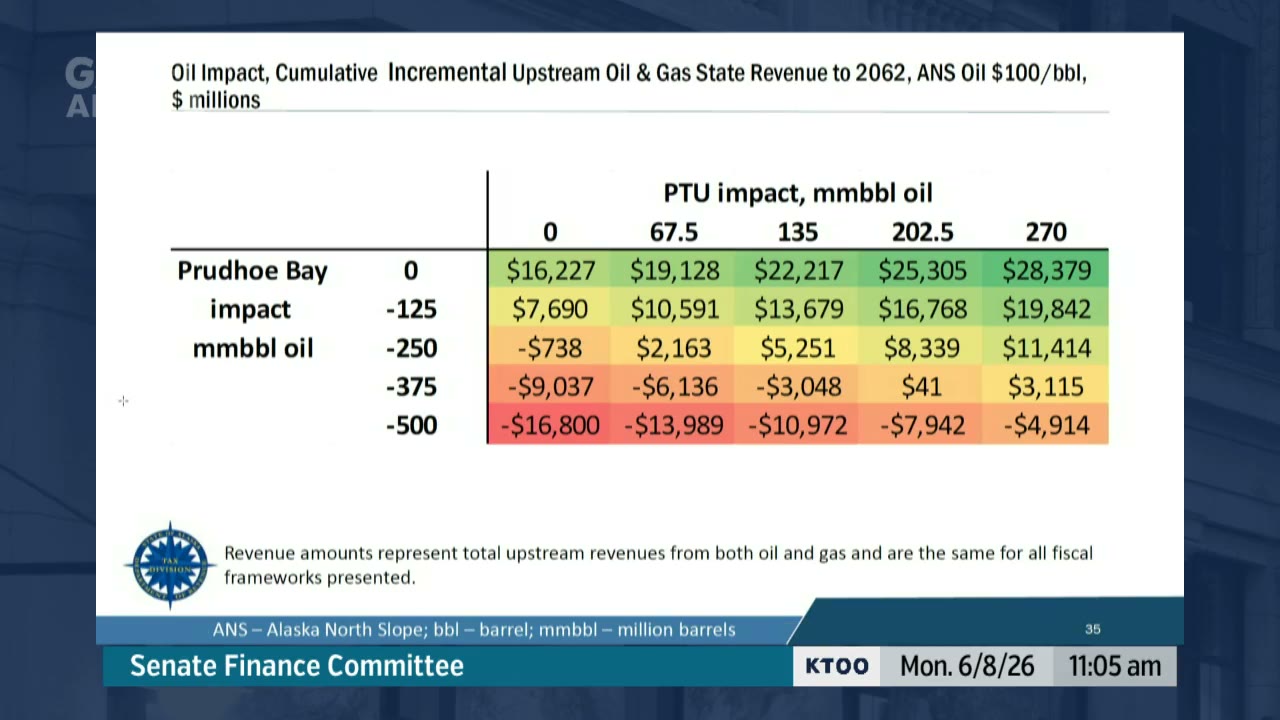
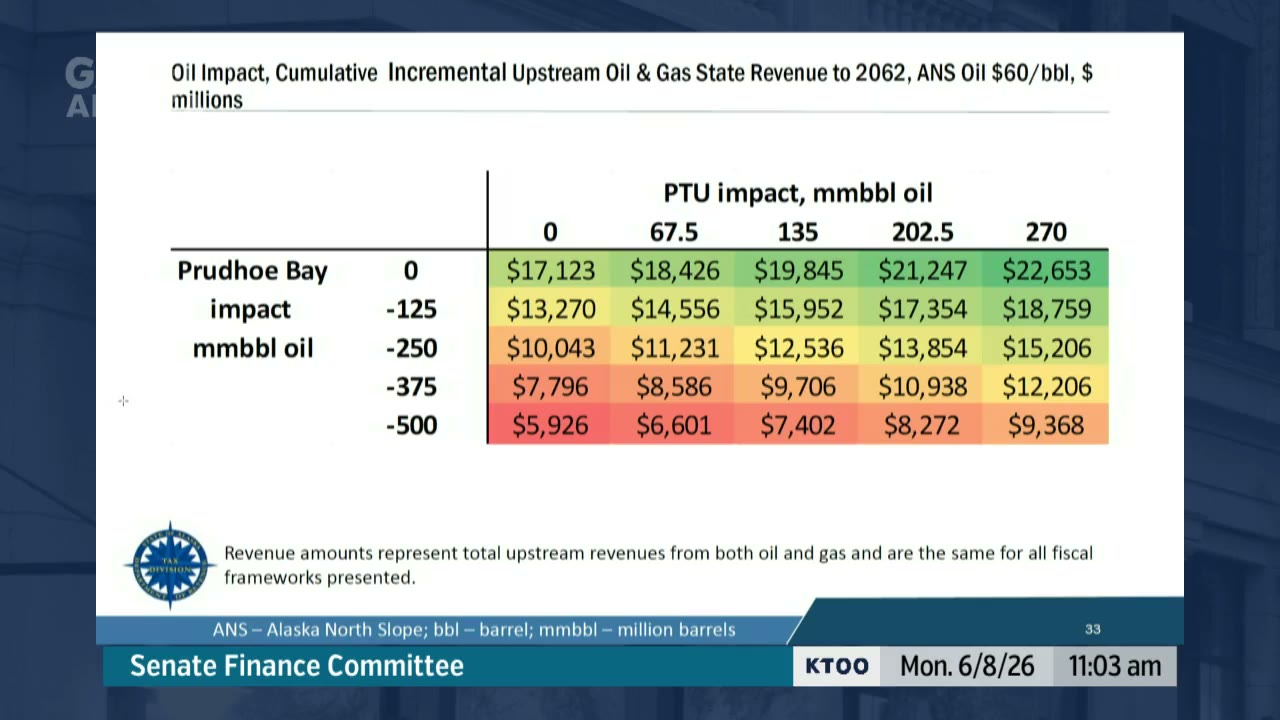
“at a higher oil price, the impact of lost barrels, if you had a scenario where Prudhoe Bay production was declining, the impact of those lost barrels is significant to state revenue, both in the reduction of value and the fact that at higher oil prices, when companies are paying under the net profits tax, we're getting a larger share of a larger pie.”Alaska Legislature: Senate Finance - June 8, 2026 10:00am · Jun 8, 2026
Speaker B
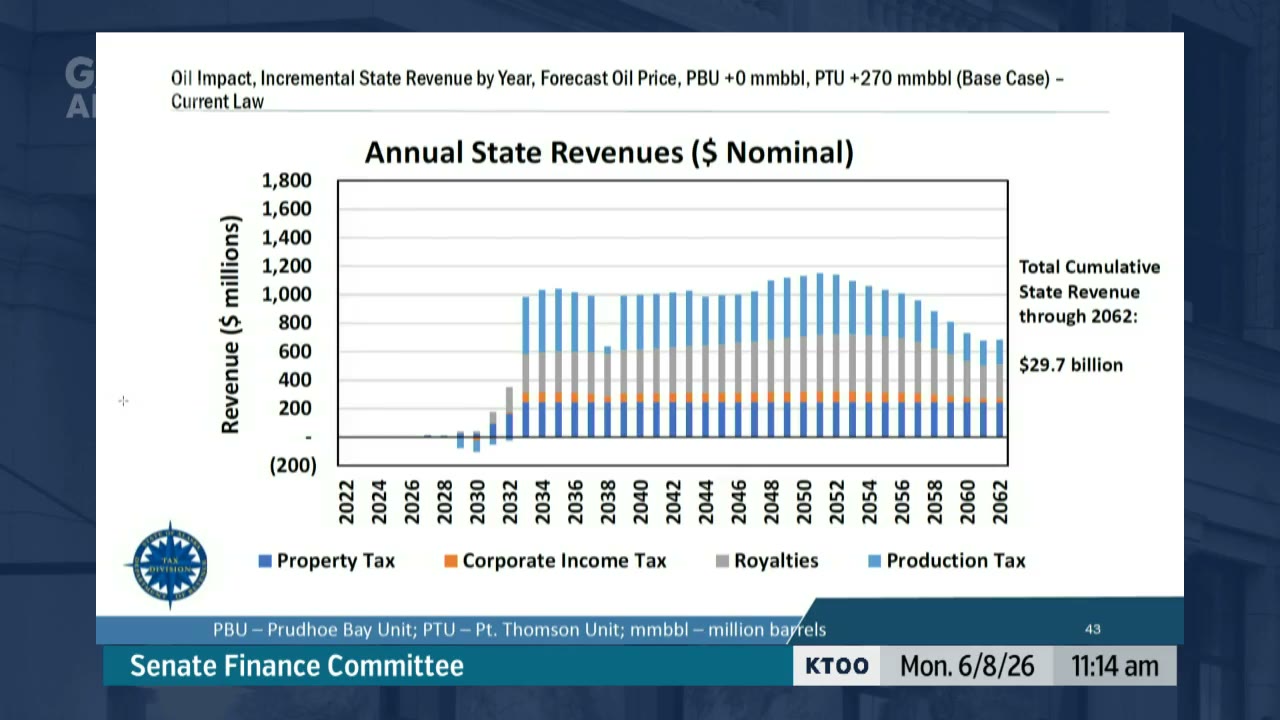
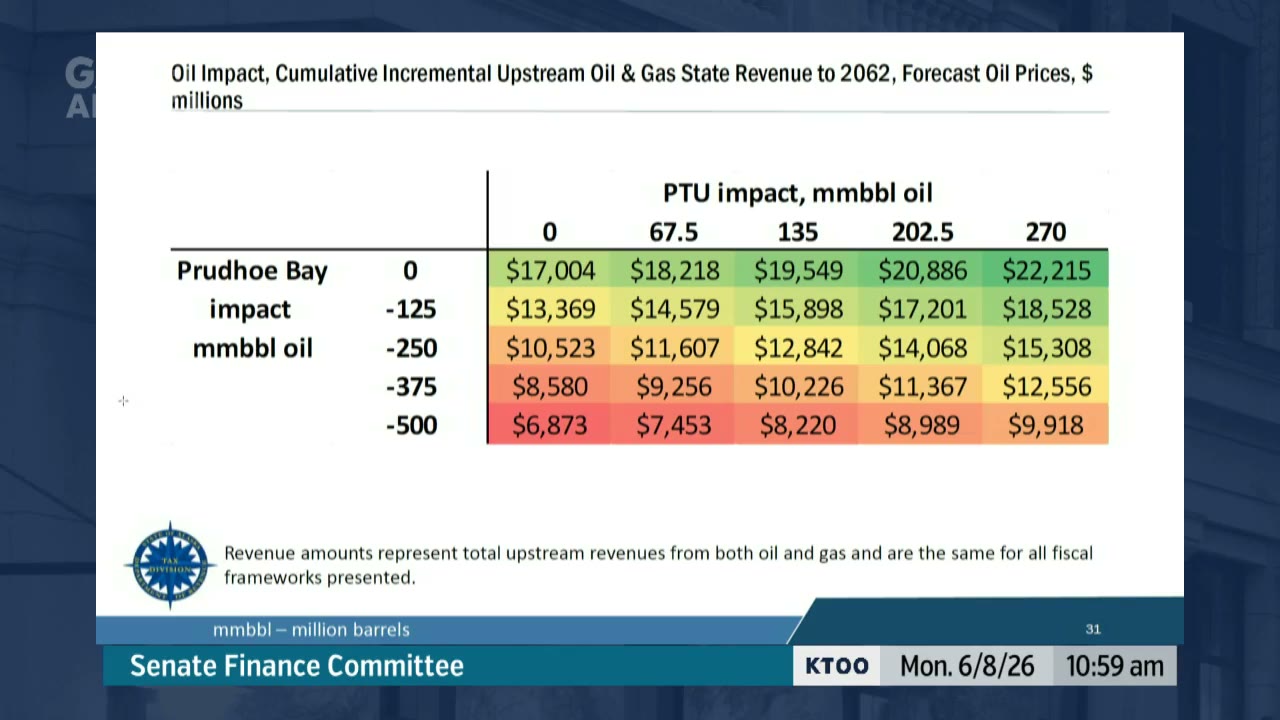
“the baseline oil price with the baseline oil production scenarios and $29.7 billion of cumulative revenue through 2062.”Alaska Legislature: Senate Finance - June 8, 2026 10:00am · Jun 8, 2026
Speaker B
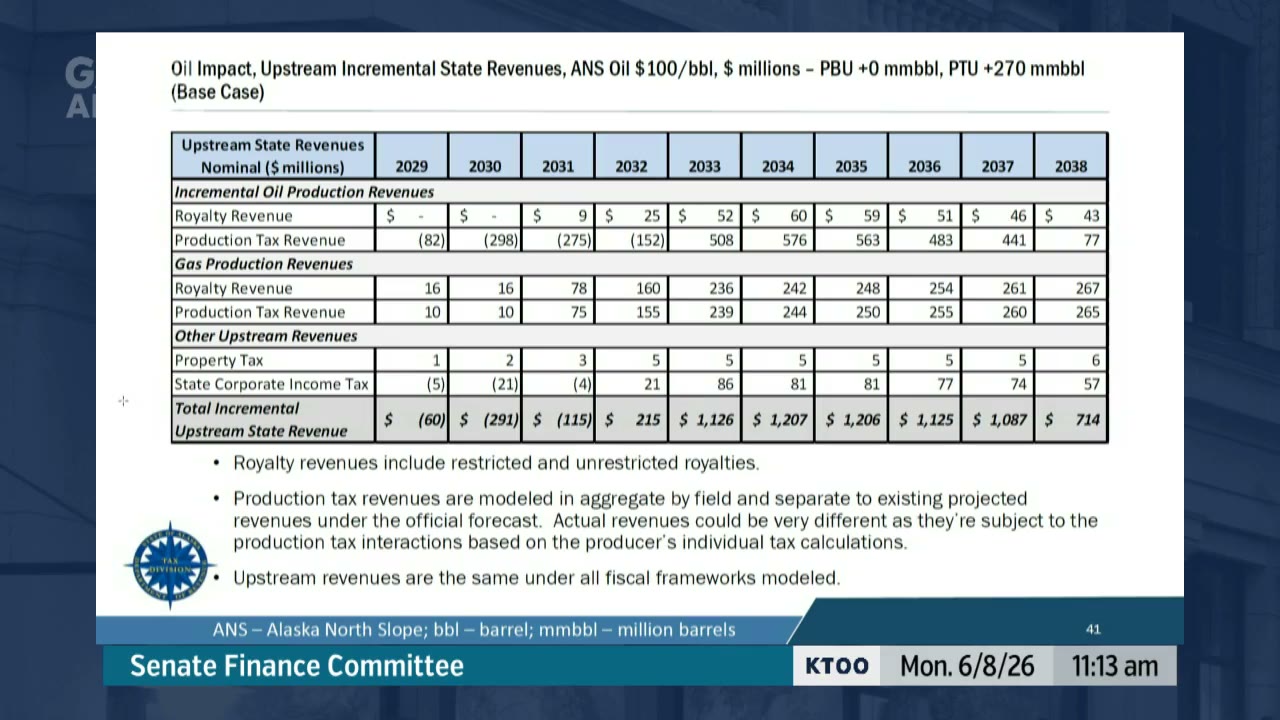
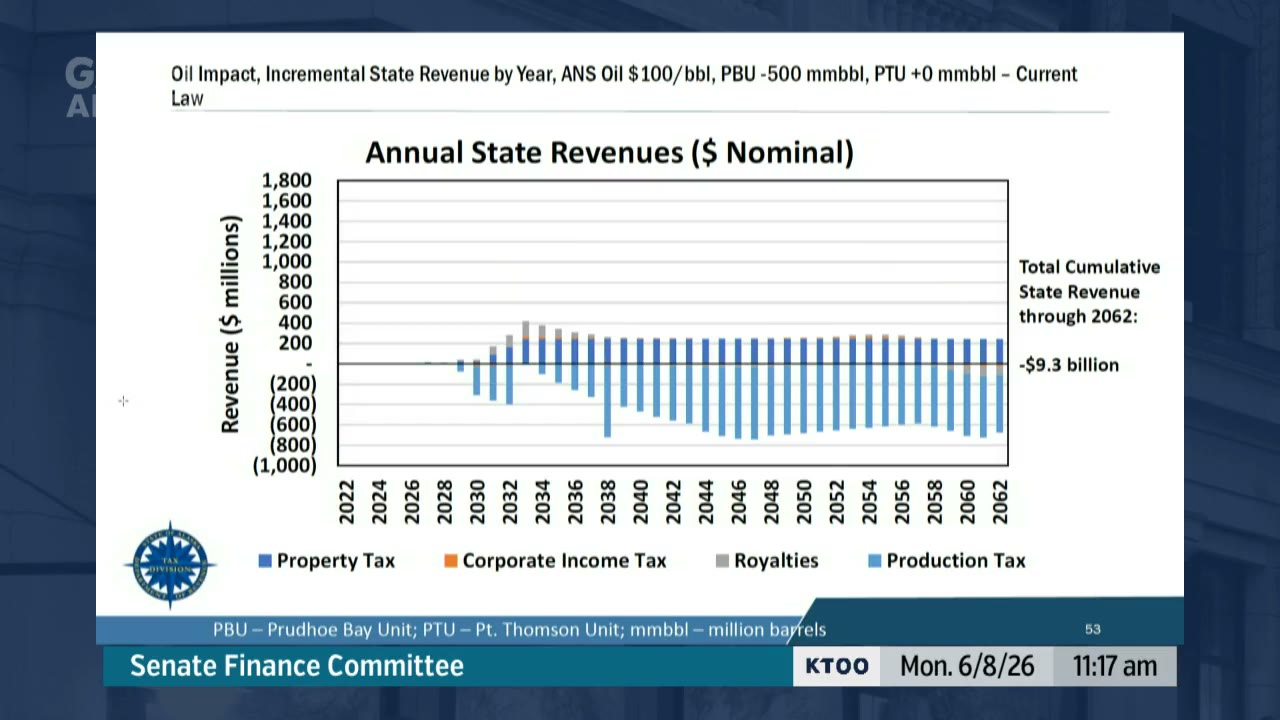
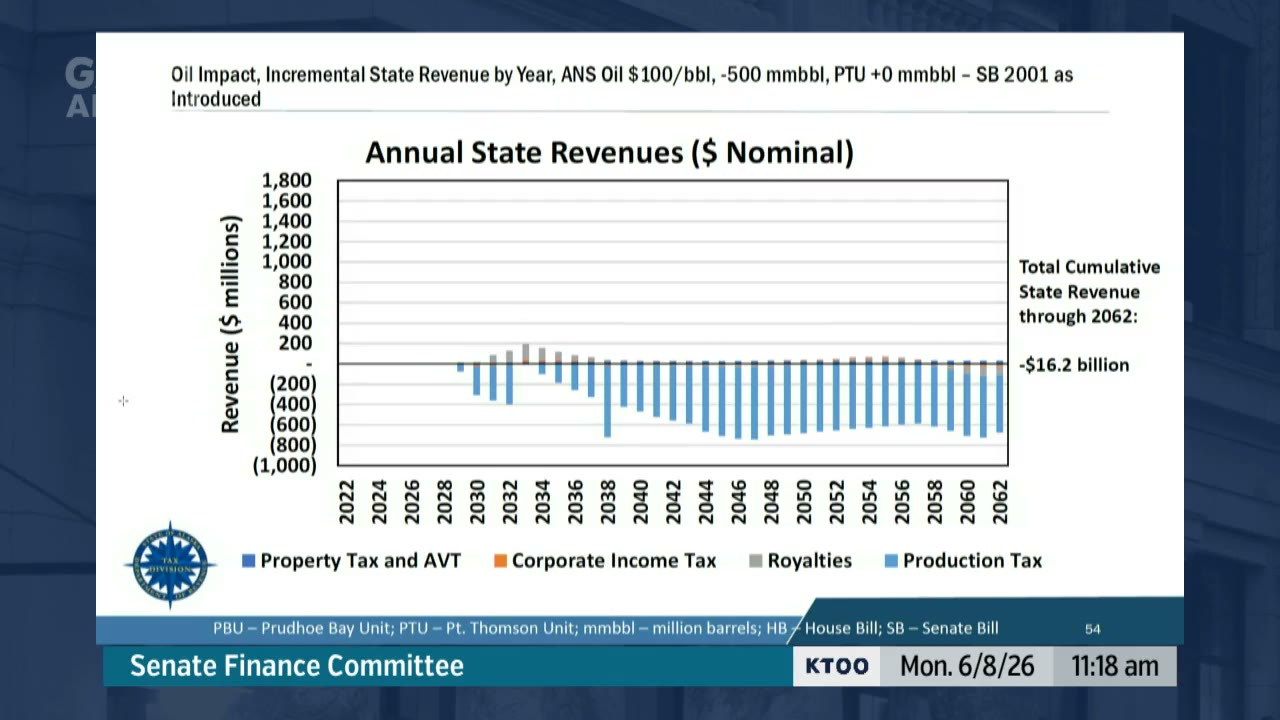
“at $100 per barrel oil, it would be a reduction to state revenue in most years under this worst-case production scenario, and that again has to do to do with just the value of those barrels, we're actually in this worst-case production scenario, we're actually forecasting that oil production will be lower than it would be absent the AK LNG project.”Alaska Legislature: Senate Finance - June 8, 2026 10:00am · Jun 8, 2026
Speaker B
“The $60 oil price represents a price that's a little bit lower than what we're forecasting and is a situation where most of the upstream producers will be in a minimum tax floor situation in the forecast. The $100 per barrel scenario represents something closer to current prices and would be a situation where most of the producers are in a net tax situation for the production tax. And so the impact of that net versus gross tax is significant when it comes to running these price scenarios.”Alaska Legislature: Senate Finance - June 8, 2026 10:00am · Jun 8, 2026
Speaker B
“We were asked to provide oil production sensitivities and price sensitivities on that as well.”Alaska Legislature: Senate Finance - June 8, 2026 10:00am · Jun 8, 2026
Speaker B
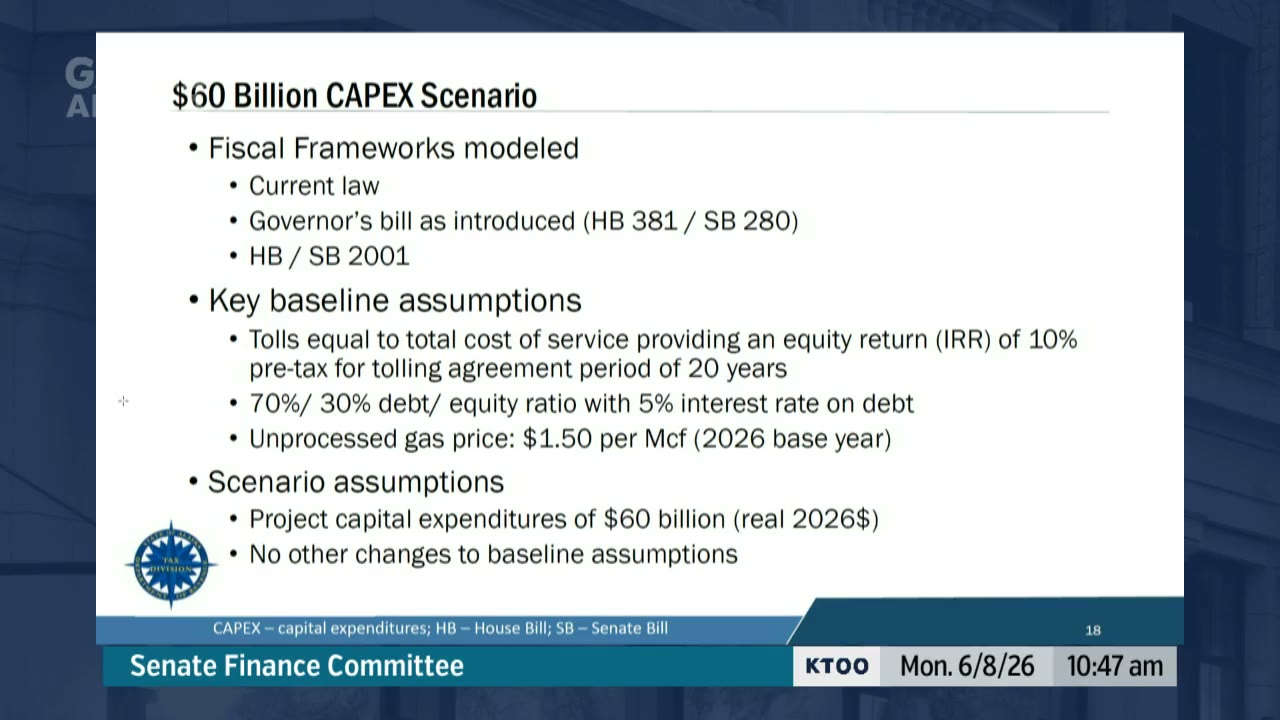
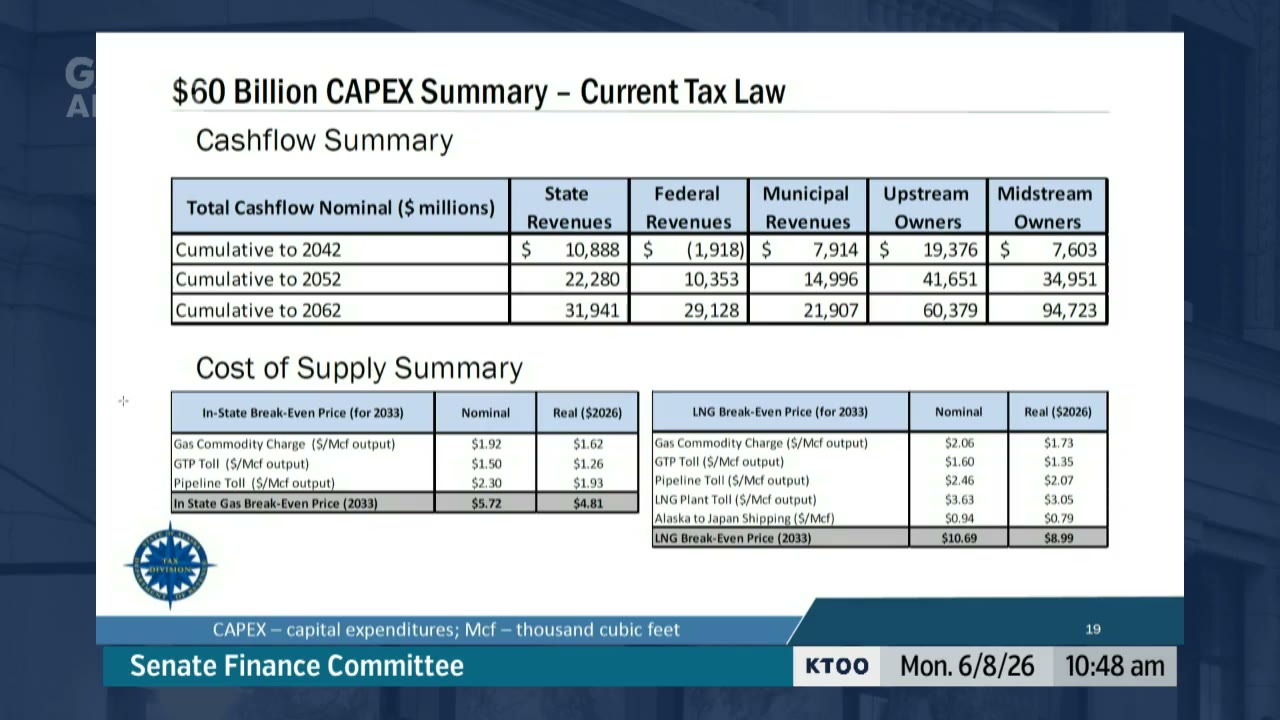
“This would result in a breakeven LNG price into the global market of $10.69 per thousand cubic feet. That compares to $9.07 per thousand cubic feet under our baseline assumptions. So a move of about $1.60 just from increasing that capital cost assumption really highlights the importance of of that capital cost assumption.”Alaska Legislature: Senate Finance - June 8, 2026 10:00am · Jun 8, 2026
Speaker B
“this next scenario was a request from the committee presentation from last week, and it was a request to model a $60 billion capital Capital expenditure scenario. So similar in total capital expenditure cost as the scenario that we just walked through, except that this next scenario keeps all of our other baseline assumptions unchanged. So the 20-year debt agreement, 70/30 debt split, 5% interest rate on debt, and other baseline assumptions, simply adjusting that capital expenditure from the $46.2 billion real up to $60 billion real.”Alaska Legislature: Senate Finance - June 8, 2026 10:00am · Jun 8, 2026
Speaker B
“Moving to the $60 billion CapEx increases the breakeven cost of supply from $8.48 under the baseline up to $9.91 per thousand cubic feet. And then under Senate Bill 2001 as introduced on slide 21, that would be $9.97 per 1,000 cubic feet, which again compares to $8.54 under our baseline assumptions.”Alaska Legislature: Senate Finance - June 8, 2026 10:00am · Jun 8, 2026
Speaker B
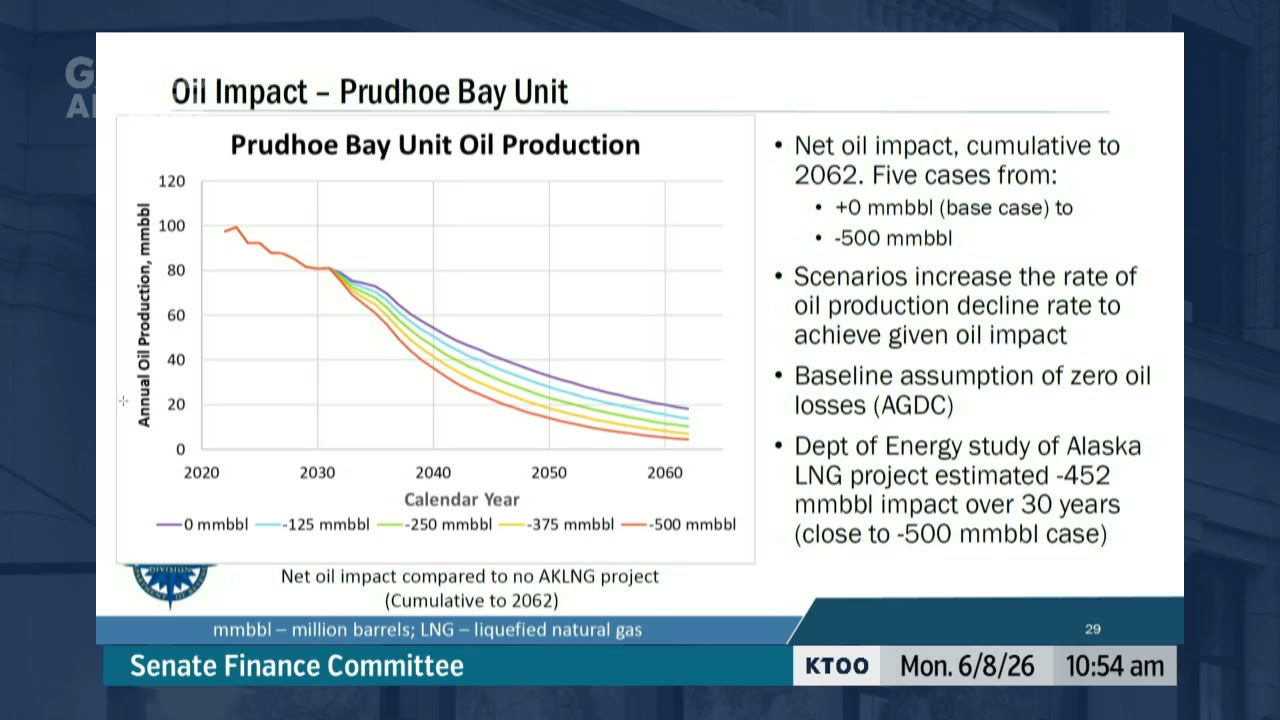
“there was a study that was presented in the Resources Committee where Department of Energy had estimated that the LNG project could reduce oil production from Prudhoe by a little over 450 million barrels total. And so that's where we developed the 500 as a nice round number to illustrate kind of a worst-case scenario there.”Alaska Legislature: Senate Finance - June 8, 2026 10:00am · Jun 8, 2026
Speaker B
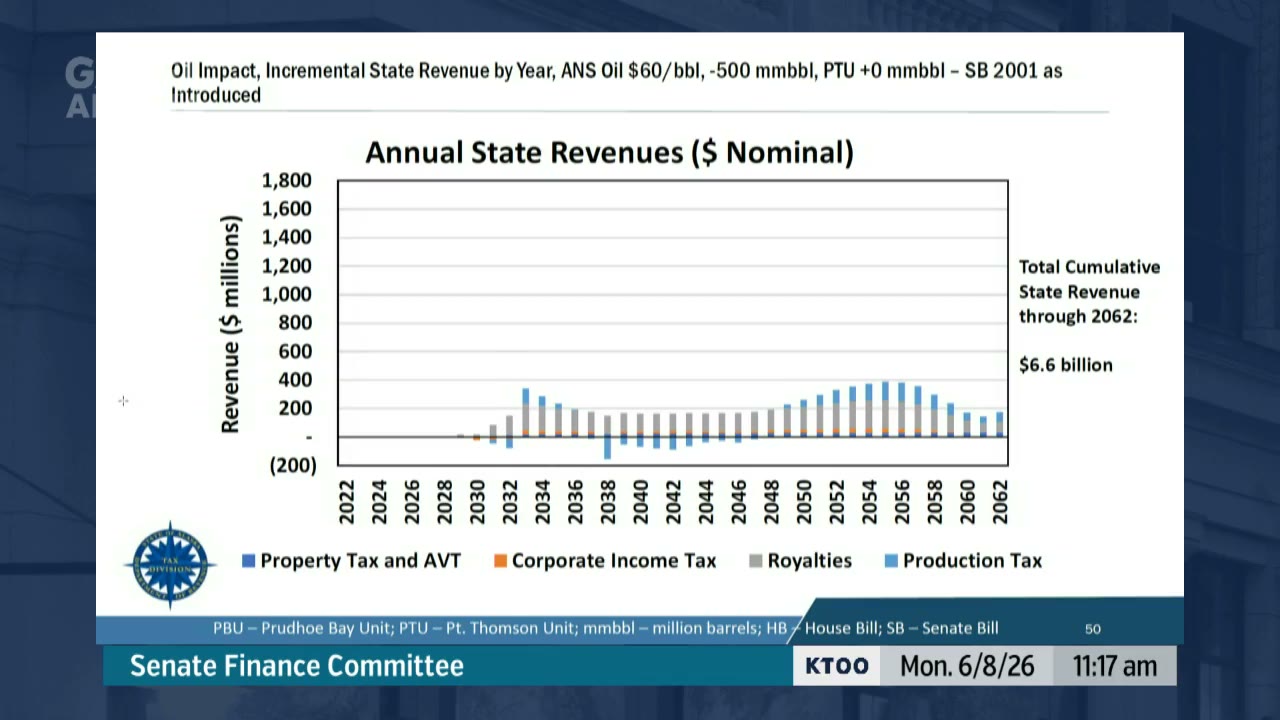
“the $100 per barrel oil, um, with our baseline oil production case and Senate Bill 2001 as introduced. That would be $29 billion of cumulative state revenue.”Alaska Legislature: Senate Finance - June 8, 2026 10:00am · Jun 8, 2026
Speaker B
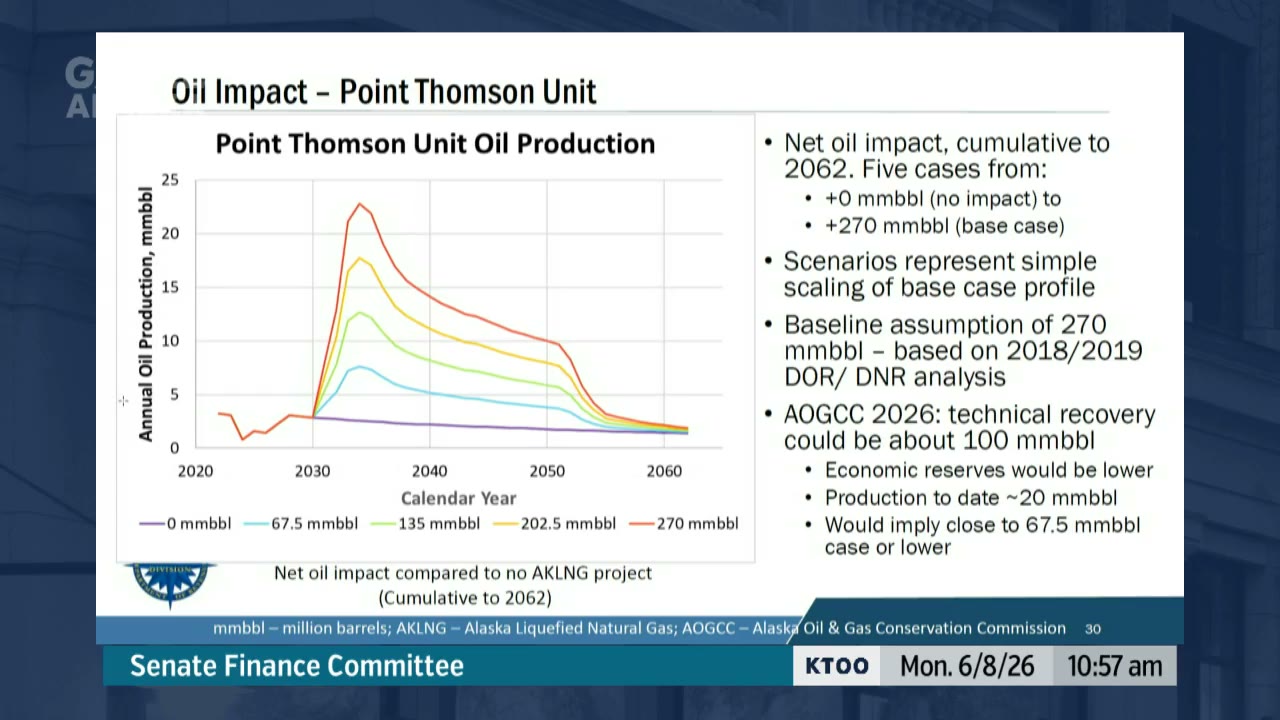
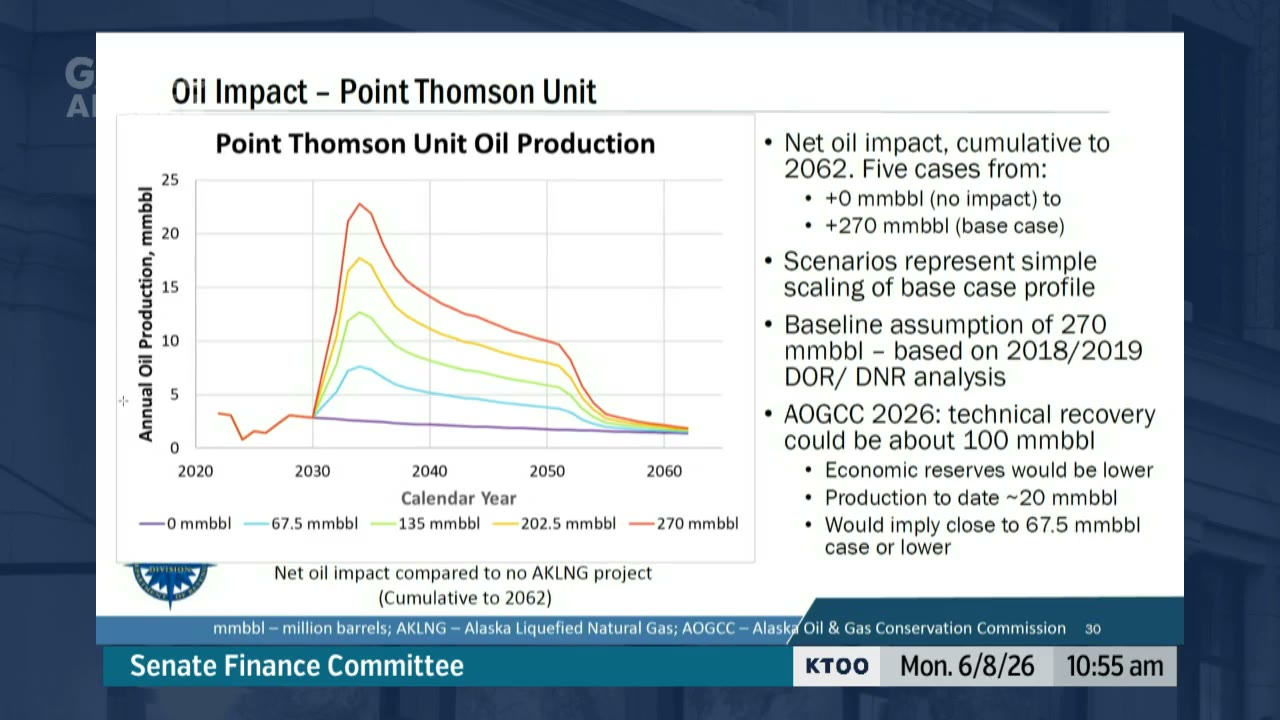
“So far about 20 million barrels have been produced, and so that would imply potential— potentially 80 million barrels of oil left that could be technically produced, and how much of that is economic would be a lesser number than that.”Alaska Legislature: Senate Finance - June 8, 2026 10:00am · Jun 8, 2026
Speaker B
“on the top right is our baseline scenario, which is going to be the 270 million barrels additional production from Point Thompson and the zero oil impact at Prudhoe Bay. And then on the bottom left is kind of the worst case scenario with zero incremental Point Thompson production and a 500 million barrel loss at Prudhoe Bay.”Alaska Legislature: Senate Finance - June 8, 2026 10:00am · Jun 8, 2026
Speaker B
“we're getting the property tax revenue and the royalties from gas are largely being offset by reduced royalties from oil, given the lower oil production. But the most significant impacts here in these $100 barrel oil with the worst-case oil production scenarios is due to reductions to production tax revenue.”Alaska Legislature: Senate Finance - June 8, 2026 10:00am · Jun 8, 2026
Speaker B
“that $100 per barrel oil impact scenario with the worst-case production scenario under Senate Bill 2001 as introduced by the Governor, which would be a $16.2 billion reduction to state revenue through 2062 in this scenario.”Alaska Legislature: Senate Finance - June 8, 2026 10:00am · Jun 8, 2026
Speaker B
“the baseline modeling assumes a total of 270 million barrels of additional production from the field at as the significant additional development to bring the gas online brings on additional oil as well.”Alaska Legislature: Senate Finance - June 8, 2026 10:00am · Jun 8, 2026
James Kaufman
“I ask these questions because it's been kind of conversationally put forth that that's available for the potential gas project. And I just want to be clear on the record with where we're at on that. Do you know if there's been any inquiry to start that?”Alaska Legislature: Senate Finance - June 5, 2026 9:00am · Jun 5, 2026
Jesse Kiehl
“I think there was conversation a few minutes ago about a barrel of oil equivalent in gas having a value like $9 versus a barrel of oil, which, you know, we cry a little bit when it's 60. And right now we're doing pretty well on the budget within at 105 or 110. So there, that's not something the commission looks at. That's something that the legislature has to look at”Alaska Legislature: Senate Finance - June 5, 2026 9:00am · Jun 5, 2026
Frank Richards
“If Glenn Farm is not able to have a retention and seeks outside investment to come in to be able to cover the cost of the project, then we would only have those developer economics that Matt talked about.”Alaska Legislature: Senate Finance - June 4, 2026 1:30pm · Jun 4, 2026
Bert Stedman
“there's significant risk exposure to this project and it's the looks like the highest and hardest hurdle of the three entities, the liquefaction plant, the conditioning plant and the pipe. The pipe being the most critical to move the project forward and also looks like it has the most risk in it.”Alaska Legislature: Senate Finance - June 4, 2026 1:30pm · Jun 4, 2026
Bert Stedman
“we got the railroad, we've got Alaska Industrial Development Authority, and we have the permanent fund, all with either substantial amount of bonding authority and or billions in cash, hundreds of millions if not in billions in liquid assets. So there is a concern there.”Alaska Legislature: Senate Finance - June 4, 2026 1:30pm · Jun 4, 2026
Matt Kissinger
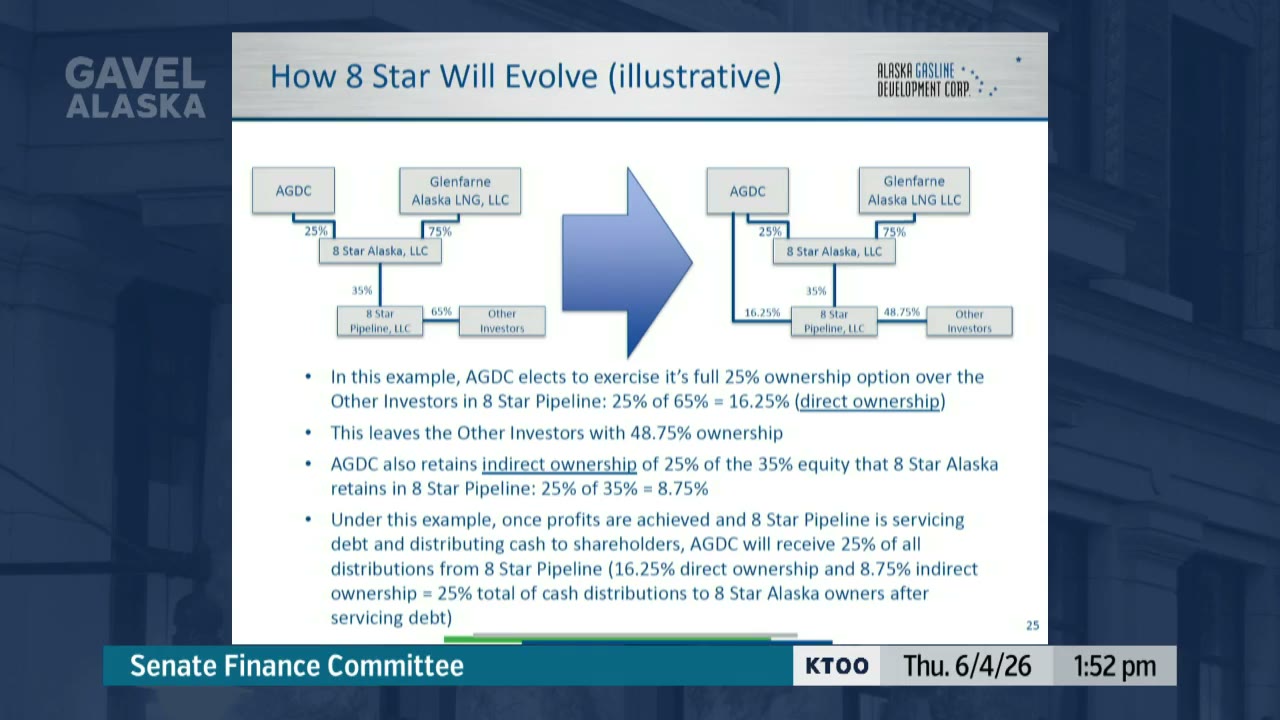
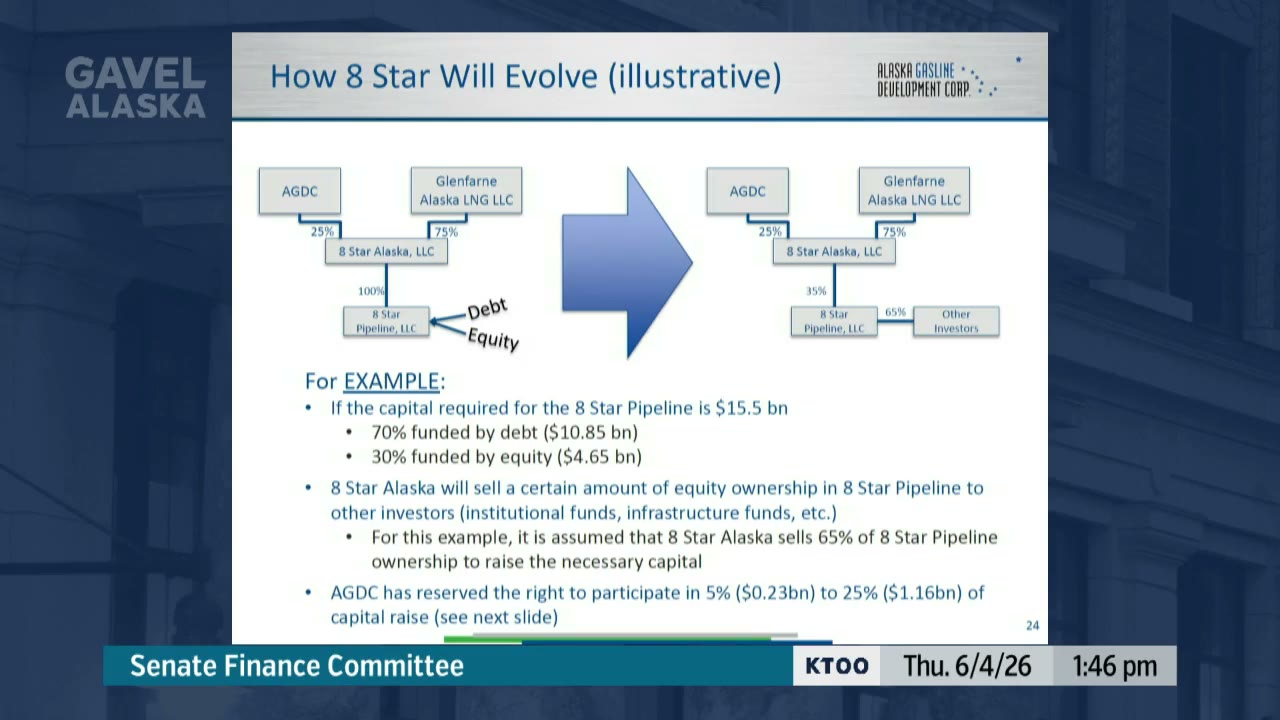
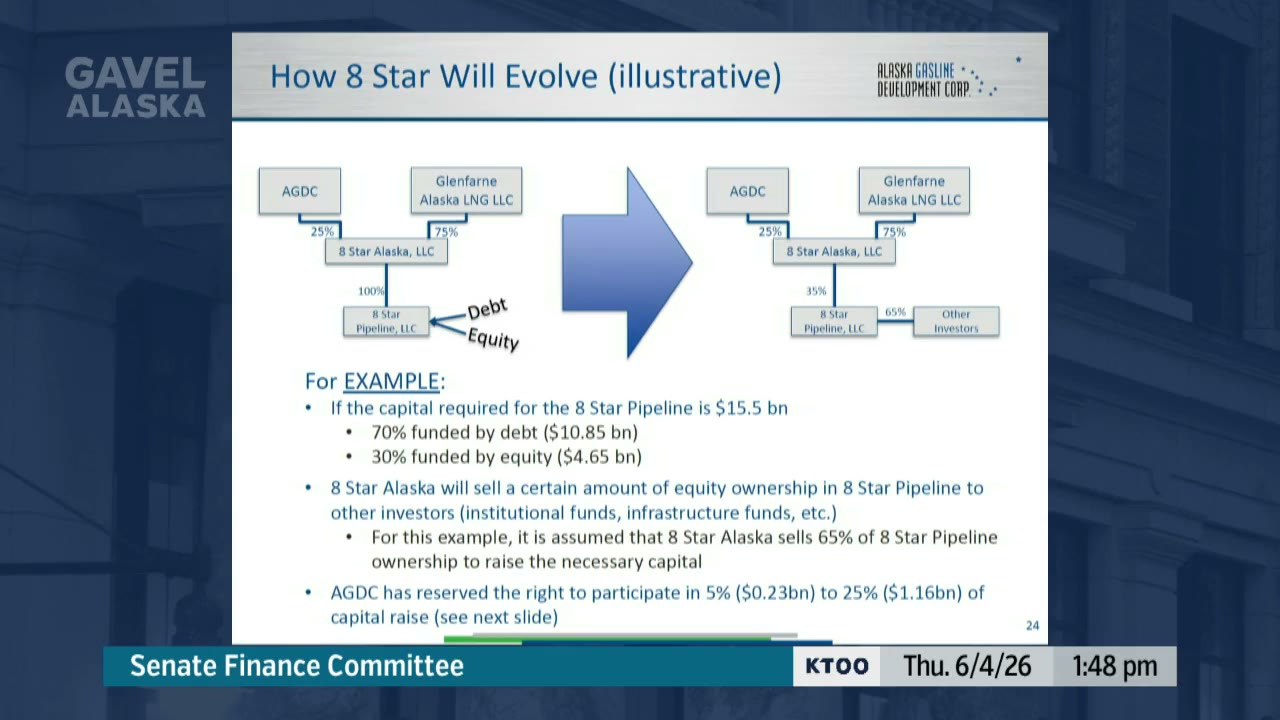
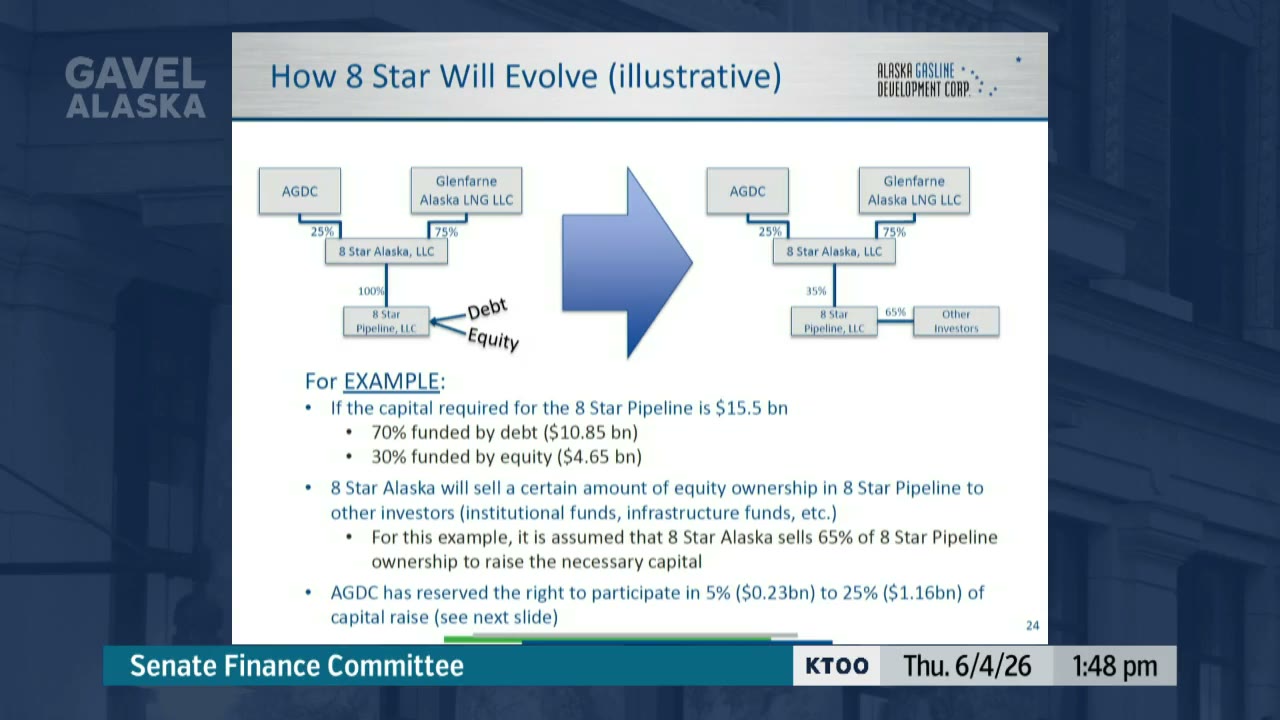
“in this example I've shown, AGDC elects to exercise its full 25% ownership option. So the 65% that the other investors selected or was issued to the other investors, we can back into 25% of that. So that's 16.25% of the total ownership of the project that we'd have direct. We still have our 25% of the carried 35% interest, which is another 8.75.”Alaska Legislature: Senate Finance - June 4, 2026 1:30pm · Jun 4, 2026
Frank Richards
“the key distinction we were trying to also reflect in this was that of the 65% equity that Glenn Farm would raise, that would be direct ownership. If we elected to take 25%. So that's direct ownership in the eight star pipeline and then the retained interest in the 35% is an indirect ownership stake. So no more money required for that.”Alaska Legislature: Senate Finance - June 4, 2026 1:30pm · Jun 4, 2026
Frank Richards
“the equity participation is an option, but it will be on the same terms as other equity investors. So no premium, no disadvantage being provided to AGDC for coming in under these preemptive rights.”Alaska Legislature: Senate Finance - June 4, 2026 1:30pm · Jun 4, 2026
Matt Kissinger
“AGDC will always get 25% of anything that goes into eight star Alaska.”Alaska Legislature: Senate Finance - June 4, 2026 1:30pm · Jun 4, 2026
Matt Kissinger
“these are preemptive rights. They're retroactive rights that get exercised once we achieve fid. So all the other investors come to the table.”Alaska Legislature: Senate Finance - June 4, 2026 1:30pm · Jun 4, 2026
Matt Kissinger
“during that 180 days, ideally we will kick off construction and be moving. But it's potential that these other investors who have the, you know, that have the potential to be preempted by us, that they're not going to want to expose themselves to too much risk during that 180 day period. And so it does behoove us to actually shorten that period, to be honest.”Alaska Legislature: Senate Finance - June 4, 2026 1:30pm · Jun 4, 2026
Matt Kissinger
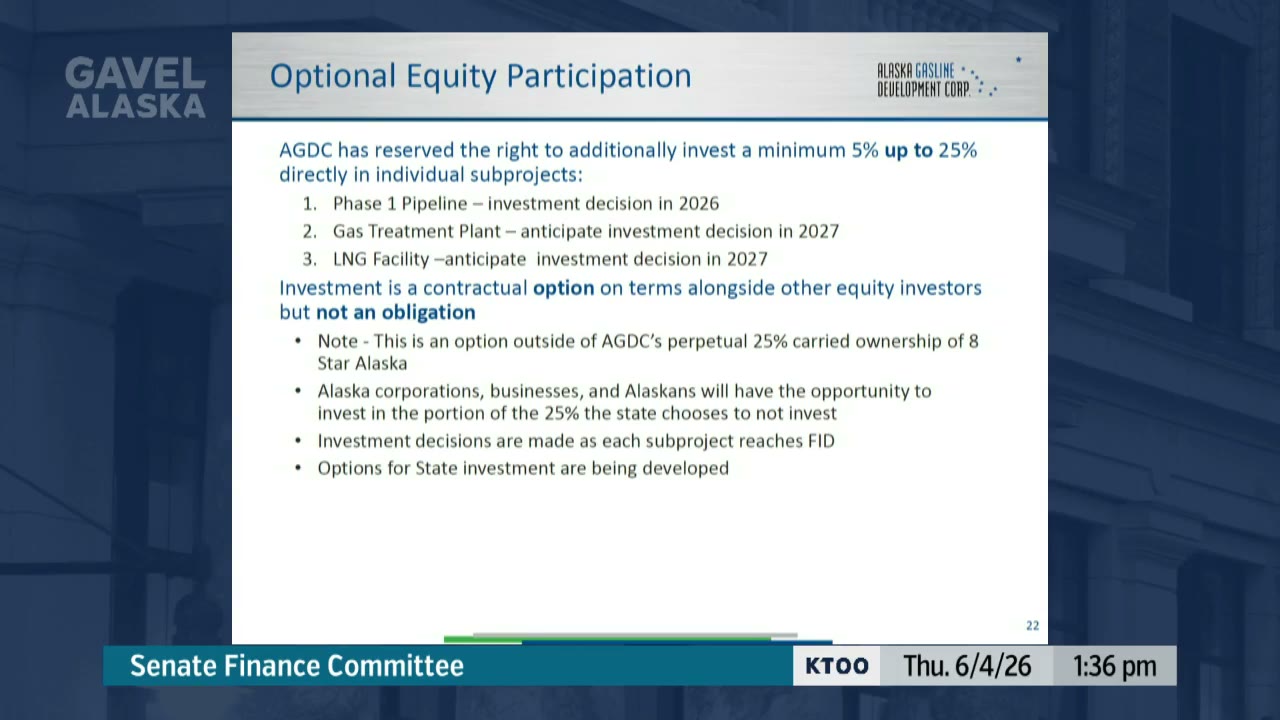
“AGDC has reserved the right to additionally invest directly into each of the sub projects at 5 to 25% of each equity raise that there is within those sub projects. Like we said, this is a contractual option, not an obligation.”Alaska Legislature: Senate Finance - June 4, 2026 1:30pm · Jun 4, 2026
Frank Richards
“What AGDC has reserved for the state and Alaskans is the opportunity after fidget to take up to 25% of the equity stake. And in this particular example we used the range of 5% or about 230 million up to 25% or about 1.16 billion.”Alaska Legislature: Senate Finance - June 4, 2026 1:30pm · Jun 4, 2026
Matt Kissinger
“they fill out the whole book of how much equity needs to be raised, and then they have to wait. They have to wait up to six months while we make a decision of whether we're going to back in and push them out of 25% of their investment, which is a real disadvantage to those investors. They have to tie up that capital with a slight bit of uncertainty.”Alaska Legislature: Senate Finance - June 4, 2026 1:30pm · Jun 4, 2026
Matt Kissinger
“we're 100% aligned with Glenfarn going through this process. Glenfarn's going to fight like mad to ensure the least amount of dilution of eight Star Alaska's ownership in eight Star pipeline as you go through that process. And then we just benefit by taking 25% of what they retain.”Alaska Legislature: Senate Finance - June 4, 2026 1:30pm · Jun 4, 2026
Matt Kissinger
“We do not include any of these developer economics in the department of Revenue Analysis. We don't include it in any of our own. But it is there and it is the reward that Glenfarn gets from the project. So Glenfarn enjoys 75% of that carried developer economics.”Alaska Legislature: Senate Finance - June 4, 2026 1:30pm · Jun 4, 2026
Frank Richards
“when the legislature created agdc, they also gave an exemption to any project that AGDC was working on that there would be no property taxes during construction. So what you hear from the developer is they're willing to pay a property tax, an alternative volumetric tax during construction.”Alaska Legislature: Senate Finance - June 4, 2026 10:00am · Jun 4, 2026
Frank Richards
“what I heard from Mr. Prestige yesterday is that, you know, they support paying the alternate volumetric tax again as it becomes responsibility of theirs to be able to do that. The real reason around this bill and the structure is around the cost of that payment in lieu of tax, I'll call it. But it's an alternative volumetric tax because the existing rates were so high.”Alaska Legislature: Senate Finance - June 4, 2026 10:00am · Jun 4, 2026
Matt Kissinger
“Developers have a habit of setting very aggressive FID dates and they do this because it's really the only way to drive everyone who's actually working on a project to a common target. But the knock on effect is it sets this unrealistic FID date out in the public and slowly credibility erodes.”Alaska Legislature: Senate Finance - June 4, 2026 10:00am · Jun 4, 2026
Frank Richards
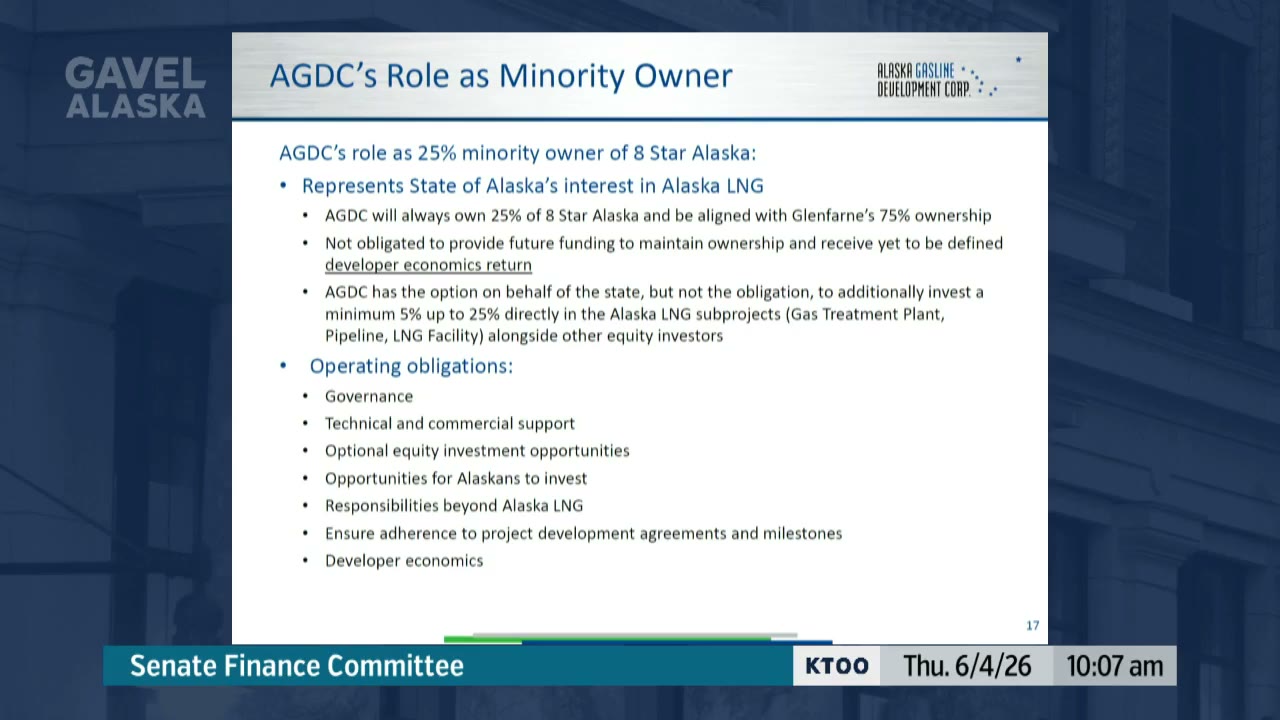
“we wanted this opportunity to acquire ownership if the State of Alaska through appropriate legislation would be available to us. And so we reserved that option. However, if that option does not proceed forward, there will still be some what we call developer economics returns. And as owner of HSTAR Alaska, because of the development cost that the State of Alaska through AGDC and now Glenn Farm working towards FID will have expended and want to have some return on the investment. So as Glenn Farm retains equity positions in any of the sub projects and has developer economics return coming up to them for fees to those sub projects, then AGDC without any more additional funding would receive 25% of those returns to the State of Alaska.”Alaska Legislature: Senate Finance - June 4, 2026 10:00am · Jun 4, 2026
Frank Richards
“we've reserved that for the for the legislature between 5 and 25% equity option is what we've reserved within our agreements with Glenn Farm. And the goal would be that the state of Alaska may not have to elect the full 25% if it chooses not to. Then that option will then be extended to Alaskans and Alaskan corporations.”Alaska Legislature: Senate Finance - June 4, 2026 10:00am · Jun 4, 2026
Lyman Hoffman
“I bring this up because that 180 day timeline makes much sense. But what triggers that timeline, to me it would make more sense when the legislature convenes that that clock would start ticking so that we would have ample time to make major decision on the amount of funds that the legislature may invest in.”Alaska Legislature: Senate Finance - June 4, 2026 10:00am · Jun 4, 2026
Jesse Kiehl
“The 5% minimum buy in, is that going to match all other potential equity investors? Is there any chance that anybody else gets in at 2%?”Alaska Legislature: Senate Finance - June 4, 2026 10:00am · Jun 4, 2026
Matt Kissinger
“that 2mil rate has since morphed into this alternative volumetric tax which we feel also brings a lot more alignment.”Alaska Legislature: Senate Finance - June 4, 2026 10:00am · Jun 4, 2026
Frank Richards
“my goal is that this project is able to reach a final investment decision for phase one sooner than that. It's really the opportunity that the developer talked to yesterday about what are those existing actions that must be undertaken to complete and have a final investment package, a decision support package that they would then make their decision on. Part of it is again around the property tax.”Alaska Legislature: Senate Finance - June 4, 2026 10:00am · Jun 4, 2026
Bert Stedman
“there is some other concerns that some of us have at the table when it's referenced to the state. You know, a lot of it's really easy to assume it come into the legislature, but there has been some interest in accessing other entities of the state if it's the Alaska Railroad, if it's ada, if it's a permanent fund. So there is concern on the structure and how that would be executed.”Alaska Legislature: Senate Finance - June 4, 2026 10:00am · Jun 4, 2026
Frank Richards
“the ownership structure of Eight Star Alaska is 75% Glenn Farm, 25% AGDC.”Alaska Legislature: Senate Finance - June 4, 2026 10:00am · Jun 4, 2026
Frank Richards
“This is the topic of discussion is really around the oil and gas property tax and what is truly going to allow this project to remain as an economic project that will move forward in this very competitive environment.”Alaska Legislature: Senate Finance - June 4, 2026 10:00am · Jun 4, 2026
Matt Kissinger
“the property taxes that we were faced with were about 10, 10 times higher than the next highest, which was Cove Point in Maryland we'd be looking at 600 to 800 million a year, possibly a billion a year once you factor in the potential risk of cost overruns. Whereas in LNG Canada I believe that they're paying somewhere around 27 million a year.”Alaska Legislature: Senate Finance - June 4, 2026 10:00am · Jun 4, 2026
Frank Richards
“once final investment decision is taken, we'll have 180 days to present the option to present the economics, the risks of inequity participation to the state of Alaska. So for an example, if there is a final investment decision in the fourth quarter, let's say the beginning of the fourth quarter quarter of this year, then that would start the 180 day clock to be able to provide the information to the legislature and to the Alaskans that would be interested in it”Alaska Legislature: Senate Finance - June 4, 2026 10:00am · Jun 4, 2026
Frank Richards
“it has been recognized really for decades that Alaska's oil and gas property tax rate is very high. And so we've looked through independent verification on where Alaska sits in comparison to other jurisdictions that have LNG projects. And so, so we've gone and we'll present some of that information today. But literally it is that Alaska is approximately 10 times higher than other jurisdictions in terms of our oil and gas property tax.”Alaska Legislature: Senate Finance - June 4, 2026 10:00am · Jun 4, 2026
Frank Richards
“Glenn Farm yesterday provided you with an updated Class 2 cost range. And I apologize, I don't have those in front of me, but it was in the 15 to 16 billion dollars range and that was at a class two cost estimate.”Alaska Legislature: Senate Finance - June 4, 2026 10:00am · Jun 4, 2026