Speaker B
58:52 - 60:04
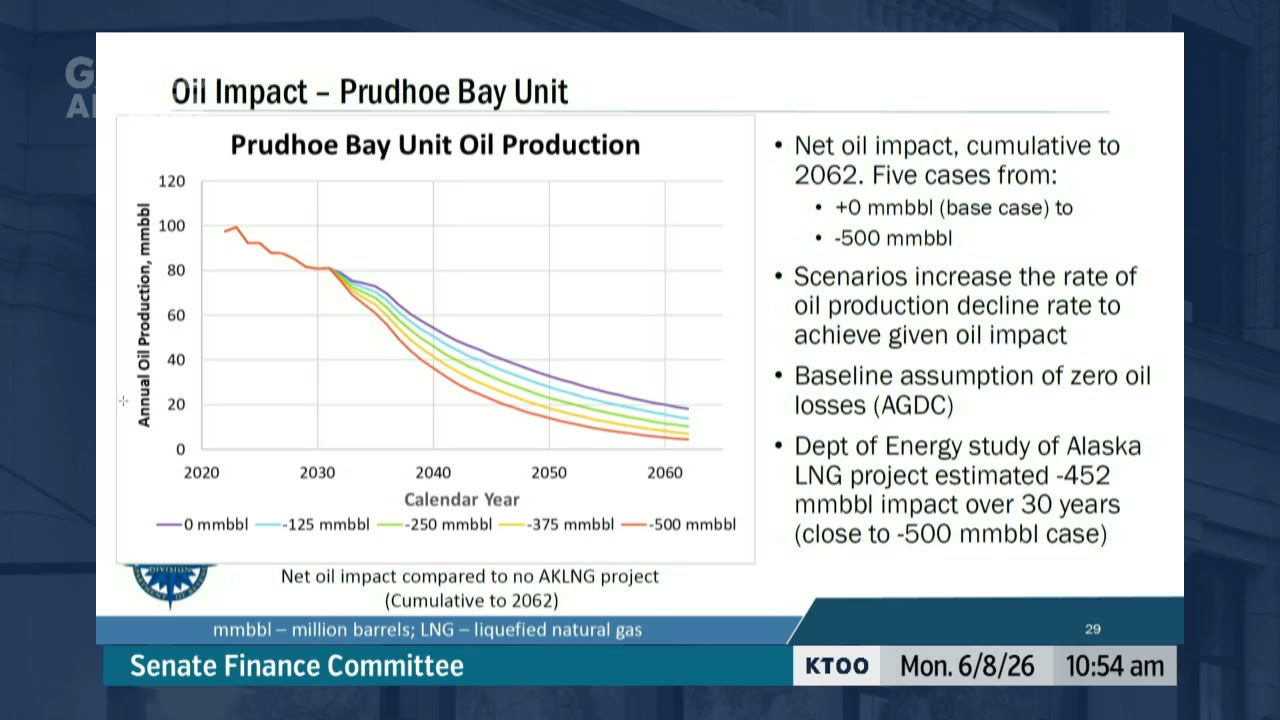
"there was a study that was presented in the Resources Committee where Department of Energy had estimated that the LNG project could reduce oil production from Prudhoe by a little over 450 million barrels total. And so that's where we developed the 500 as a nice round number to illustrate kind of a worst-case scenario there."
“there was a study that was presented in the Resources Committee where Department of Energy had estimated that the LNG project could reduce oil production from Prudhoe by a little over 450 million barrels total. And so that's where we developed the 500 as a nice round number to illustrate kind of a worst-case scenario there.”
- Speaker
- Speaker B
- Timestamp
- 58:52 – 60:04
- Community
- Alaska News
- Location
- Alaska
- Captured at
- June 8, 2026
From the transcript
So what this represents is the change in total So the lines show annual oil production that are assumed in the modeling, and then the 5 scenarios represent the total change to oil production cumulatively over the life of the AQLNG project. So on the top, in the, I guess, purplish line, is our baseline assumption for Prudhoe Bay oil production with no oil losses, and then we ran up to a 500 million barrels of oil losses in the red line, and then 3 intermediate scenarios as well. So there was a study that was presented in the Resources Committee where Department of Energy had estimated that the LNG project could reduce oil production from Prudhoe by a little over 450 million barrels total. And so that's where we developed the 500 as a nice round number to illustrate kind of a worst-case scenario there. And then again, the range of intermediate scenarios as well.
Related Coverage
Department of Revenue presents Senate Finance with Alaska LNG breakeven modeling across cost and tax scenarios
Department of Revenue modeling shows that if the Alaska LNG project costs $60 billion instead of the baseline $46.2 billion, the price needed to break even in global markets would jump by $1.60 per thousand cubic feet, significantly affecting project viability and the state's fiscal analysis of competing tax proposals.
 by Walter AlaskaNews3mo ago2 min readAI
Department of Revenue presents Senate Finance with 25-scenario sensitivity analysis on Alaska LNG fiscal impact
Alaska Department of Revenue modeling shows the Alaska LNG project could cost the state $16.2 billion through 2062 under worst-case production scenarios combining Prudhoe Bay oil losses with Point Thompson underperformance at $100 per barrel oil prices.
by Walter AlaskaNews3mo ago2 min readAI