Senate Education Committee Advances Opioid Awareness Bill, Hears Tribal School Compact Proposal
The Alaska Senate Education Committee moved forward Friday with legislation requiring opioid education in middle and high schools. The committee also heard the first presentation on a proposal to allow tribes to operate public schools under state-tribal compacts.
The committee advanced Senate Bill 228, which directs the Department of Education and Early Development to create an opioid abuse awareness and prevention curriculum for grades 6 through 12. Schools would teach the material during Red Ribbon Week, an annual drug prevention campaign.
Senator George Rauscher, the bill's sponsor, said the measure aims to intervene before tragedy strikes.
The committee adopted a substitute version that adds language directing the Alaska Department of Health to request funding from the state's opioid settlement steering committee within six months of the bill's effective date. Mike Mason, aide to committee chair Senator Löki Tobin, said the change came from committee members seeking uses for settlement money.
Senator Keele praised the prevention approach. "The legislature has done a lot of work on the criminal penalty side of the opioid epidemic that we have," Keele said. "This is a step in the prevention direction, and we have got to hit it from that angle too."
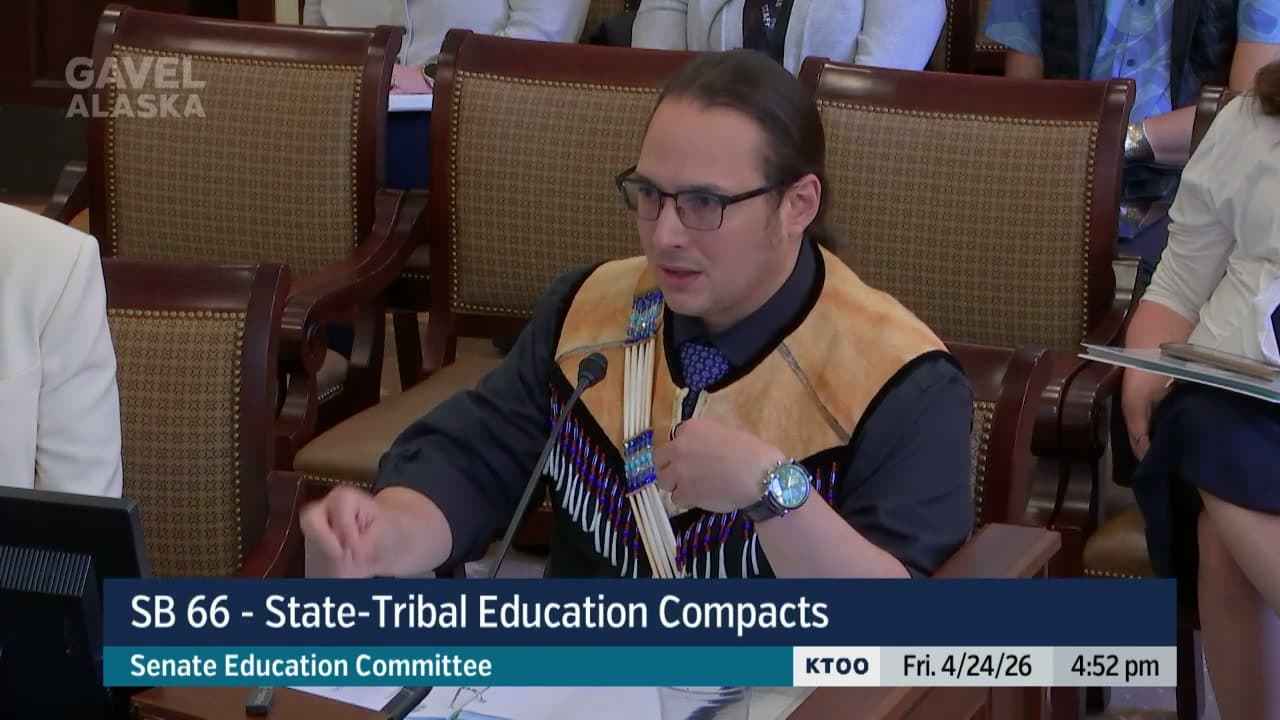
The committee then turned to Senate Bill 66, sponsored by Governor Mike Dunleavy to establish state-tribal education compacts. The bill would allow federally recognized tribes to operate public schools through government-to-government agreements with the state.
Commissioner Dena Bishop said the legislation would create opportunities for families, especially those in tribal communities, to stay engaged in public education in ways that reflect their values, cultures, and needs.
The proposal grew from work that began with Senate Bill 34, enacted in 2023 to authorize a demonstration project. Five tribal partners participated in negotiations with the state from April through December 2023. Each received grants for the compact negotiations: the Inupiat Community of the Arctic Slope, Central Council Tlingit and Haida Indian Tribes of Alaska, Ketchikan Indian Community, Knik Tribe, and a consortium of King Island Native Community and Native Village of Solomon.
Dr. Joel Isaac, the department's compacting consultant, explained that tribally compacted schools would function as school districts for funding purposes. They would receive money through the state's foundation formula based on student enrollment. The schools would remain public, open to all students, and funded with public dollars.
Teachers at these schools would need state licenses, but tribes would develop their own training and certification processes that the department would verify. "The tribe, because they are a sovereign state or sovereign government, the nation, they need to have a voice in that process for how they meet state law," Isaac said.
Committee members asked about testing requirements and accountability. Isaac confirmed that students would take the same standardized tests required of other public schools under federal and state law. The schools would use the state's Uniform Chart of Accounts for financial reporting and remain under State Board of Education oversight. Isaac said the schools would be part of Alaska's one statewide education system.
In response to questions about the 95 percent testing participation requirement under federal law, Isaac said tribal partners expressed strong interest in assessment data for their students. Commissioner Bishop noted the department is working to address testing logistics for all schools, including providing proctored testing options and additional funding for testing facilities.
Representative Chuck Kopp, who co-chaired the Alaska Education Challenge's tribal and community ownership workgroup, testified about current outcomes in some rural districts. He cited proficiency rates in the Northwest Arctic Borough School District at approximately 11 percent in English language arts and math, and about 7 percent in the Lower Kuskokwim. Kopp characterized these results as indicating systemic failures.
Kopp explained the voluntary nature of the compacts. "These compacts, as Dr. Isaac said, would be voluntary agreements between the State of Alaska and the tribes or tribally authorized organizations and they would allow participating communities to integrate cultural values, language, and locally defined measures of success into the education delivery while still meeting statewide standards," Kopp said.
Sonya Skan, education and training director for Ketchikan Indian Community, described her tribe's Tribal Scholars Program, which operates within the school district. The program serves 26 students this year and maintains a 100 percent graduation rate. Students often enter reading below grade level and reach or exceed grade level through culturally grounded instruction.
"We have data, we have our students and parents that will talk to every one of you and tell you that without our program, their kids would have dropped out, or worse," Skan said.
Sandra Kowalski, an Inupiaq educator and former director of indigenous programs at the University of Alaska Fairbanks, testified about her sons' experience at a tribally operated Inupiaq immersion preschool in Kotzebue in the 1990s. She later served as principal at June Nelson Elementary, where she observed strong outcomes for students who had attended the immersion school.
"If you can ground our Indigenous youth in their identity, they're going to be more successful," Kowalski said.
Kowalski suggested removing a provision in the bill requiring tribes to waive sovereign immunity. She argued the legislation should align more closely with the tribal health compacting model, which preserves sovereignty.
Senator Gary Stevens, who sponsored the 2023 demonstration project legislation, praised the work that led to the current proposal. "The fact that you have these 5 tribes out there working together, you know, I believe what Sandra said, it is not a race that you got to do it right, and you do it slow and make sure it is right," Stevens said.
The committee will hold a second hearing on Senate Bill 66 on Monday, when members will review a detailed sectional analysis and fiscal notes. Friday's presentation focused on the overview of how the bill was developed through the demonstration project process. The committee also plans to hear Senate Bill 232, which addresses personal collection of fossils.
The committee adjourned at 4:57 p.m.
This article is based on a public meeting — Alaska Legislature: Senate Education, 4/24/26, 3:30pm ().
AI-assisted. How we use AI Transcript byLucas Brown
Stay informed. Support what matters.
Free, permanent access to local news you can verify. Subscribe to support Alaska News and go ad-free.
Related Coverage
Alaska's tribal school compact bill navigates sovereignty and public education law
Alaska News · 5mo ago
Senate panel hears data center safeguards, tribal education bill
Alaska News · 5mo ago
Senate panel advances education bill with energy relief, loan program
Alaska News · 4mo ago
Murkowski moves to shield the offices funding Alaska Native and special education
Alaska News · 2mo ago
Senate Education Committee advances teacher loan repayment pilot program
Alaska News · 5mo ago
Comments
Sign in to leave a comment.
No comments yet. Be the first to share your thoughts.