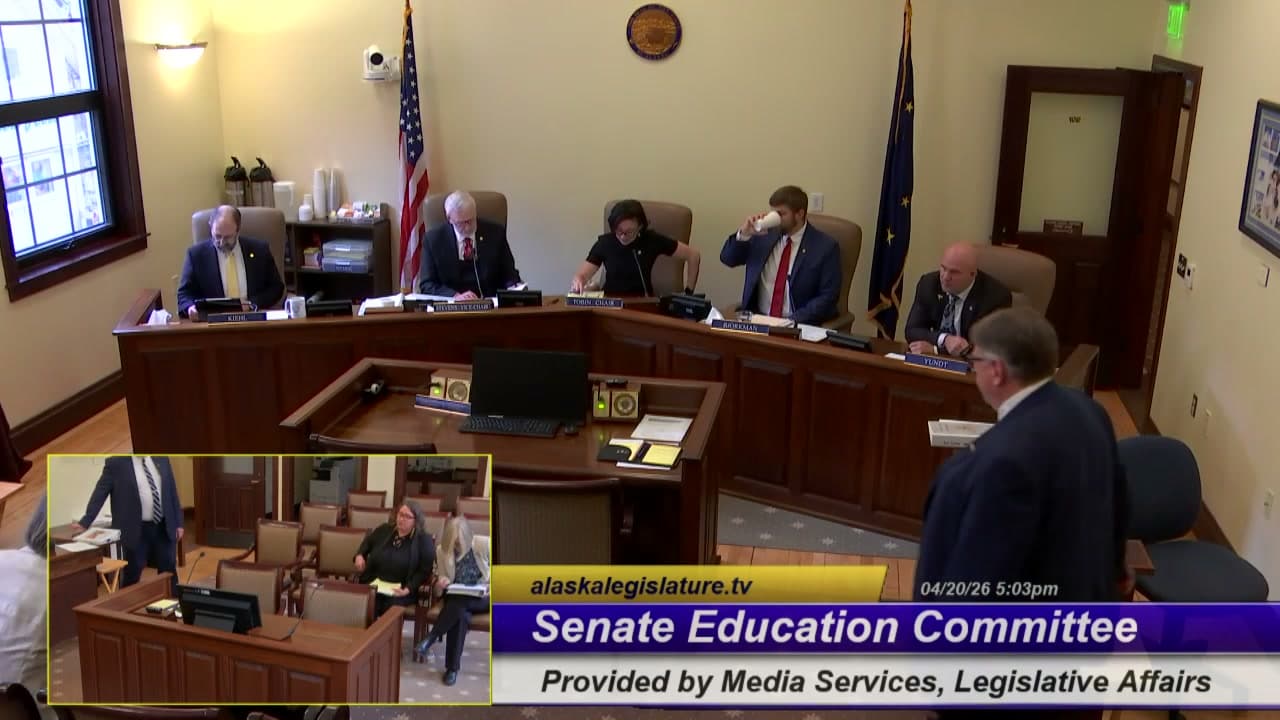
Senate Education Committee advances teacher loan repayment pilot program
The Alaska Senate Education Committee voted Monday to advance a bill creating a student loan repayment pilot program for public school teachers in high-need subject areas.
The committee adopted a committee substitute for House Bill 28 and moved the measure forward with individual recommendations. The bill targets teachers in special education, English as a second language, science, technology, engineering, and mathematics.
Under the program, the Alaska Commission on Postsecondary Education would award grants equal to one-third of a teacher's outstanding student loan balance each year, up to $5,000 annually for a maximum of three years. Teachers must first exhaust all other federal and state student loan repayment programs before qualifying.
Representative Andi Story, the bill's sponsor, thanked the committee for its work on the measure. "I wanted to thank you for your understanding of the importance of filling our significant teacher vacancies and recognizing how employer-sponsored student loan repayment programs have emerged as a top tool for recruiting and retaining workers in other states and can help with our teacher shortage here," Story said.
The House passed the bill on May 20, 2025, before it moved to the Senate. The committee substitute removed language that would have allowed state employees to participate in the program. It also eliminated a cap of 125 grant recipients that appeared in the original version, which proposed up to $24,000 in relief over three years at $8,000 annually.
Mike Mason, staff to Senator Lukey Gail Tobin, explained that the program would operate for three years and require a report to the legislature by December 31, 2028, on its effects on teacher recruitment and retention. The program would sunset on June 1, 2030.
The committee adopted Amendment 1, which increased per-pupil student transportation funding by 10 percent. The amendment also reduced a proposed one-time energy cost relief payment to school districts from $58.7 million to $43.87 million, subject to appropriation.
Story praised the transportation and energy provisions. "One of them, adjusting student transportation funding so districts will have funds for transportation and can focus their funds on the students. And their teachers. I think it's also really important the one-time school energy cost relief payment will also be extremely beneficial, I think, to help retain teachers and keep the focus on students," she said.
Mason said the amendment would remove conditional language from House Bill 57, passed in 2025, that tied reading proficiency grants and increased career and technical education funding to passage of a digital business tax. Removing that condition would allow approximately $9.7 million in career and technical education funding and $21.8 million in reading proficiency money to go forward for the FY27 school year.
The committee substitute also reinstates an annual reporting requirement for school districts to file details about their correspondence programs with the Alaska Department of Education and Early Development. The requirement mirrors a one-time report authorized in 2024.
Another provision allows students who leave correspondence study programs to retain textbooks, equipment, and curriculum materials, including items purchased through annual student allotments, if the materials are of a type students could keep when leaving a physical school.
The bill directs Legislative Budget and Audit to procure a study evaluating current education funding provisions and recommending changes or alternative funding methods, in consultation with the Institute for Circumpolar Health Studies at the University of Alaska Anchorage.
The measure also permits regional resource centers to hire retired educators.
After adopting the amendment, committee members expressed support for the changes. Senator Yunt said the amendment addressed his district's top priorities, including career and technical education funding, reading grants, and transportation. "These is my district's priorities right here. CTE, reading grants, transportation. Those were our top 3. And then obviously the one-time energy is something that we all desperately need right now," Yunt said.
Senator Bjorkman said he would continue to examine how the state handles increases to the required local contribution and its effect on state aid to districts. "I still am interested in looking and reassessing how we handle increases to the required local contribution and what that results in state aid to districts at the end of the education funding formula process. I'll be looking for that in additional versions of this bill," Bjorkman said.
Earlier in the meeting, the committee advanced House Joint Resolution 39, which urges the federal government to waive the $100,000 H-1B visa fee for individuals being hired as educators in Alaska. Representative Galvin sponsored the resolution, citing teacher recruitment challenges in the state. The committee reported the resolution with individual recommendations, an attached zero fiscal note, and legislative legal authority to make technical and conforming changes.
The committee voted to report House Bill 28, work order 34-LS0303/G as amended, from committee with individual recommendations and attached fiscal notes. The bill's effective date is July 1, 2026.
President Stevens made the motion to move the bill forward. No committee members objected.
This article is based on a public meeting — Alaska Legislature: Senate Education, 4/20/26, 3:30pm ().
AI-assisted. How we use AI Transcript byLucas Brown
Stay informed. Support what matters.
Free, permanent access to local news you can verify. Subscribe to support Alaska News and go ad-free.
Related Coverage
Senate Finance considers $1M teacher loan repayment pilot program
Alaska News · 4mo ago
Senate panel advances education bill with energy relief, loan program
Alaska News · 4mo ago
Alaska House passes education package with teacher loan repayment, energy relief
Alaska News · 4mo ago
Senate panel advances bill to stabilize Alaska school funding with enrollment averaging
Alaska News · 4mo ago
Alaska House panel advances free school meals for reduced-price students
Alaska News · 5mo ago
Comments
Sign in to leave a comment.
No comments yet. Be the first to share your thoughts.