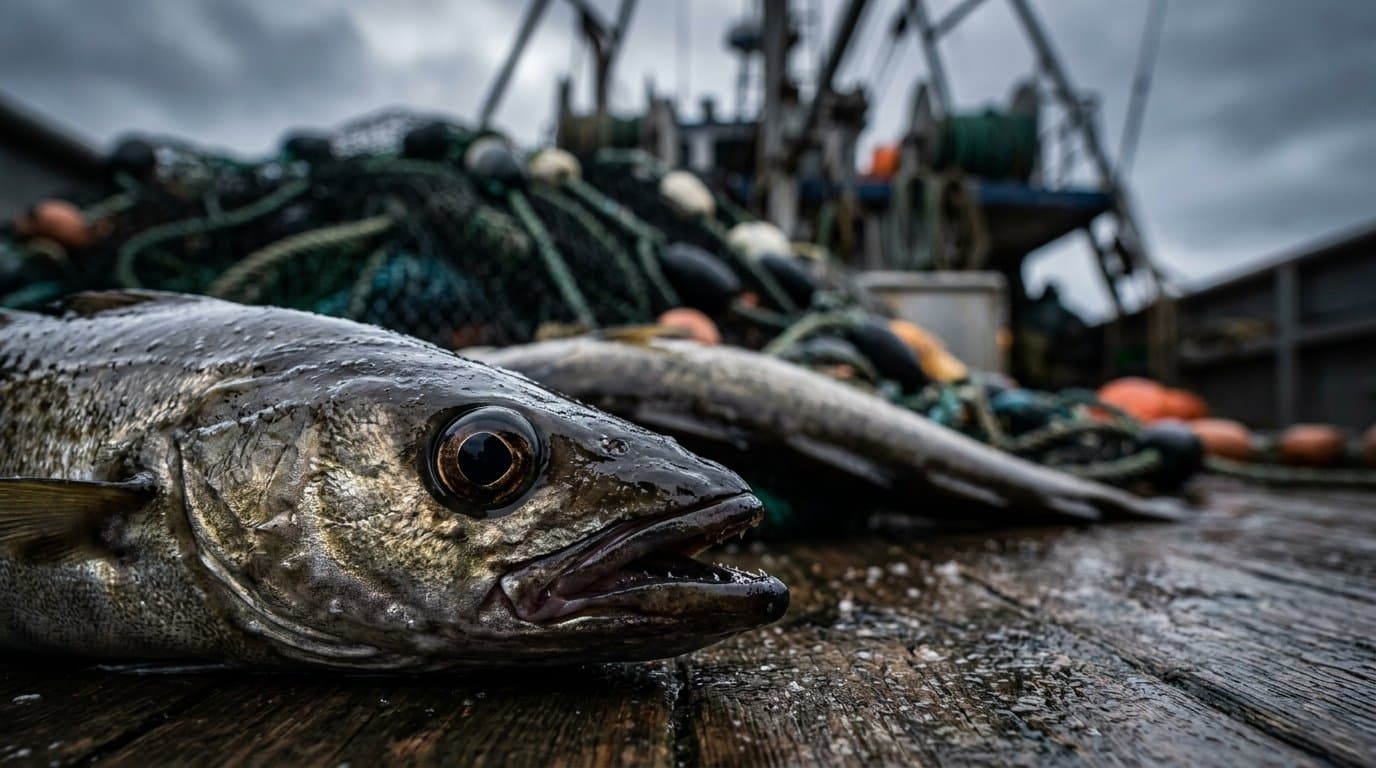
AI image
Scientists recommend a 7% lower Bering Sea pollock ceiling for 2027 as surveys find more fish
Federal scientists recommend cutting next year's catch ceiling for eastern Bering Sea pollock 7%, in an assessment posted Sunday, even though surveys found more fish.
The ceiling is the most the North Pacific Fishery Management Council may let the fleet catch. The council adopts 2027 catch limits in December. Bering Sea and Aleutian Islands pollock products had a first-wholesale value of about $1.47 billion in 2024, the assessment states. Federal rules set aside 10% of the Bering Sea pollock quota for Western Alaska community development quota groups.
The assessment, by James Ianelli of the Alaska Fisheries Science Center and seven co-authors, puts the 2027 ceiling, known as the acceptable biological catch, at 1,896,000 metric tons. It recommends 1,968,000 tons for 2028. The 2027 figure is about 140,000 tons below this year's 2,036,000 tons, which itself was down from 2,417,000 tons in 2025.
The ceiling is not the catch. The council adopts the quota, which cannot exceed the ceiling, and in every year since 2018 but 2022 the quota was lower, the assessment's catch history shows. This year's quota was 1,375,000 tons, later raised to 1,389,500 tons, and the fleet caught an estimated 1,312,505 tons. The recommended 2027 ceiling is still about 520,000 tons above this year's starting quota.
Federal rules cap the combined quotas of all Bering Sea and Aleutian Islands groundfish at 2 million metric tons, and the quotas for 2026 and 2027 are set at that cap. Those limits keep the 2027 pollock quota at 1,375,000 tons for now. Because the 2024 assessment set no 2027 ceilings, the council's Scientific and Statistical Committee temporarily set them equal to this year's figures. The final 2027 and 2028 limits, expected in December, will replace them.
In 2022 the ceiling and the quota were the same, both set at 1,111,000 tons.
The acoustic-trawl survey estimated 3.682 million tons of pollock in its core area, 28% more than in 2024. The bottom-trawl index for the eastern and northern Bering Sea rose to 9.034 million tons, up from 5.801 million tons in 2025.
The authors built this year's assessment, the first full one since 2024, on a new model. It sets the maximum fishing rate at 0.335, down from the 0.394 used for 2025 and 2026.
They rate the stock as not overfished. They estimate this year's female spawning biomass at 3.057 million tons, above the 2.155 million tons the assessment uses as a stand-in for the stock size that produces maximum sustainable yield. All four risk categories scored normal, so the authors recommend the maximum ceiling the rules allow.
The fleet had a mixed year. Fishing in the A season, which runs from January to June, appeared good, the authors wrote, but "Later in the B-season, fishing occurred farther north than normal, and pollock of desirable sizes were limited."
The Scientific and Statistical Committee reviews the recommendation Nov. 30 to Dec. 3. The full council meets Dec. 4 to 9 in Anchorage to adopt 2027 catch limits. Written comment is open until noon Nov. 27.
What did you make of this story? (no account needed)
Made by our human newsroom with AI. How humans and AI work here · Grow with our newsroom ·
Keep Alaska News free for everyone.
No paywall, ever. Members pay so everyone can read the meetings and records Alaska News covers.
Get Alaska News in your inbox
Create your free account and get the day’s top stories around 6 each morning, in a few minutes’ read.
Top stories, around 6 each morning.
Stories on what you follow, on Sundays.
Source: North Pacific Fishery Management Council meetings and documents, Final assessment recommends a 7% lower 2027 Bering Sea pollock ceiling, 1.896 million tons, even as surveys find more pollock.





Comments
Sign in to leave a comment.
No comments yet. Be the first to share your thoughts.