Alaska marks 50 years of regional education attendance areas
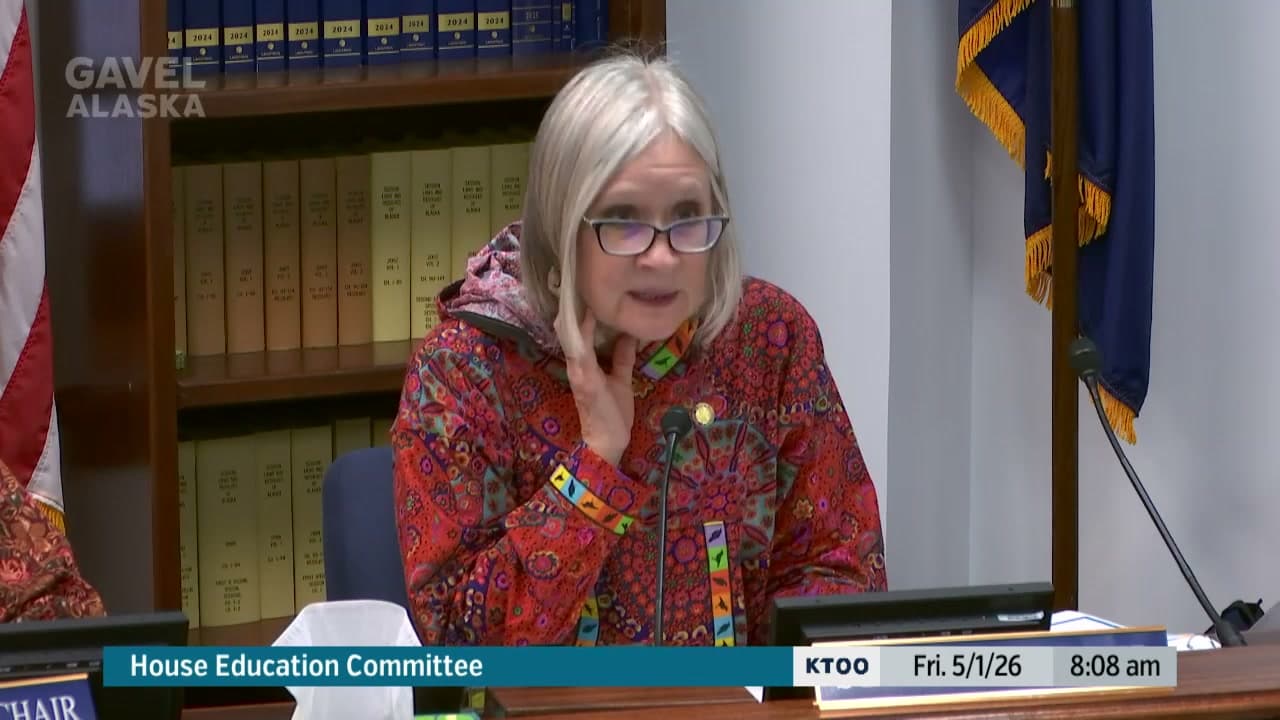
The Alaska House Education Committee marked the 50th anniversary of the state's Regional Education Attendance Areas on Friday. Former commissioners who helped create the unique governance structure testified about how it brought local control to rural schools.
Twenty-one REAAs were established in 1975-76 to provide education in Alaska's unorganized borough, where no local governments exist to levy taxes or operate schools. The districts serve roughly 15 percent of the state's students across more than half its land area.
Marshall Lind, who served as education commissioner for 13 years beginning in 1971, credited Alaska Native leaders with implementing the system within a single year. Byron Mallott of Yakutat and Roger Lang of Sitka led teams that worked with communities statewide to establish district boundaries aligned with Alaska Native Claims Settlement Act regional corporations.
"The only way this restructuring could be done would be to heavily involve the Alaska Native community," Lind said. "This was not something the state bureaucrats could easily do."
The REAAs replaced a patchwork system in which the Bureau of Indian Affairs operated most rural schools while the state ran schools on military bases and in some villages. Alaska's Constitution requires a public education system open to all students, but the state lacked the financial resources to fulfill that mandate until oil revenue began flowing in the early 1970s.
Lind said the legislature has failed to maintain its responsibility for REAA facilities as the assembly for the unorganized borough. Eight REAAs now own all their properties. The remaining 11 districts have a mix of state-owned and district-owned facilities.
"The legislature has clearly dropped the ball on serving as the borough assembly for the unorganized borough," Lind said. "If we do not maintain those facilities, we are doing the people in rural Alaska a major disservice."
Jerry Covey, who served as commissioner from 1991 to 1996, said the REAA system has graduated thousands of students who have contributed to Alaska's economy and communities. He noted that 23 states still operate Bureau of Indian Affairs schools serving Indigenous students.
"That move by the legislature and the subsequent action by Marshall and many people repositioned Alaska in a very effective way," Covey said.
Lori Weed, school finance manager for the Department of Education, told the committee that 19 REAAs currently operate in the unorganized borough alongside 19 boroughs and 14 cities with education powers. Two former REAAs, Rail Belt and Northwest Arctic, incorporated as boroughs.
REAA school boards consist of five to 11 elected members representing geographic sections within each district. The boards hire superintendents, set policies, and adopt annual budgets. Unlike municipal districts that raise local tax revenue, REAAs rely almost entirely on state aid through the foundation formula and federal grants.
Weed said REAAs receive higher per-student funding than municipal districts on average because they operate many small schools in remote areas. Those schools carry higher adjustment factors in the state funding formula. Capital funding for REAA facilities comes through competitive state grants rather than local bonds.
Lind said he opposed eliminating the state income tax. He suggested the legislature will need to increase revenue through taxation or reduce the Permanent Fund dividend to adequately fund education. He also recommended that Mount Edgecumbe High School, the state-operated boarding school in Sitka, be governed by an elected school board rather than the state.
The committee did not take action on any legislation related to REAAs.
This article is based on a public meeting — Alaska Legislature: House Education, 5/1/26, 8am ().
AI-assisted. How we use AI Transcript byLucas Brown
Stay informed. Support what matters.
Free, permanent access to local news you can verify. Subscribe to support Alaska News and go ad-free.
Related Coverage
Alaska passed a federal check that keeps its school funding system intact
Alaska News · 3mo ago
House Education Committee Advances Bill to Boost Residential School Funding
Alaska News · 6mo ago
Alaska House debates school transportation funding amid rural-urban divide
Alaska News · 5mo ago
Alaska residential schools seek doubled stipends to cover rising costs
Alaska News · 4mo ago
Alaska's tribal school compact bill navigates sovereignty and public education law
Alaska News · 5mo ago
Comments
Sign in to leave a comment.
No comments yet. Be the first to share your thoughts.