Alaska residential schools seek doubled stipends to cover rising costs
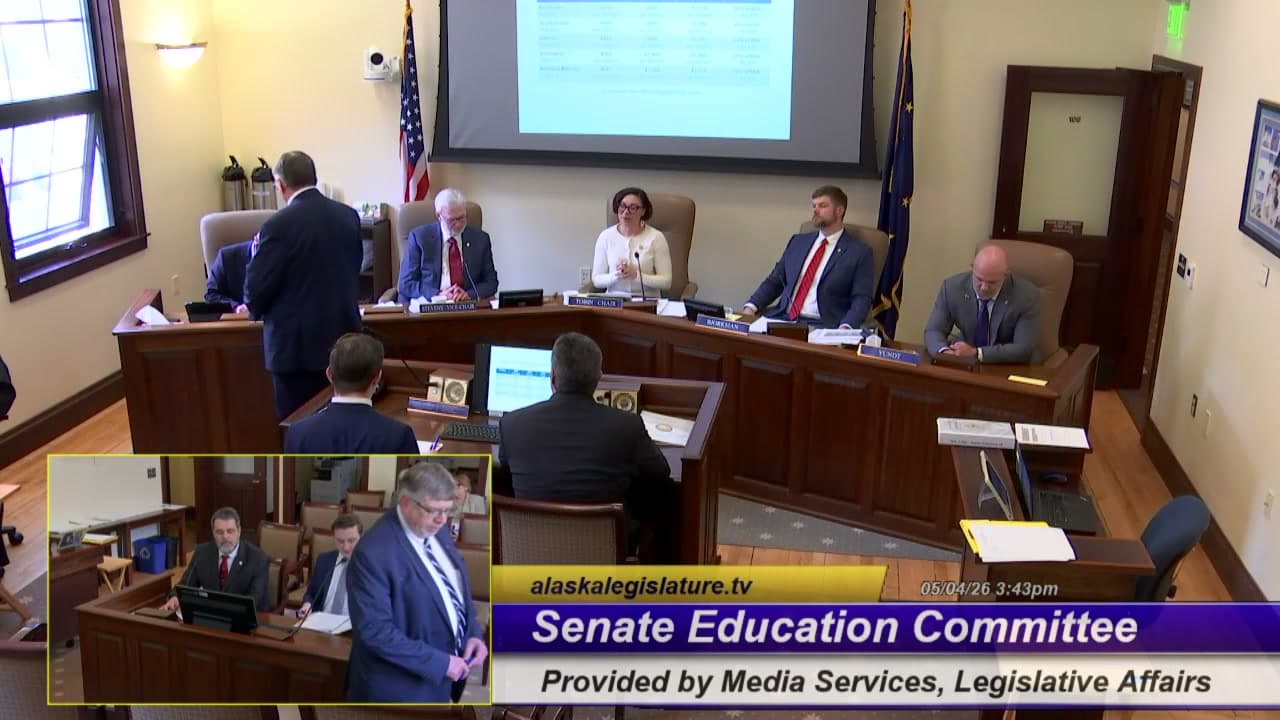
The Senate Education Committee heard testimony Monday on legislation that would double state funding for residential school programs serving rural Alaska students, addressing a gap that has forced districts to choose between cutting services and depleting reserves.
Senate Bill 257, sponsored by Senator Mike Cronk, would tie residential school stipends to percentages of the base student allocation and effectively double current funding levels. The bill aims to bring stipends closer to the actual cost of housing, feeding, and caring for students who leave their home communities to access educational opportunities unavailable in their villages.
Alaska's residential school stipend funding statute has remained unchanged since 2014, while the cost of taking care of kids has only gone up, Cronk said. Senate Bill 257 aims to bring the stipend much closer to what it actually costs to feed, house, and care for residential students by effectively doubling the current amount of the residential school stipend and tying it to various percentages of the base student allocation.
Residential programs currently receive about $12,900 per student annually in state stipends, roughly half the $25,700 actual cost to provide room, board, and wraparound services, according to audited data from the Alaska Residential Schools Coalition. Districts have covered the gap through grants, federal funding, and reserve drawdowns, but many of those sources are no longer available.
The funding squeeze comes as Alaska's broader budget crisis has limited state support for rural schools. Lawmakers budgeted only $40 million of the nearly $800 million that districts say is needed to fix and maintain schools. Since 1998, at least 135 rural school projects have waited for state funding for five years or more. Just under half of Alaska's rural schools are owned by the state, which is required by law to pay for construction and maintenance projects.
Conrad Woodhead, career and technical education director for Kuselbek Career Academy in the Lower Yukon School District, said residential schools were the only public school programs that lost funding in fiscal years 2025 and 2026 when one-time stipend increases expired.
Residential schools were also the only public school programs that lost funding in fiscal year 2025 and fiscal year 2026 when the 25 percent one-time stipend increases expired after those years, Woodhead said. So while the state continues to prioritize workforce development, the programs delivering that access to rural students at the K-12 level are operating behind.
Woodhead said Kuselbek Career Academy has served more than 500 students over seven years, filling more than 1,000 session slots. Students who attend the program have had a zero percent dropout rate over the last three years. Roughly 70 percent of the district's top academic performers have participated in one or more sessions.
The bill would tie stipends to the base student allocation, ensuring residential funding is considered whenever education funding is discussed. Since 2006, when the residential school stipend was created, the base student allocation statute has changed nine times while the residential stipend statute has changed only twice.
When the stipend is left out of the funding increases, districts have to pit funding their residential programs against funding their other brick-and-mortar charter or correspondence programs, Cronk said.
The push for increased residential school funding follows the May 2025 withdrawal of federal claims that Alaska's education funding formula was too generous to rural schools. The U.S. Department of Education dropped its maintenance of equity claims against the state, citing a misunderstanding of Alaska's hold harmless provision for districts experiencing enrollment drops.
Stephen Culkin, principal of Nenana City School and incoming superintendent of the district, said his district spent $2.4 million operating its residential program last year. That included $1.1 million on staff wages and benefits, $203,086 on building maintenance and utilities, and $178,300 on food services. The district received state stipend funding for roughly 70 percent of those expenses with one-time funding included, but that percentage will drop to about 50 percent now that one-time funding has sunset.
Culkin said residential advisors who tutor students in pre-calculus and counsel them through mental health crises start at just under $21 an hour. A Nenana student working as a shift manager at a Fairbanks McDonald's earns $24 an hour with benefits.
Doug Walrath, director of the Northwestern Alaska Career and Technical Center in Nome, said his program's per-student allocation has remained at $1,776 per month since 2014 while costs have doubled. The daily student per diem rate for meals alone is now $60, which would total $46,800 per month for 26 students. That is $624 more than the current monthly allocation of $46,176.
Residential programs serve students from more than 40 communities statewide, providing access to career and technical education, Advanced Placement courses, and dual credit programs that prepare students for the workforce, military service, or post-secondary education.
If we are serious about workforce development in Alaska, we have to be serious about K-12 as the foundation of that workforce and about making sure all students have access to it, Woodhead said. For a large portion of the state, that access requires residential programs.
Lori Weed, school finance manager for the Department of Education and Early Development, said the fiscal note for Senate Bill 257 would increase total fiscal year 2027 funding to $18.05 million, an increase of $8.74 million over the governor's requested budget of $9.3 million. The bill includes an immediate effective date, which would require a supplemental appropriation of $6.27 million.
The committee held the bill for a future meeting. Chair Gail Tobin said members who wish to offer amendments should work with the bill sponsor and her office.
This article is based on a public meeting — Alaska Legislature: Senate Education - May 4, 2026 3:30pm ().
AI-assisted. How we use AI Transcript byLucas Brown
Stay informed. Support what matters.
Free, permanent access to local news you can verify. Subscribe to support Alaska News and go ad-free.
Related Coverage
Residential Schools Seek Doubled Funding Tied to Base Allocation
Alaska News · 5mo ago
House Education Committee Advances Bill to Boost Residential School Funding
Alaska News · 6mo ago
Senate panel advances bill to stabilize Alaska school funding with enrollment averaging
Alaska News · 4mo ago
Alaska House debates school transportation funding amid rural-urban divide
Alaska News · 5mo ago
Senate panel approves $441 million education budget with teacher incentives
Alaska News · 5mo ago
Comments
Sign in to leave a comment.
No comments yet. Be the first to share your thoughts.