Senate panel proposes doubling Dalton Highway surcharge in gas line bill
The Senate Resources Committee introduced a new version of the governor's gas pipeline bill Tuesday with a 30-cent Dalton Highway maintenance surcharge, double what the administration proposed.
The committee substitute for Senate Bill 280 changes the governor's proposed 15-cent-per-barrel oil surcharge to 30 cents to maintain the remote highway critical for Alaska oil field access. The committee held its 24th hearing on the bill since receiving it March 20.
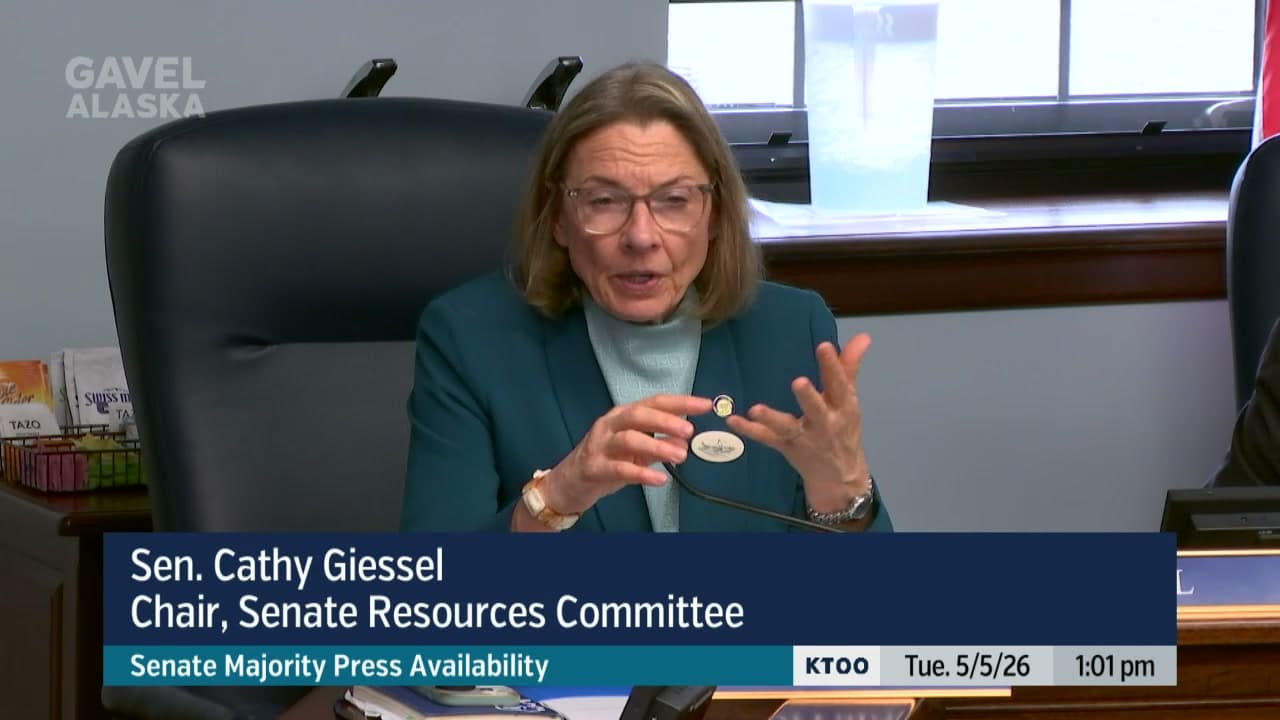
"This particular version has added a Dalton Highway maintenance surcharge," said Senator Cathy Giessel, who chairs the Resources Committee. "The surcharge idea came from the governor in a tax bill that he put forward to us. He had proposed 15 cents per barrel of oil going through TAPS. We have changed that a little bit to 30 cents to be used to maintain the road."
The new version also adds legislative oversight provisions for the Alaska Gasline Development Corporation and includes a failure contingency that would sunset many of the bill's policies if the project does not reach commercial operation.
Senators questioned the value of the governor's proposed $1 billion in property tax cuts for the pipeline, calculating the breaks would save an average Anchorage household only $55 annually while costing the state roughly $500 per person in lost revenue.
"The billion dollars in property tax cuts that the people of Alaska are being asked to give by the governor, it does not really help the project go forward," Senator Bill Wielechowski said. "What it really does is, according to the testimony we heard this morning, it lowers the amount that the people of Alaska, well, in South Central anyway, and hopefully Fairbanks, will pay for their natural gas."
Wielechowski said the Department of Revenue estimates the $1 billion in property tax cuts would reduce natural gas costs by 43 cents per thousand cubic feet. With the average Anchorage household using about 128 thousand cubic feet annually, that translates to $55 in savings.
"The average Alaskan is being asked to give up $500 roughly in state revenue for $55 per household in savings," Wielechowski said.
Senators said testimony at Tuesday's hearing indicated the project could proceed without the legislation. The Alaska Gasline Development Corporation has federal permits and authorization from the Federal Energy Regulatory Commission to move forward under existing property tax law.
"We heard again this morning that we do not need to pass a bill for this project to go forward. They can go forward right now," Wielechowski said.
Giessel said the committee has struggled to get concrete cost estimates from the Alaska Gasline Development Corporation despite 24 hearings. The committee plans to hear Department of Revenue modeling of the new committee substitute Monday.
"The main point here is that we are not able to get the real numbers," Giessel said. "You heard us ask Glenn Farn this morning, tell us what each of the components will cost, and they were very reluctant to even give us ballpark numbers."
Wielechowski said Department of Revenue projections show phase one of the project would result in natural gas costs of $23 to $30 per thousand cubic feet in South Central Alaska, compared to current costs of $10 to $13. He said producers stand to make an 83 percent rate of return on gas sales according to the governor's office.
"Why are the people of Alaska the only ones being asked to forego a billion dollars in our revenue and not the producers who stand to make an 83 percent rate of return according to the governor's office," Wielechowski said.
Senator Gary Stevens, whose Kodiak district would not be served by the pipeline, said the rail belt's energy future affects the entire state.
"I am very concerned about what happens to the rail belt where over half of our population, enormous part of our population, will be affected by what happens with this gas line," Stevens said. "So I am really anxious to see us find an answer, but I am also concerned about several steps along the way."
The committee has met with the Alaska Oil and Gas Association, the Resource Development Council, and the Alliance, incorporating their input into the current version. Giessel said the committee will consider further modifications based on Tuesday's testimony from the Alaska Gasline Development Corporation.
With two weeks remaining in the legislative session, senators acknowledged the bill may not reach final passage before adjournment. The governor could call a special session to continue work on the measure.
This article is based on a public meeting — SMAJ-20260505-1250 ().
AI-assisted. How we use AI Transcript byLucas Brown
Stay informed. Support what matters.
Free, permanent access to local news you can verify. Subscribe to support Alaska News and go ad-free.
Related Coverage
Senate panel doubles oil surcharge for Dalton Highway maintenance in gas pipeline bill
Alaska News · 4mo ago
Senate unveils gas pipeline bill with $600M property tax, consumer protections
Alaska News · 5mo ago
Alaska Senate panel hears gas line bill with $900M annual tax break
Alaska News · 4mo ago
Senate panel advances gas pipeline bill with reduced community payments
Alaska News · 4mo ago
Senate panel examines regulatory questions on gas pipeline tax plan
Alaska News · 5mo ago
Comments
Sign in to leave a comment.
No comments yet. Be the first to share your thoughts.