Senate panel examines regulatory questions on gas pipeline tax plan
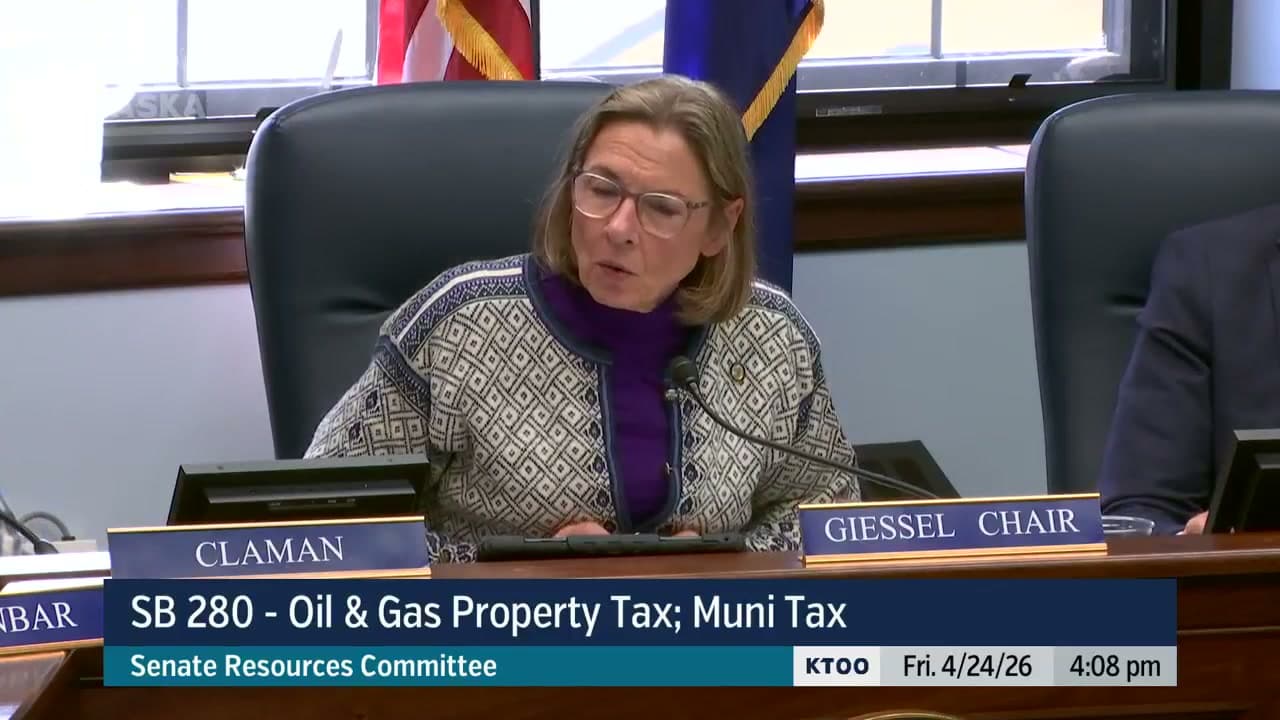
The Alaska Senate Resources Committee on Friday examined complex questions about regulatory jurisdiction and tax structure for a proposed natural gas pipeline project. Members probed whether federal or state authorities would oversee different phases of construction.
The committee heard testimony from Nils Andreesen, executive director of the Alaska Municipal League. He said local governments want the ability to negotiate directly with project developers. Andreesen said the original version of Senate Bill 280 went too far in restricting municipal revenue authority. The current committee substitute may have overcorrected in the opposite direction.
"There is probably a sweet spot in the middle that gets to a project that is economic and ensures some benefit to Alaskans," Andreesen said.
Bill creates alternative tax structure
The bill would create an alternative tax structure for what it defines as qualified property. That means an Alaska liquefied natural gas project and related infrastructure owned or financed by a state instrumentality. Under the proposal, the property would be exempt from state and municipal taxes during construction. It would remain exempt during a ramp-up period after commercial operations begin.
Once the pipeline reaches throughput of 1 billion cubic feet per day or after 10 years, whichever comes first, an alternative volumetric tax of 6 cents per 1,000 cubic feet would replace traditional property taxes. That rate would increase by 1 percent annually.
Questions arise over regulatory jurisdiction
Committee members questioned whether the Federal Energy Regulatory Commission or state regulators would have jurisdiction over a pipeline that initially operates only within Alaska. The project envisions a two-phase approach. First, builders would construct an 807-mile pipeline from the North Slope to Southcentral Alaska. Later, they would add a liquefaction facility in Nikiski for exports.
Frank Richards, representing a project participant, said FERC approved the project in 2020 as an integrated system including the pipeline, gas treatment plant, and export facility. He said FERC recognized the construction would occur in phases and is now considering an implementation plan for phase one.
"FERC knew that the construction execution was going to be done in various phases based on the components," Richards said.
But Senate Majority Legal Counsel Sonja Kawasaki said it remains unclear whether FERC has jurisdiction over a pipeline that would operate for years as an intrastate facility before any export capability exists. She said the Regulatory Commission of Alaska indicated in written responses that FERC has not considered the scenario of only phase one being built.
The RCA's written response noted that in cases where an interstate pipeline connects to an international pipeline, FERC may cede jurisdiction over the intrastate portion to state regulators. The response said FERC has almost invariably done so, typically ceding authority over all but about 1,000 feet of pipeline near the border crossing.
Legislative approval provisions discussed
Committee members also discussed provisions in the bill requiring legislative approval for certain agreements with foreign entities, including gas purchase agreements. Kawasaki acknowledged that provision could face legal challenges based on federal authority over international commerce.
Municipalities seek project benefits
Andreesen said municipalities along the pipeline corridor want assurance that the project will deliver benefits to Alaska communities. He said local officials need more detailed modeling of what final energy costs would look like for residents and businesses.
"What I have heard is the need for more information. If the numbers have been presented, I have not seen them as fully developed as local governments are hoping for," Andreesen said.
The committee heard concerns about potential gas price increases during phase one. One member noted that Southcentral Alaska currently pays roughly $10 to $12 per thousand cubic feet for gas. The project developer has indicated phase one could result in prices of $16 to $18, a 60 to 80 percent increase.
Andreesen said the Alaska Municipal League passed a resolution in December stating that municipalities want to negotiate individually with project developers. He said the original bill version was inconsistent with that resolution. The current version moves in a better direction by allowing more local control.
Tax revenue allocation outlined
The bill would allocate the alternative volumetric tax revenue between municipalities and the state based on where the pipeline is located. Revenue from portions in the unorganized borough would go to the state general fund. The Department of Revenue would develop regulations for the allocation methodology.
Andreesen said local governments can negotiate payment-in-lieu-of-tax agreements with project developers without new legislation. State law would be needed for the state to negotiate away its own taxing authority.
The committee will continue discussion of Senate Bill 280 on Monday, April 27, when the Department of Revenue is scheduled to testify. The Legislature has less than 30 days remaining in the current session.
This article is based on a public meeting — Senate Resources Committee ().
AI-assisted. How we use AI Transcript byLucas Brown
Stay informed. Support what matters.
Free, permanent access to local news you can verify. Subscribe to support Alaska News and go ad-free.
Related Coverage
Senate panel debates gas pipeline tax structure in 26th hearing
Alaska News · 4mo ago
Senate panel weighs municipal concerns over Alaska LNG tax structure
Alaska News · 4mo ago
House Finance begins review of Alaska LNG tax bill with competing rate proposals
Alaska News · 4mo ago
House panel hears gas line tax bill with 15-cent volumetric fee
Alaska News · 4mo ago
House panel hears tax proposal for Alaska LNG project
Alaska News · 4mo ago
Comments
Sign in to leave a comment.
No comments yet. Be the first to share your thoughts.