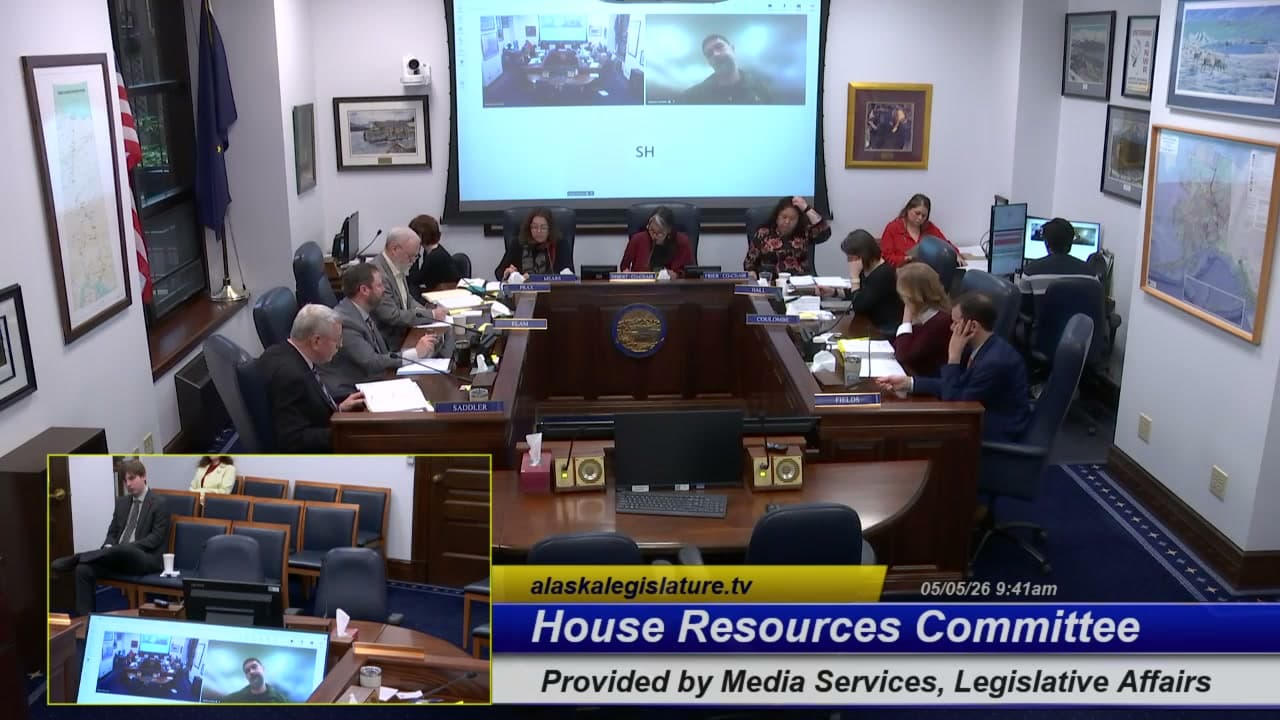
The House Resources Committee heard Tuesday from the Department of Revenue on a proposal to exempt the Alaska LNG project from most property taxes in exchange for a lower alternative tax tied to gas volume.
House Bill 381 would exempt the entire project from state property taxes. That includes the gas treatment plant, pipeline, and LNG facility. The pipeline would also be exempt from municipal property taxes. In place of those levies, the bill would impose a 15-cent per thousand cubic feet volumetric tax on gas moving through the pipeline, beginning with first commercial production.
Dan Stickel, chief economist with the Department of Revenue, said the core purpose is to create a framework for exempting the Alaska LNG project from state property tax and potentially from some municipal property tax, then provide an alternative mechanism for receiving revenue from that project.
Under current law, if the project were to proceed, state and municipal property taxes would total about $50 million in 2029. That would ramp up to nearly $500 million by 2033 for the gas treatment plant and LNG facility alone. State property tax on the pipeline would add another $244 million by 2033, Stickel said.
"You add these two numbers up and in 2033 we are looking at a total property tax burden if the project were to go forward of nearly $750 million per year," Stickel said. "And so that is the burden that is being reduced through this legislation."
The alternative volumetric tax would generate about $10 million in 2029, increasing to nearly $200 million by 2033 when full export operations are underway, Stickel said. About 81 percent of that revenue would be shared with municipalities. Half would be distributed proportionally along the pipeline route based on miles of pipe. Half would be distributed to all communities statewide on a per capita basis. The state would retain the unorganized borough portion of the mileage-based share, resulting in unrestricted general fund revenue of $2 million in 2029, rising to $37 million in 2033.
The bill sets eligibility conditions for the tax relief. The project developer must commit to entering into community benefit agreements with every community within 50 miles of the project. The developer must set aside a portion of project revenue for community impact payments, enter into a project labor agreement, and commit to construction of a Fairbanks spur line before full export operations begin.
Representative Dan Saddler said what the committee hears clearly from project managers and developers is that the project will not proceed without tax modifications. "So to my mind, calculating what the revenue might go to municipalities and the state without tax modifications is hypothetical and not that useful," Saddler said. "We are not forgoing this money. It will not happen without the tax modifications."
The Department of Revenue's modeling shows the bill would reduce the in-state cost of gas to $4.76 per thousand cubic feet in 2033, compared to $4.86 under current law. The breakeven price for LNG delivered into the global market would drop from $9.07 to $8.96 per thousand cubic feet. Current futures market prices for global LNG looking out to 2033 are in the $8 to $9 per thousand cubic feet range, Stickel said.
Representative Donna Mears asked for clarification on the tiered tax structure in the current version of the bill, which imposes 5 cents per thousand cubic feet on gas moving through the treatment plant, 5 cents on the pipeline, and 10 cents on the LNG facility. Co-Chair Freer said the 15-cent flat rate Stickel presented is based on an amendment the committee will consider later, not the current bill language.
The bill would allow municipalities to exempt the gas treatment plant and LNG facility from property tax by passing a local ordinance. If they do, they may negotiate for an ownership interest in lieu of property tax. The North Slope Borough and Kenai Peninsula Borough can opt for an equity stake proportional to forgone taxes instead of receiving alternative volumetric tax revenue. There is no alternative volumetric tax for the treatment plant or LNG facility in this version of the bill. The exemptions would repeal if commercial operations do not commence prior to 2030.
Stickel said the bill before the committee is a smaller tax reduction than the bill as proposed by the governor. Governor Mike Dunleavy introduced the legislation in January proposing to replace property tax with a volumetric tax of 6 cents per thousand cubic feet after a ramp-up period, with exemptions during construction and ramp-up to 1 billion cubic feet per day or 10 years. The House Resources Committee adopted a committee substitute in late April that narrowed the exemptions, raised the volumetric tax to 20 cents per thousand cubic feet split across project components, and added conditions including construction of a Fairbanks spur line and community benefit agreements. The alternative volumetric tax on the pipeline is higher than what the governor had proposed for the alternative volumetric tax on the entire project. The gas treatment plant and LNG facility remain subject to municipal property tax.
The Department of Revenue is requesting four positions to implement the bill. That includes an additional appraiser for property tax work, a tax auditor to administer the new alternative volumetric tax, an oil and gas revenue specialist, and a commercial analyst. The department is also requesting $500,000 in capital funding for contract work to implement the provisions in its tax revenue management system.
The committee will take up amendments to the bill Tuesday afternoon.
This article is based on a public meeting — HRES-260505-0800 ().
AI-assisted. How we use AI Transcript byLucas Brown
Stay informed. Support what matters.
Free, permanent access to local news you can verify. Subscribe to support Alaska News and go ad-free.
Related Coverage
House panel hears gas line tax bill with 15-cent volumetric fee
Alaska News · 4mo ago
House Finance begins review of Alaska LNG tax bill with competing rate proposals
Alaska News · 4mo ago
Energy consultant: Alaska LNG tax bill could cut delivered cost by 20 cents
Alaska News · 5mo ago
House Resources gas line bill would cost municipalities $13B under governor's plan
Alaska News · 4mo ago
Alaska LNG tax bill ties $26.5B in revenue to volume, not value
Alaska News · 3mo ago
Comments
Sign in to leave a comment.
No comments yet. Be the first to share your thoughts.