House Finance begins review of Alaska LNG tax bill with competing rate proposals
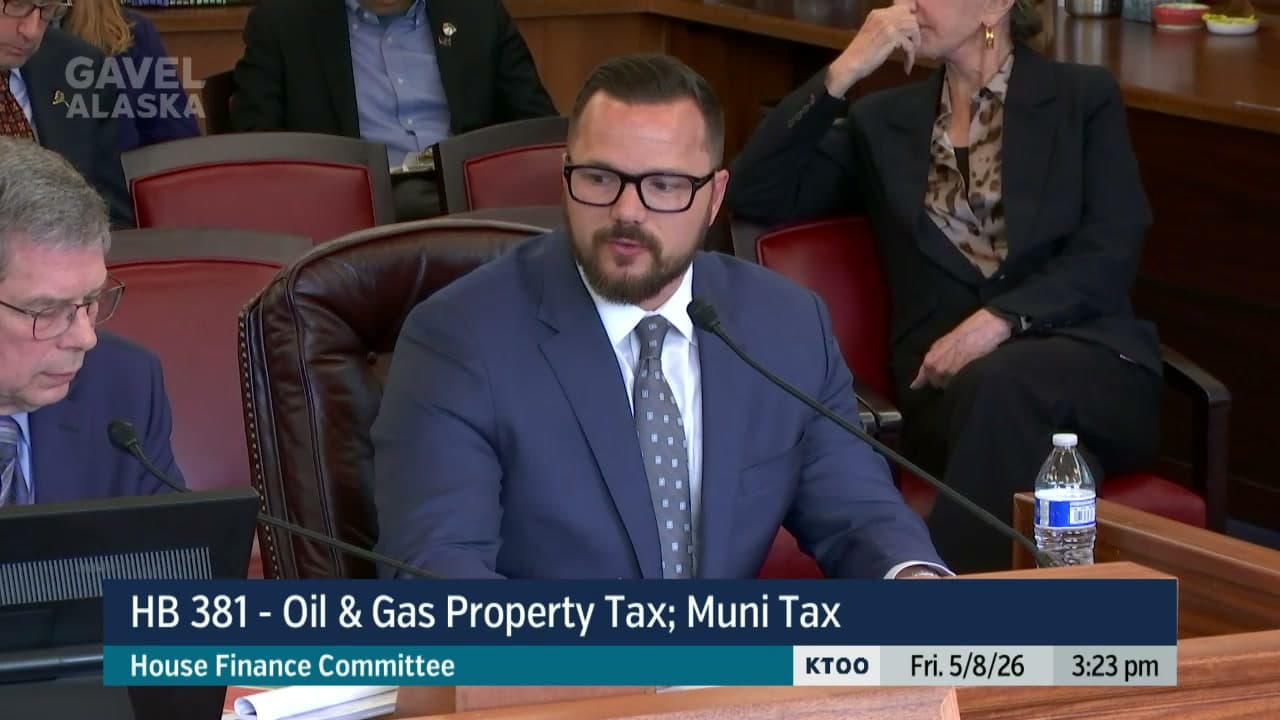
The House Finance Committee on Friday began reviewing legislation that would fundamentally change how Alaska taxes a proposed natural gas pipeline from the North Slope. Competing proposals would have different revenue effects for the state and local governments.
The bill would replace traditional property taxes on the Alaska LNG pipeline with an alternative volumetric tax based on gas throughput. The House Resources Committee version proposes 15 cents per thousand cubic feet. The administration's original proposal called for 6 cents.
"We had proposed 6 cents. So that's a fundamental difference that we have," Co-chair Foster told the committee.
Mark Begich, representing the administration through Northern Compass Group, estimated the state would receive about $800 million annually in combined taxes and royalties over 30 years. Local governments would receive approximately $4 billion during the same period under the new tax structure, he said.
Matt Kissinger, commercial director for the Alaska Gasline Development Corporation, warned that Alaska's current property tax structure threatens the project's viability. He told the committee that independent analysis found Alaska property taxes were "a whole order of magnitude, so 10 times that of the next highest" when compared to competing jurisdictions including Texas, Louisiana and Canada.
Kissinger said AGDC brought in Gas Strategies, a London-based intelligence service, to benchmark Alaska's property taxes against other states and foreign countries. "What they found was that the property taxes in Alaska were a whole order of magnitude, so 10 times that of the next highest," he said.
The House Resources version includes provisions the administration opposes. Section 4 authorizes municipalities to apply local property tax to project properties and adjust the mill rate in negotiation with the project developer. Administration officials called this a problematic two-tier system.
"This element that I'm referring to right now gives it the right to the city or the municipalities of North Slope Borough and the Kenai Peninsula Borough to select their mill levy, which makes it very troublesome," Co-chair Foster said. "Because we will not know that value as we're trying to figure out the cost and some certainty."
Another provision would allow municipalities to take an equity stake in the project instead of collecting property taxes. Administration officials said this would require the project to raise additional cash, increasing costs and interest expenses.
The Resources version also removed a 10-year tax abatement period that was in the original bill. It changed the inflation adjustment from 1 percent annually to the Consumer Price Index. Administration officials recommended a floor of 1 percent and ceiling of 2 percent instead. They argued that natural gas is a commodity product whose price depends on market conditions rather than inflation.
In the original bill presented by the administration, the 6-cent rate applied across all project components. "In the original bill presented by the administration, it was 6 cents across the board. That meant 6 cents on the treatment plant, the export plant, and the pipe," Co-chair Foster said.
The bill would allocate alternative volumetric tax revenue with 50 percent distributed proportionally to property tax jurisdictions along the pipeline corridor. The other 50 percent would go to all communities in the state using a formula similar to the Community Assistance Fund. It would direct most project revenue to a Constitutional Alaska Education Fund. It would send 20 percent of gas royalties to the Renewable Energy Fund.
Calvin Zullo, staff to the House Resources Committee, explained that core provisions of the bill would take effect only after the commissioner of revenue certifies specific commitments. The project developer must commit to create a $40 million community impact fund, negotiate a project labor agreement, and construct a Fairbanks spur line before gas exports begin. The administration had recommended a community impact fund of around $30 million to be paid by the developer to six communities affected by construction.
Canada has emerged as Alaska's primary competition for Asian LNG markets. "Canada is really our competition now," Begich said. "They have really changed their dynamics of what they're doing, especially in the last 3, 4 years, because they see the market and frankly they see us as the biggest market changer."
Committee members requested additional information including comparisons of tax structures in competing jurisdictions, modeling of how different volumetric rates would affect delivered gas costs, details on the project's corporate structure, and analysis of potential state equity investment at various levels.
The committee did not take testimony or vote on the bill. It will continue reviewing the legislation at its next meeting Monday.
This article is based on a public meeting — HFIN-260508-1330 ().
AI-assisted. How we use AI Transcript byLucas Brown
Stay informed. Support what matters.
Free, permanent access to local news you can verify. Subscribe to support Alaska News and go ad-free.
Related Coverage
House panel hears gas line tax bill with 15-cent volumetric fee
Alaska News · 4mo ago
House panel hears tax proposal for Alaska LNG project
Alaska News · 4mo ago
Energy consultant tells House Finance that property tax makes Alaska LNG unfinanceable
Alaska News · 4mo ago
House Resources gas line bill would cost municipalities $13B under governor's plan
Alaska News · 4mo ago
AGDC tells House Finance that Alaska property tax is 10 times higher than competing LNG projects
Alaska News · 4mo ago
Comments
Sign in to leave a comment.
No comments yet. Be the first to share your thoughts.