Senate panel advances gas pipeline tax bill after 36 hearings
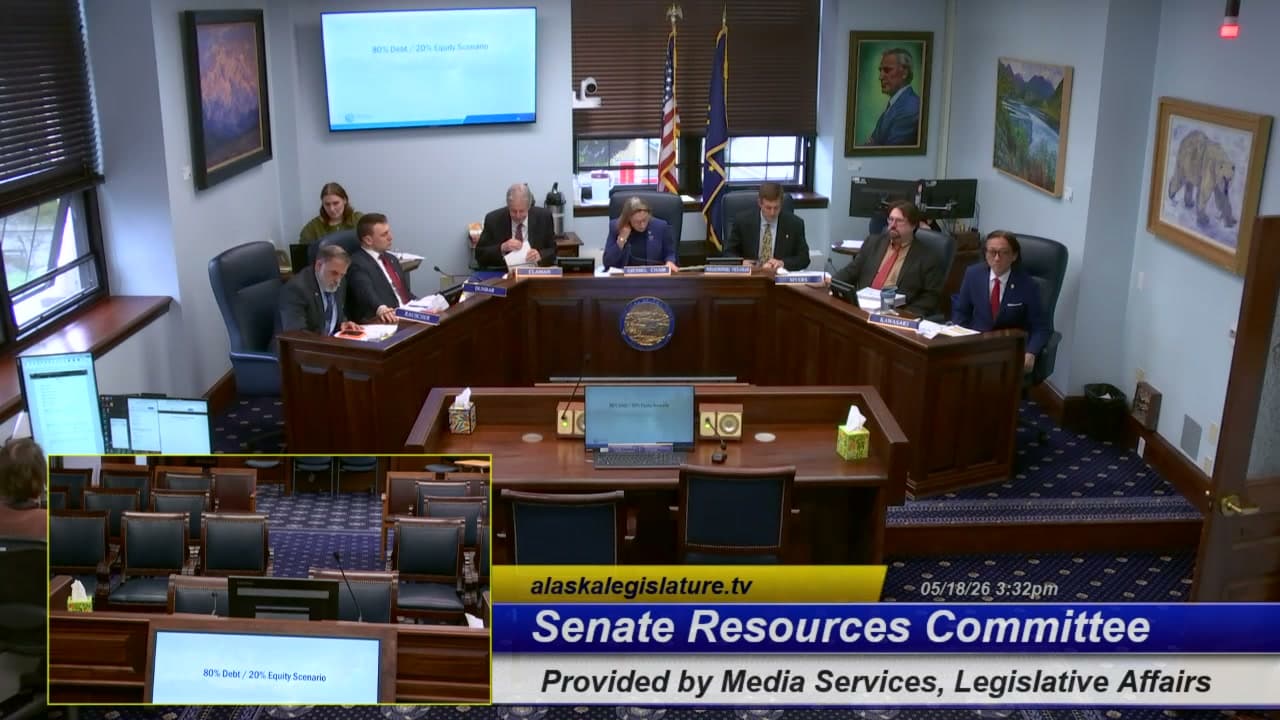
The Alaska Senate Resources Committee voted Monday to advance Senate Bill 280, version S, from committee with individual recommendations and attached fiscal notes after 36 hearings over two months.
The governor submitted the bill on March 20; the committee revised it through multiple substitute versions. The committee substitute advanced Monday combined the tax provisions of SB 280 with closely related policy issues from SB 275.
The committee moved the bill forward despite deep concerns from members about making tax policy with limited information about the project and virtually no support from the governor's administration. The bill includes consumer protections, cost overrun safeguards, price caps, and a 10-year sunset provision.
One senator said the committee had been groping around in the dark trying to craft policy without expert witnesses from the administration.
The vice chair criticized the complete absence of administration support, contrasting it with previous pipeline bills that had teams of 25 people meeting daily to provide analysis and answer questions. He said he had not received a single visit from anyone in the governor's administration about the bill.
Department of Revenue modeling presented at the meeting showed approximately $15 billion in revenue uncertainty over 30 years depending on the impact of gas development on oil production at Prudhoe Bay and Point Thompson. The analysis examined scenarios ranging from no impact on oil production to a negative 500 million barrel impact at Prudhoe Bay.
Breakeven prices for the project varied significantly based on assumptions. Under current law with 70 percent debt financing, the in-state breakeven price was estimated at $4.86 per thousand cubic feet. Under the latest version of the bill with the same debt structure, the breakeven price was $4.78 per thousand cubic feet.
The modeling also examined higher rates of return that potential investors might require. At a 15 percent pre-tax rate of return under the latest bill version, the in-state breakeven price would rise to $5.26 per thousand cubic feet, and the LNG export breakeven price would reach $10.02 per thousand cubic feet.
One senator said the bill protects consumers from cost overruns and price gouging, noting that the governor had stated Alaskan consumers would pay $4.50 to $4.75 per thousand cubic feet but then objected when that price was written into statute. The bill includes a pass-through entity tax and a 6 percent minimum tax floor that would generate an estimated $462 million per year in state revenue in later years.
Another senator expressed skepticism about the project, saying capital analysts believe the pipeline would likely cost $70 billion to $80 billion rather than the $44 billion estimate that has not changed in several years. He said the sunset provisions were among the best parts of the bill, ensuring that if nothing happens by 2028 or if the pipeline is not built by 2032, the state would revert to current law.
One senator said he felt reluctant to pass the bill, noting that the committee had barely scratched the surface on a volumetric tax structure that has never been used before. He said the committee was unsure whether the tax rate should be 5 cents, 6 cents, or 55 cents per thousand cubic feet.
Another senator said the House version of the bill was not acceptable because it removed transparency provisions and did not address lease expenditures that would reduce oil revenue in the short and medium term through a decoupling issue. A floor debate on the House version was happening at the same time as the committee meeting.
The committee chair said the bill had received 36 hearings in two months, which she believed was a record. The bill now moves to the next committee of referral.
This article is based on a public meeting — SRES-260518-1530 ().
AI-assisted. How we use AI Transcript byLucas Brown
Stay informed. Support what matters.
Free, permanent access to local news you can verify. Subscribe to support Bill AlaskaNews and go ad-free.
Related Coverage
Senate panel debates gas pipeline tax structure in 26th hearing
Alaska News · 4mo ago
Senate panel advances gas pipeline bill with oil tax floor increase
Alaska News · 4mo ago
Senate panel examines regulatory questions on gas pipeline tax plan
Alaska News · 5mo ago
Gas pipeline bill adds oil tax increase, industry calls process rushed
Alaska News · 4mo ago
Alaska Senate panel hears gas line bill with $900M annual tax break
Alaska News · 4mo ago
Comments
Sign in to leave a comment.
No comments yet. Be the first to share your thoughts.