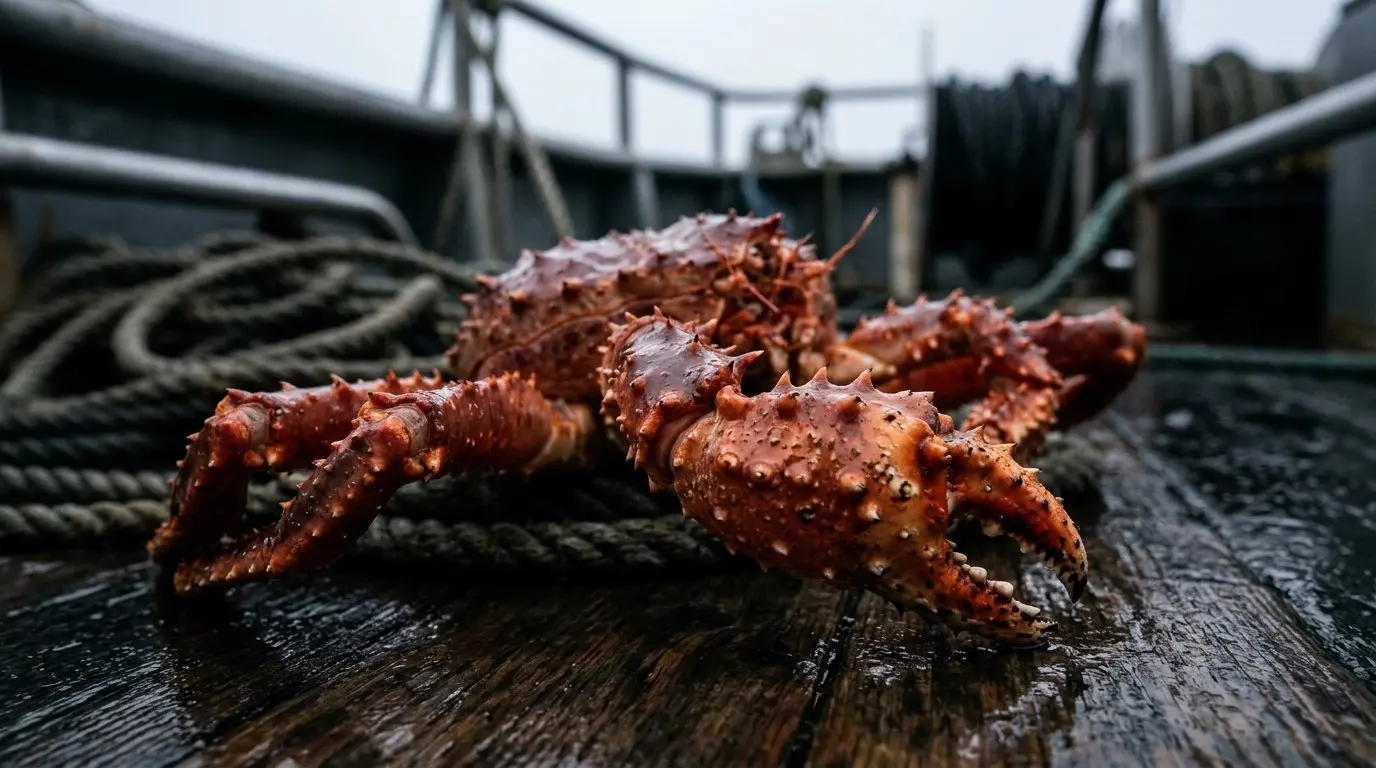
AI image
Crab plan team recommends lower 2027 Norton Sound red king crab limits
The North Pacific Fishery Management Council's Crab and Scallop Plan Team recommended Nov. 5 a 2027 overfishing limit of 143 metric tons (about 315,000 pounds) for Norton Sound red king crab, down from 193 tons this year, and an acceptable biological catch of 100 tons (about 220,000 pounds), down from 135 tons.
The overfishing limit is a total-catch threshold for overfishing. The acceptable biological catch sits below it, with a 30 percent buffer for uncertainty in the assessment, and the state sets its harvest level beneath that.
The team agreed with Alaska Department of Fish and Game biologists Caitlin Stern and Katie Palof, whose assessment recommended the lower limits in October. Their new model folds the state and NOAA trawl surveys into a single index. The authors said that is a more rigorous way to estimate abundance because the survey stations sampled have varied over time. The plan team's November report says the 2027 limit comes out smaller than 2026's partly because of a change in scale tied to the new index.
Under the model, the stock stays in Tier 4b, the category for a stock below its benchmark, which lowers the fishing rate used to set the limit. Projected 2027 mature male biomass is 1,590 tons, 61 percent of a 2,600-ton benchmark based on average biomass since 1980. The introduction to the stock assessment says the stock is not overfished.
The assessment estimates mature male biomass fell from 4,070 metric tons in 2022, the highest since the late 1970s, to 1,970 tons in 2026.
The 2026 summer commercial fishery generated $3.5 million in ex-vessel value. Its 297,072-pound harvest ran 111 percent of the combined summer quota, and total commercial retained catch, including winter, reached 313,033 pounds, 16.8 percent over the guideline harvest level. Summer crab averaged 3.7 pounds, and 34 percent of retained males fell in the largest size bin, both records.
Total 2026 fishing mortality of 338,628 pounds exceeded the acceptable biological catch by 13.6 percent but stayed under the overfishing limit, so overfishing did not occur.
Neither NOAA's Northern Bering Sea survey nor the state trawl survey ran in 2026, leaving no new data from surveys independent of the fishery. The authors cite that gap, along with older uncertainties, as reasons for keeping the 30 percent buffer.
The council's Scientific and Statistical Committee is set to review the recommendation in December, ahead of the council's meeting Dec. 4 through 9 in Anchorage. Written comments on the council agenda are due by noon Nov. 27.
What did you make of this story? (no account needed)
Made by our human newsroom with AI. How humans and AI work here · Grow with our newsroom ·
Get Alaska News in your inbox
Create your free account and get the day’s top stories around 6 each morning, in a few minutes’ read.
Top stories, around 6 each morning.
Stories on what you follow, on Sundays.
Source: NPFMC Crab Plan Team.






Comments
Sign in to leave a comment.
No comments yet. Be the first to share your thoughts.