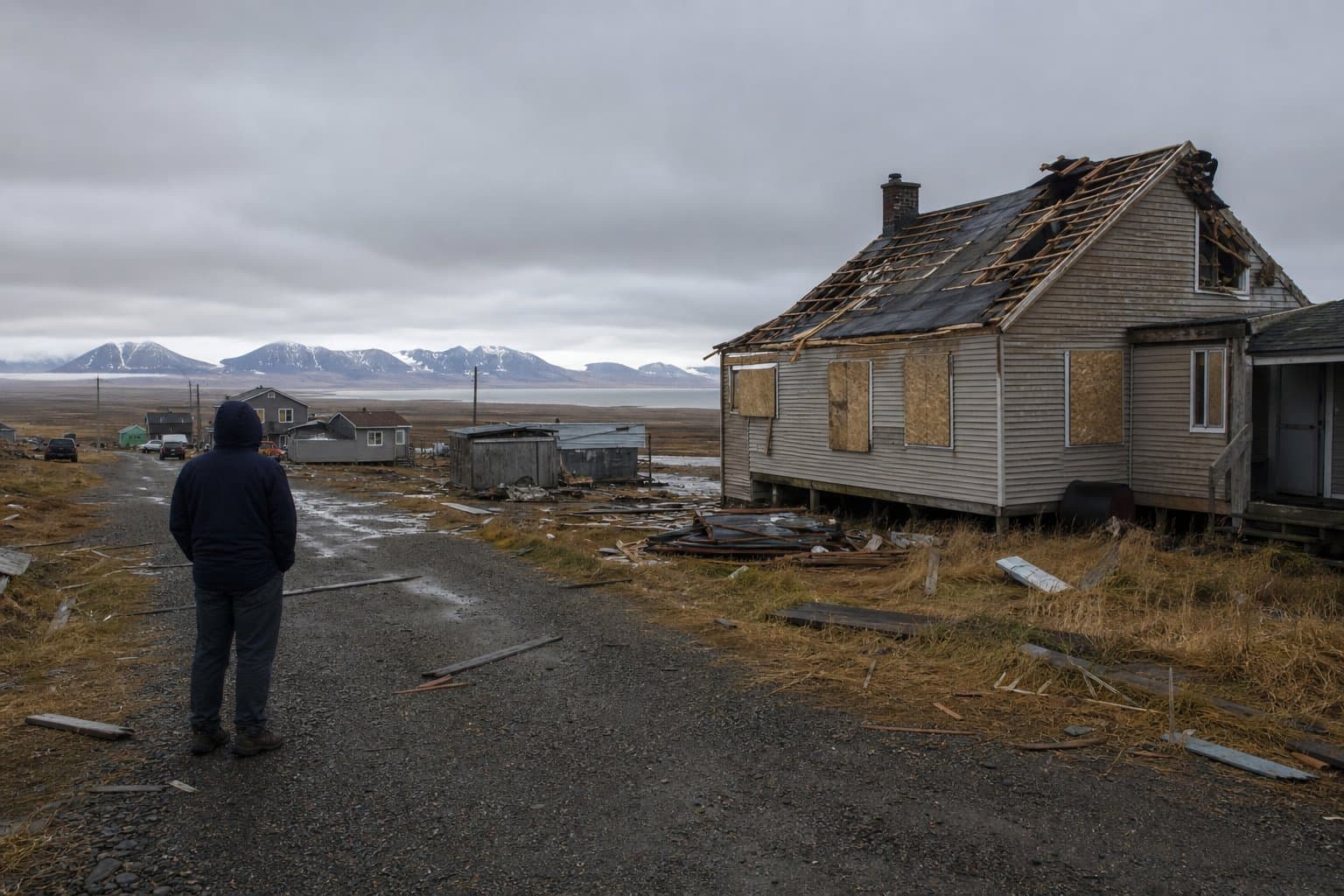
AI image
Bering Strait homeowners waited 184 days for storm repair loans
Homeowners in the Bering Strait region could not borrow a dollar from the Small Business Administration to repair storm-damaged houses until April 15, 2026, 184 days after the remnants of Typhoon Halong crossed Western Alaska. Homeowners in three other affected areas could borrow starting October 22, 2025, nine days after the storm ended.
The federal agencies answered quickly each time they were asked. The SBA declared on the same day the President did in October. It took two days to approve the Bering Strait request in April. What the records do not show is why that request is dated April 13.
The storm ran October 8 to 13, 2025. The state requested a major disaster declaration on October 16, and the President signed it October 22, authorizing Individual Assistance and Public Assistance in the designated areas.
The SBA opened loans off that signature the same day, naming three primary areas for physical damage: the Lower Kuskokwim, Lower Yukon and Northwest Arctic regions. In unorganized Alaska, disaster eligibility is drawn on school attendance areas, known as REAAs. A homeowner in any of the three could borrow at 3 percent to repair a house.
The Bering Strait REAA appeared in that same notice under a different heading: "Contiguous Areas (Economic Injury Loans Only)." An economic injury loan covers lost business revenue. It does not cover physical damage and is not available to a homeowner. From day nine, a business in a Bering Strait village could borrow against lost trade. The household next door with a damaged roof could not borrow at all.
On February 3, 2026, FEMA amended the declaration. For Individual Assistance it added the Kashunamiut and Yupiit REAAs and the City of Saint Mary's. For Public Assistance it added those three plus Bering Strait, Iditarod, the Pribilofs and Yukon-Koyukuk. Bering Strait was added to the program that repairs public infrastructure. It was not added to the program that reaches households.
The SBA moved the same way that day, adding the three new areas for homeowner and business loans and adding Bering Strait only to the declaration for private non-profits. From February 3, a non-profit in a Bering Strait village could borrow for physical damage. A homeowner in the same village still could not.
Counted from declaration to final deadline, the original three areas had 163 days to file for loans. The three added in February had 59.
The homeowner and business program closed April 3. The state asked the SBA for a Bering Strait homeowner and business declaration ten days later, on April 13. The SBA approved it April 15 as an administrative declaration, one the agency can issue itself rather than off a presidential one, at the same rates the first three areas received in October. The filing deadline was June 15 and was never extended. Bering Strait households had 61 days.
The SBA publishes a table of state and tribal requests for disaster declarations. Across 58 requests with usable dates, the median gap between the end of a disaster and the state's request is 32.5 days. Alaska's gap, 182 days to the request, is the fourth longest, behind two Illinois requests and one from New Mexico.
Nothing in the federal record explains why the request for Bering Strait went in on April 13 rather than in October. Damage assessments in Western Alaska take time, and a request that cannot be substantiated can be refused. Neither the Governor's state declaration nor the request letter to the President was located. Whether Bering Strait was in the original October request and declined, or was never included, is not established by these documents.
The records are one-sided by construction. Every voice in them is a government describing its own decisions through notices and tables. No state or FEMA official explains the sequence, and no resident of the region appears. Nome, Shishmaref, Wales, Teller, Brevig Mission, Golovin, Elim, Koyuk, Shaktoolik, Unalakleet, Stebbins, St. Michael, Savoonga, Gambell, White Mountain and Diomede all sit inside the Bering Strait REAA. None is named in any of the notices.
No damage assessment, application count or approval count for the Bering Strait REAA appears in these records. Both FEMA and the SBA publish data that would show how many households applied in the 61 days they were given.
Source: One storm, one declaration, two classes of village: Bering Strait households waited 184 days for the damage loans their neighbours got in nine, and were given 61 days to apply ().
Drafted with AI. Edited by Cale Green (1 revision). Reviewed by Cale Green. Who is accountable.
Stay informed. Support what matters.
Free, permanent access to local news you can verify. Subscribe to support Walter AlaskaNews and go ad-free.
Related Coverage
Storm-hit Alaska businesses have until July 22 to seek recovery loans
Alaska News · 2mo ago
Alaska villages can rebuild after Halong. They can't use the money to move.
Alaska News · 11mo ago
Kipnuk households paid $18 million; no village infrastructure project
Alaska News · 6d ago
Kipnuk storm loan deadline hits Tuesday
Alaska News · 3mo ago
Nearly four years on, Alaska has been paid 15 percent of Merbok's $90.9 million
Alaska News · 1mo ago
Comments
Sign in to leave a comment.
No comments yet. Be the first to share your thoughts.