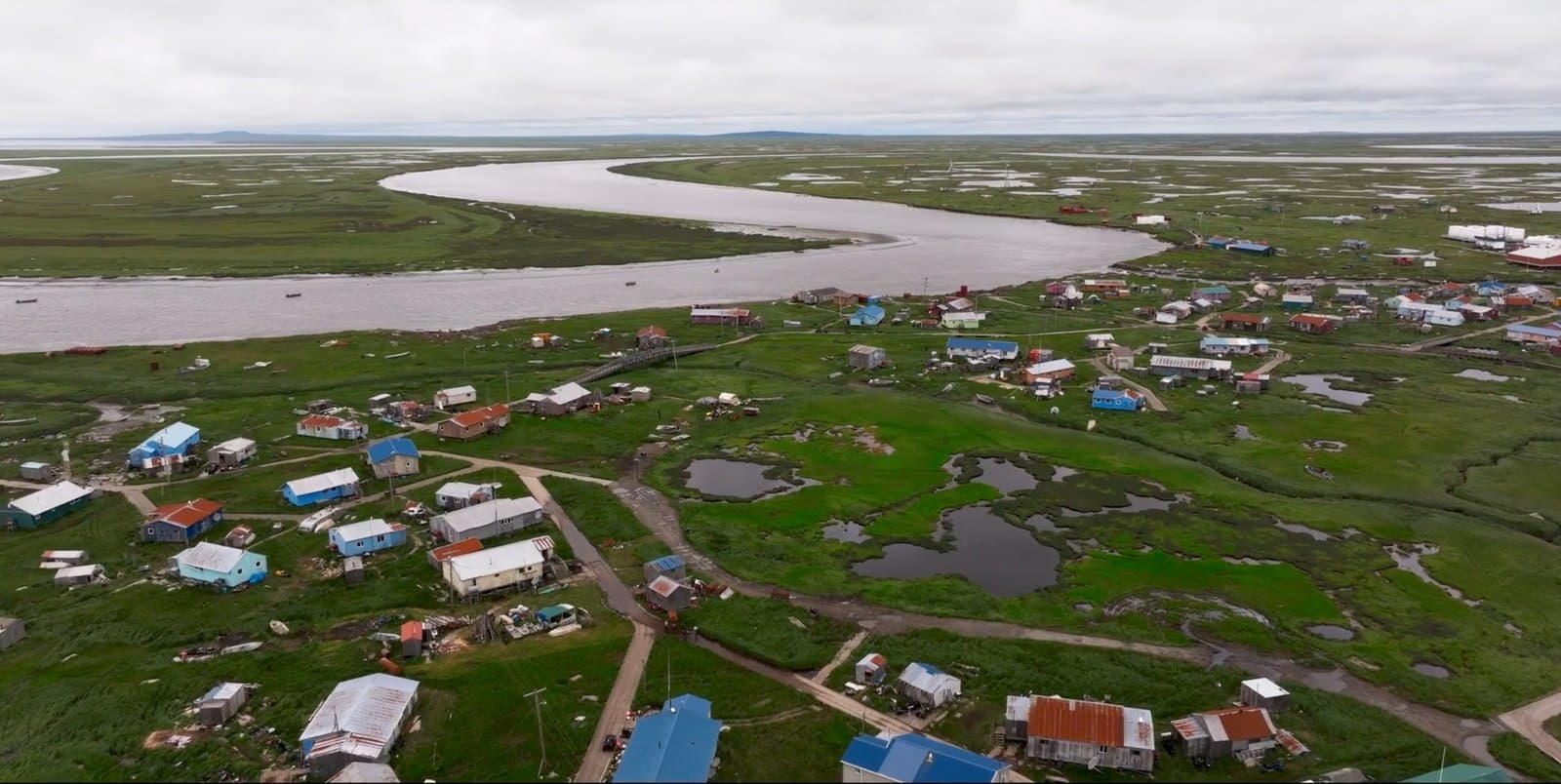
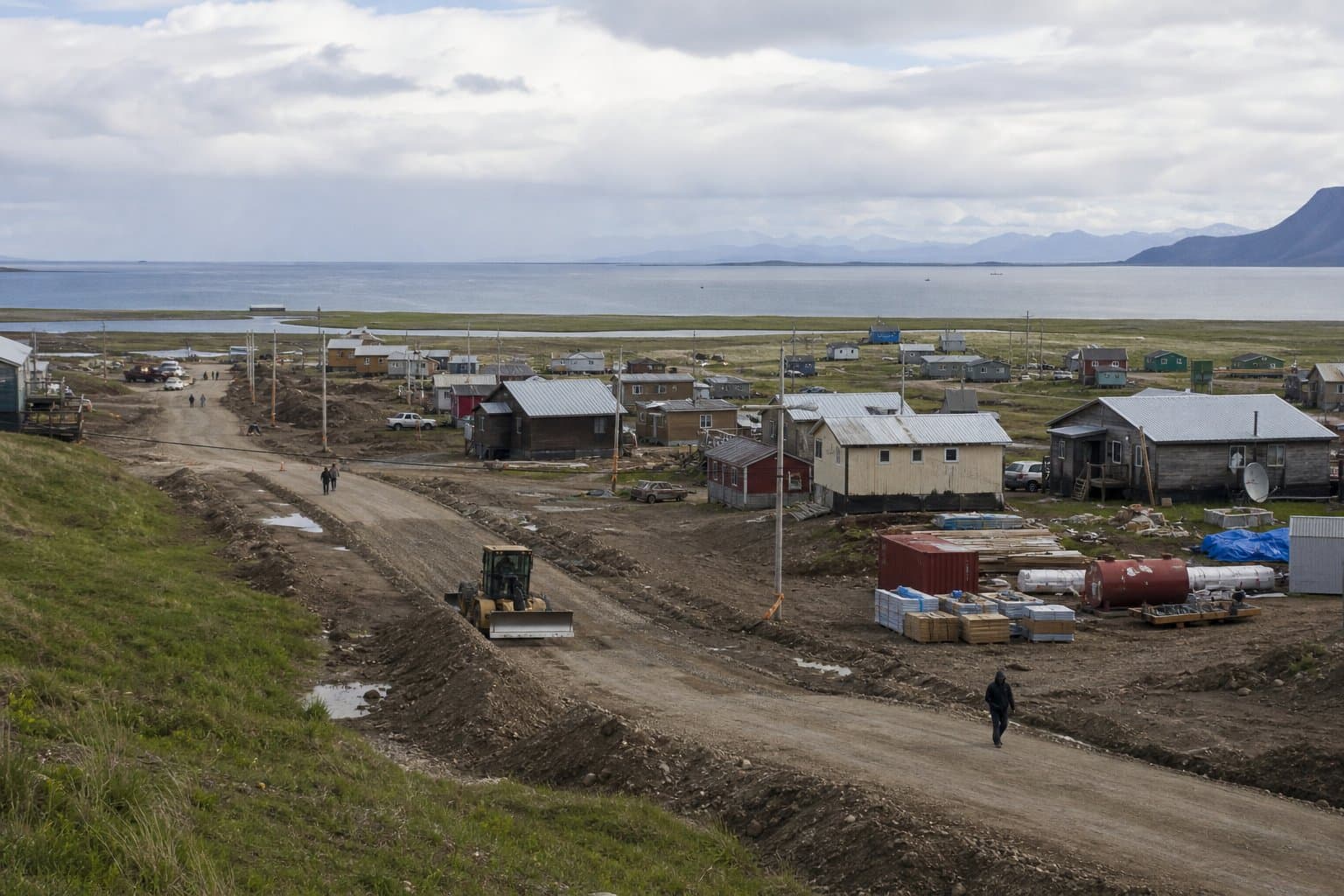
Aerial photo of Kipnuk before Typhoon Halong
Kipnuk households paid $18 million; no village infrastructure project
Kipnuk lost 153 homes when the remnants of Typhoon Halong tore through western Alaska last October, more than any other village. Families there have since received more than $18 million in federal aid for repairs, replacement and rent.
But the money to rebuild what a community shares, its roads, water system, utilities and public buildings, has almost entirely not come. And the public records don't explain why.
Federal disaster aid runs on two separate tracks. One goes to households, for their own repairs and housing. The other, called public assistance, rebuilds public infrastructure. In this disaster, the household checks reached the hardest-hit villages, and the infrastructure money mostly did not.
The numbers show the split starkly. Kipnuk and Kwigillingok, the two worst-hit villages, lost 208 of the 245 homes destroyed across western Alaska, and together their families received $26.1 million of the $62.4 million in household aid, the largest shares in the disaster. Kipnuk's eligible households averaged $76,154 each, the highest anywhere.
The public-infrastructure side tells the opposite story. Of the $5.7 million obligated so far, 86 percent went to the State of Alaska, largely for sheltering and its own emergency operations. Everything obligated to every other applicant combined, all the villages, cities, tribes and school districts, comes to $774,636. And none of it is for permanent construction: not one project is for roads, water systems, utilities or public buildings. The disaster's entire permanent-work category so far totals about $82,000, all of it equipment claims.
Most striking, Kipnuk itself does not appear on the applicant list at all. Neither does Kwigillingok. A second disaster declaration the Kipnuk tribe requested for the same storm shows zero funded projects and zero applicants more than three months later. FEMA's data doesn't capture projects still being processed, so the absence doesn't prove no work is planned, but the records simply do not show whether Kipnuk applied and was turned down, applied and is waiting, or never applied.
What the records also don't show is what has actually been rebuilt in either village, or where Kipnuk's 237 eligible households are living now. Those answers rest with the tribal and city governments, the state division that administers the infrastructure money, and the federal recovery office.
Source: Kipnuk lost 153 homes to Typhoon Halong and its households have been paid $18 million. Federal money obligated for the village's own infrastructure: none.
Made by our human newsroom with AI. Reviewed by Cale Green. How humans and AI work here · Grow with our newsroom
Stay informed. Support what matters.
Free local news you can verify. Support Walter AlaskaNews and go ad-free.






Comments
Sign in to leave a comment.
No comments yet. Be the first to share your thoughts.