
Screen capture from Gavel to Gavel coverage of the special legislative session
Alaska House passes new tax structure for Alaska LNG pipeline aimed at attracting investors
The Alaska State House passed legislation Friday establishing a volumetric tax framework for the proposed Alaska LNG Project, replacing standard property taxation with a throughput-based levy. The 34-5 vote sends House Bill 381 to the Senate.
The bill applies a 6-cent-per-thousand-cubic-feet tax to the pipeline and 13 cents per thousand cubic feet to the gas treatment plant and LNG export facility. A tax holiday runs until gas flow reaches 500 million cubic feet daily or five years after first gas, whichever comes first. Ninety-three percent of revenue from the gas treatment plant routes to the North Slope Borough, 93 percent from the LNG facility to the Kenai Peninsula Borough, with the remaining 7 percent going to the state. The framework sunsets if the project has not started by 2032, reverting to standard property tax. It only takes effect if Glenfarne Group — which took over from the state-owned Alaska Gasline Development Corporation in 2024 — funds a $40 million to $80 million Municipal Impact Fund, signs a project labor agreement covering all three major facilities, and begins construction on the Fairbanks spur line within a year of permits.
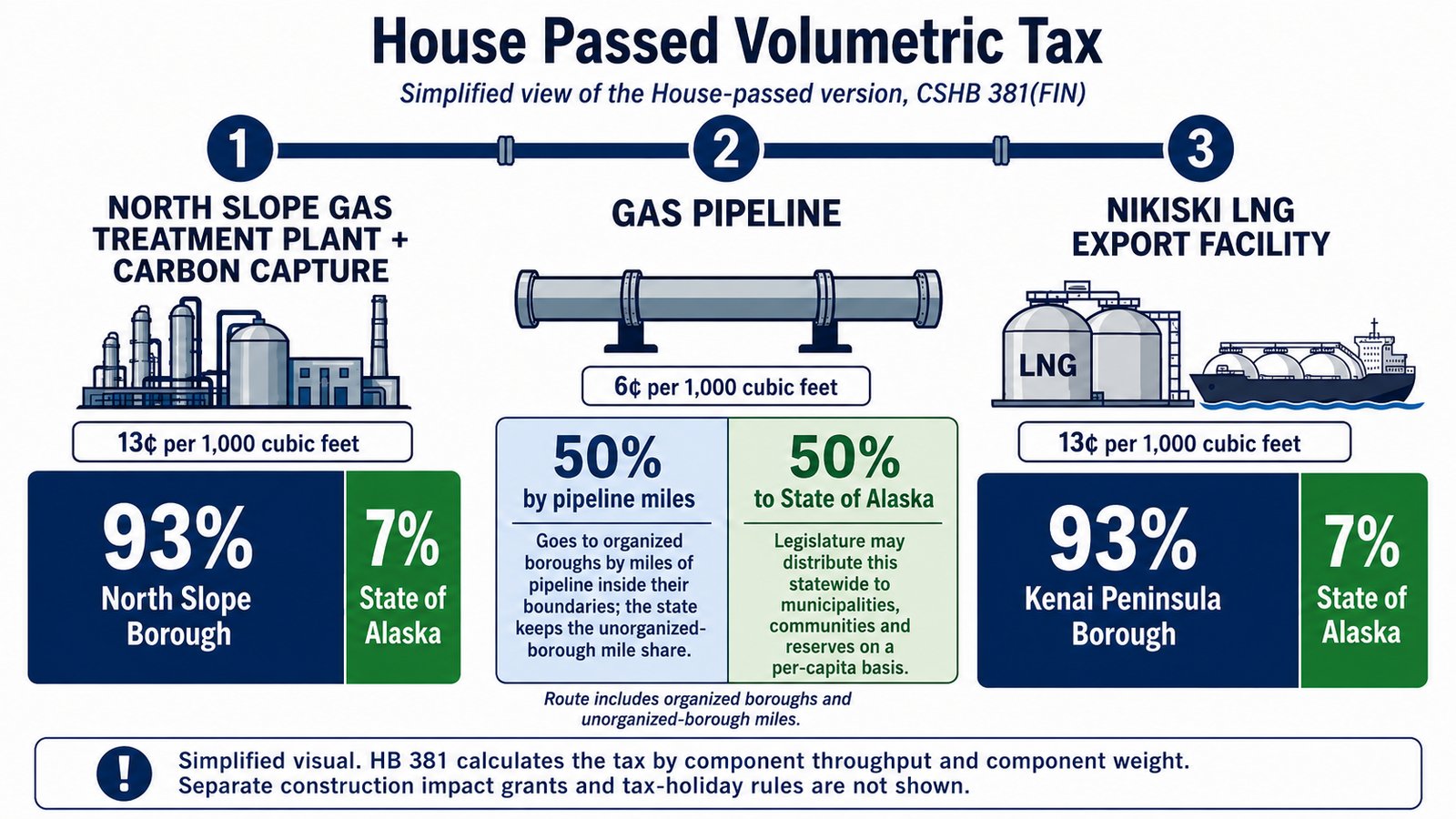
Two amendments from Rep. Robyn Niayuq Frier, who represents the North Slope, were rejected. One would have placed the gas treatment plant and LNG facility under the municipal property tax statute and authorized the North Slope and Kenai Peninsula boroughs to negotiate directly with the developer; it failed 12-27. The other would have raised the volumetric rate on the gas treatment plant from 13 to 22 cents per thousand cubic feet; it failed 8-31.
"The North Slope Borough's property taxing ability has allowed us to fund our own search and rescue, our own water and sewer, our own utilities. We've been able to build our own schools, and that's with the ability to tax property," Frier said. She added that of the 19 communities she represents across the North Slope and Northwest Arctic, only two have access to natural gas.
House Majority Leader Chuck Kopp opposed both amendments. "This amendment is challenging to the project mostly because it affects the financing terms the rate of return calculations and refinancing risk when the authority would be returned to the municipalities that host the two most expensive pieces of the project," Kopp said. The Department of Revenue and legislative consultants had described the current rate as "the maximum extractable rate consistent with the project moving forward," he said.
The bill prohibits the Regulatory Commission of Alaska from approving contracts that force Alaska ratepayers to pay for cost overruns and caps residential gas rates at $16 per million British thermal units with inflation adjustment. Rep. Andrew Gray noted that the current price of Cook Inlet gas is $11 per MCF — context for what the cap actually permits. The Department of Revenue projects volumetric tax revenue beginning at $39 million in 2031, rising to $131 million in 2033, and escalating roughly 2 percent annually thereafter.
Gov. Mike Dunleavy, who transmitted the original legislation in March, called the House passage "an important victory for Alaska's future."
The project — an 800-mile pipeline from the North Slope to Southcentral Alaska, a gas treatment plant, and a Nikiski-area liquefaction facility — has been proposed in various forms for decades without reaching final investment decision. Estimated project cost has ranged above $40 billion in recent feasibility analyses.
The structural critique of volumetric tax frameworks is that they defer state and municipal revenue to operational years that may never arrive, weakening the assured revenue base that property taxation would provide whether the project is profitable or not. Frier's amendments — and the North Slope Borough's interest in retaining direct property tax authority — reflect the same concern from the host-community side. The pipeline route also crosses lands and waters of multiple Alaska Native corporations and traditional use areas.
The bill now advances to the Senate.
Based on a press release from Office of the Governor.
Made by our human newsroom with AI. How humans and AI work here · Grow with our newsroom
Stay informed. Support what matters.
Free, permanent access to local news you can verify. Subscribe to support Walter AlaskaNews and go ad-free.
Related Coverage
Alaska House Rewrites LNG Tax Bill, Raising Rate While Empowering Boroughs
Alaska News · 5mo ago
House panel hears tax proposal for Alaska LNG project
Alaska News · 5mo ago
House Finance advances Alaska LNG tax bill, curtailing North Slope's power to negotiate
Alaska News · 4mo ago
House panel hears gas line tax bill with 15-cent volumetric fee
Alaska News · 5mo ago
Alaska LNG Tax Bill Walks Tightrope Between Project Viability and Local Needs
Alaska News · 6mo ago
Comments
Sign in to leave a comment.
No comments yet. Be the first to share your thoughts.