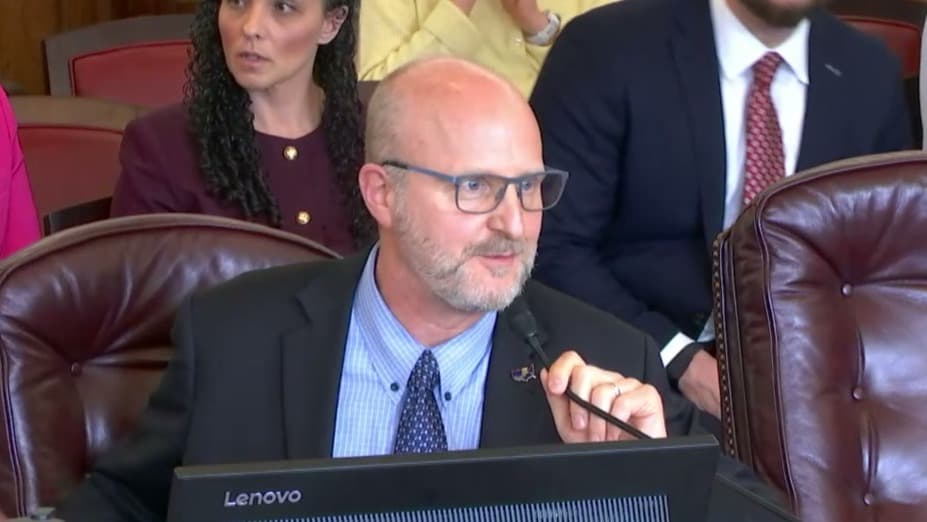
Frame from "Alaska Legislature: House Finance, 6/10/26, 11am" · Photo source
House Finance advances Alaska LNG tax bill, curtailing North Slope's power to negotiate
The Alaska House Finance Committee voted 11-0 Wednesday to advance House Bill 381, the Alaska LNG project bill, after adopting amendments that rewrite how municipalities would tax the project, strip local governments of the power to negotiate their own tax deals, and double a community impact fund to $80 million.
The bill replaces the project's existing property-tax structure with a throughput-based volumetric tax. Under Amendment 5, adopted 7-4, the levy rises to 13 cents per thousand cubic feet on gas treatment plants, 6 cents on the pipeline, and 13 cents on LNG facilities — up from an earlier 12-6-12 — with the added revenue going to the state. The weighted average lands around 10.5 to 11 cents per molecule, said Ken Alper, staff to Rep. Andy Josephson.
Revenue would be shared between municipalities and the state. The North Slope Borough would keep 93 percent of gas treatment plant taxes, with 7 percent retained by the state — a split set by a conceptual amendment after an earlier 90-10 version. The same 93-7 split would apply to LNG facilities in the Kenai Peninsula Borough. Pipeline revenue would be divided in half: one portion allocated by mileage among the boroughs it crosses, the other distributed statewide by population.
The most contentious change was what Amendment 5 took away: municipalities' ability to negotiate separate tax structures. The North Slope Borough wanted both more money and the autonomy to cut its own deal, Alper said, estimating the House Finance version works out to roughly a 2- or 3-cent tax on the gas treatment plant after weighted averages — versus a larger share of a 10-cent tax under the Senate Resources Committee's version. "I don't think they're particularly thrilled… They really wanted the autonomy to be able to negotiate their own way," he said.
Co-Chair Neal Foster and Josephson voted against the amendment. Foster said he was swayed by the borough's case that "the resource comes from the region and they'd like to have more say over what they do within their region." Josephson said he could not tell whether the foregone revenue was actually needed to make the project economical, and argued the state owes its municipalities more support: "We create them, but we have to nurture them." He noted a mid-2010s Municipal Advisory Group had pegged community impact needs as high as $800 million — a figure the Senate Resources bill cut to $200 million and House Resources to $40 million.
Rep. Calvin Schrage, who backed the amendment, framed it as a balance: "I'm doing what I can to try and enable this project and give it a fighting chance while still protecting the state's interest."
The committee moved to address those impact concerns through Amendment 22, which raised community impact aid from $40 million to $80 million and shifted its administration to the Department of Commerce, Community and Economic Development. The money is split into two $40 million tranches: the first deposited upfront, the second released only after municipalities submit proof of verified actual or reasonably expected impacts. Eligibility is limited to six municipalities — the five boroughs the pipeline crosses, plus Anchorage.
A separate measure, Amendment 10, tightened transparency rules for the Alaska Gasline Development Corporation, clarifying when confidential contract terms can be disclosed and requiring legislative approval for certain debt and asset transfers, with inaction after 90 days counting as approval.
The bill advanced with individual recommendations and attached fiscal notes.
This article is based on a public meeting of Alaska State Legislature — Alaska Legislature: House Finance, 6/10/26, 11am ().
Made by our human newsroom with AI. How humans and AI work here · Grow with our newsroom Transcript byLucas Brown
Watch key moments from the source meeting. Click to expand.
Stay informed. Support what matters.
Free, permanent access to local news you can verify. Subscribe to support Walter AlaskaNews and go ad-free.
Related Coverage
Alaska House Rewrites LNG Tax Bill, Raising Rate While Empowering Boroughs
Alaska News · 5mo ago
House panel hears gas line tax bill with 15-cent volumetric fee
Alaska News · 5mo ago
House Finance amendment lets pipeline-route municipalities bill Alaska LNG directly — skipping the state appropriation step
Alaska News · 4mo ago
Alaska LNG tax bill advances to floor on split conference committee votes
Alaska News · 3mo ago
Alaska House passes new tax structure for Alaska LNG pipeline aimed at attracting investors
Alaska News · 4mo ago
Comments
Sign in to leave a comment.
No comments yet. Be the first to share your thoughts.