Alaska House Rewrites LNG Tax Bill, Raising Rate While Empowering Boroughs
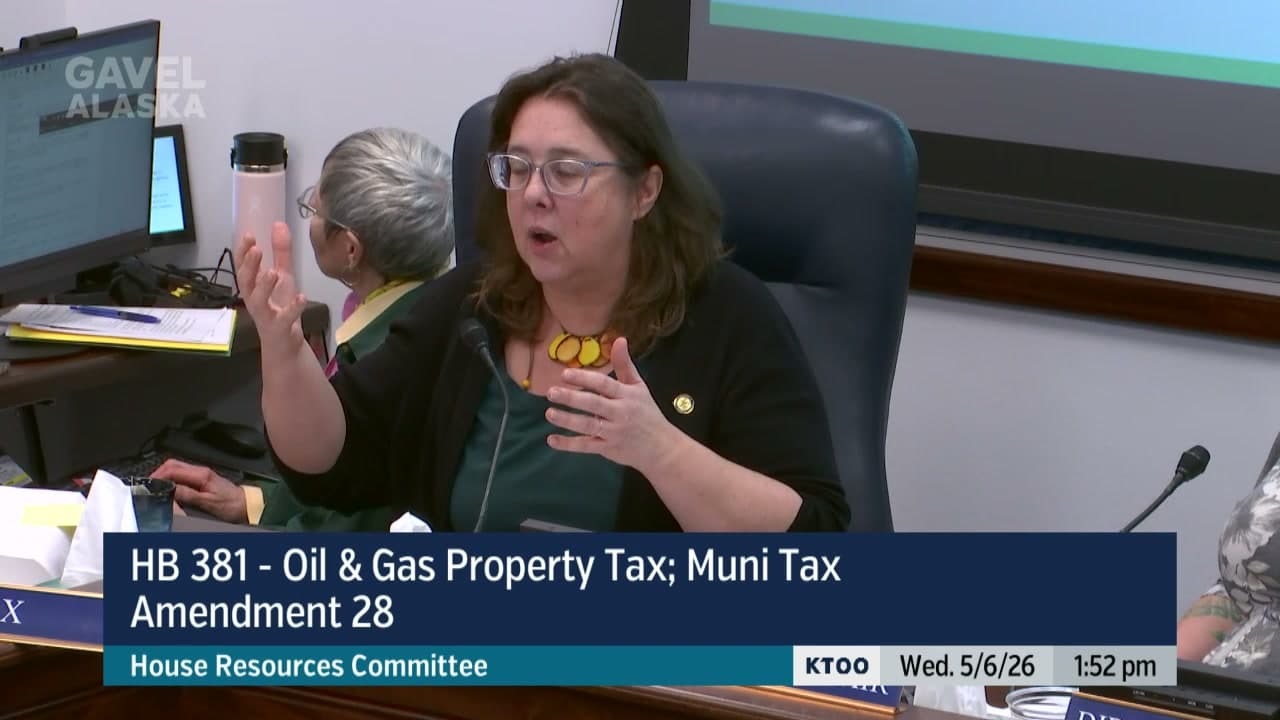
The Alaska House Resources Committee voted 8-1 Wednesday to advance a substantially rewritten version of the governor's Alaska LNG tax bill, raising the proposed pipeline tax while giving boroughs new authority to negotiate property taxes on gas facilities.
Governor Dunleavy introduced legislation in April to replace oil and gas property tax with a volumetric tax based on gas throughput for the Alaska LNG project, projecting $26 billion in revenue over 30 years.
The committee's Amendment 28 sets a single alternative volumetric tax of 15 cents per thousand cubic feet of pipeline throughput, applied at first gas with no abatement period. That rate is higher than the governor's proposed 6 cents but lower than the 20 cents the committee had previously drafted. The amendment removes the three-tier tax structure that had applied different rates to the pipeline, gas treatment plant, and LNG facility.
Co-Chair Representative Freer said the 6-cent rate "was based on a project that would be approximately $46 billion from a number that AGDC put out in, I think, 2023," adding "I think 15 cents kind of relates more to what the actual project cost may be."
The amendment also removes the gas treatment plant on the North Slope and the LNG facility on the Kenai Peninsula from the alternative volumetric tax system. Instead, it subjects them to municipal property taxes under Title 29. Committee aide Calvin Zullo said this "empowers those two boroughs to further reduce the tax burden on the project unilaterally based on negotiations with the project developer."
After legal counsel raised questions about whether existing statutes would allow boroughs to negotiate variable mill rates without additional authorization, the committee adopted a conceptual amendment providing an exemption using language similar to existing economic development provisions in state law. The amendment also allows boroughs to take equity in the project in lieu of property tax revenue.
The legislation terminates the alternative tax structure if commercial operations have not begun by January 1, 2040, reverting to standard property tax.
Adam Prestidge, representing project sponsor Glenfarn, expressed concern about the increased tax burden. "The governor's bill proposed an AVT tax of 6 cents that was applied on the entire project, 6 cents total," Prestidge said. "What I see here with this proposal is a 15 cents on the pipeline itself, leaves in place another 10 cents on the LNG facility, and then an unknown tax on the gas treatment facility."
Calvin Zullo clarified that the amendment applies no volumetric tax to the LNG facility. "Under this amendment there is no 10-cent AVT applied to the LNG facility," Zullo said. "It's just the 15 cents on the pipeline. The LNG facility and the gas treatment plant on the North Slope are taxed under municipal property taxes."
David Herbert from the Department of Revenue testified that the change would result in a decrease in state property tax revenue from the gas treatment plant on the North Slope, about $24 million per year, or 10 percent of the total property tax on that facility. The LNG plant in the Kenai Peninsula Borough would not represent a decrease in state revenue because it is not currently subject to state oil and gas property tax.
The committee also unanimously approved Amendment 29, which addresses the Fairbanks spur line. The amendment, which was modified during committee action to change the pipeline length reference from 750 miles to 730 miles, requires that before completion of the gas pipeline, the entity responsible for constructing the spur line must begin permit applications and take steps to meet regulatory requirements. Once all permits are issued and regulatory requirements satisfied, construction must begin within one year.
Co-Chair Representative Dybert said the amendment "strikes a practical balance" and "keeps the commitment to the Fairbanks Spur Line in place while recognizing the realities of permitting, regulatory review, and project development timelines."
Prestidge said the commitment represents Glenfarn's willingness to work with communities, though several committee members raised concerns about the one-year construction deadline if permits face legal challenges or force majeure events. Emily Nauman, director of Legislative Legal Services, explained that the provision requires the Commissioner of Revenue to determine that property owners have committed to the requirements, likely through a contractual arrangement that could spell out exceptions.
Prestidge also expressed concern about complexity. "Inserting just more hurdles of negotiation, breaking out more pieces and more conditions that have to be satisfied and more parties to negotiate with that can hold the project up will have the effect of holding the project up," Prestidge said.
Representative Kollum supported the approach. "I think 15 is better," Kollum said of the volumetric tax rate. "This isn't done. It is more stable. And I think, you know, if we're going to try to move the bill forward and try to, like, we're running out of time."
Representative Mears voted against the final bill, citing concerns about Amendment 27, which had been adopted in a previous session and removed community benefit agreement language. "I think that removing community benefit agreements and having a limited fund that is controlled by the project is too rigid for communities, and I don't think it's going to meet their needs," Mears said.
Mayor Edna DeVries of the Matanuska-Susitna Borough testified that the borough supports the shift to volumetric tax but has concerns about revenue reallocation. "The overall purpose of this bill to restructure the tax system is to increase the livelihood of the project development by reducing tax burden, not to reallocate revenues to jurisdictions that are not directly impacted by the infrastructure," DeVries said.
The bill now moves to the House Finance Committee with two weeks remaining in the legislative session. Representative Mears noted that six and a half weeks have passed since the bill was introduced and "there's still a tremendous amount of work left to be done on the bill."
This article is based on a public meeting — HRES-260506-1300 ().
AI-assisted. How we use AI Transcript byLucas Brown
Stay informed. Support what matters.
Free, permanent access to local news you can verify. Subscribe to support Alaska News and go ad-free.
Related Coverage
House Finance advances Alaska LNG tax bill, curtailing North Slope's power to negotiate
Alaska News · 3mo ago
Alaska LNG Tax Bill Walks Tightrope Between Project Viability and Local Needs
Alaska News · 5mo ago
Alaska House passes new tax structure for Alaska LNG pipeline aimed at attracting investors
Alaska News · 3mo ago
House panel hears tax proposal for Alaska LNG project
Alaska News · 4mo ago
Senate panel advances gas pipeline tax overhaul with $610M revenue target
Alaska News · 5mo ago
Comments
Sign in to leave a comment.
No comments yet. Be the first to share your thoughts.