AI image
A UAF fix for the battery-and-generator clash in village grids
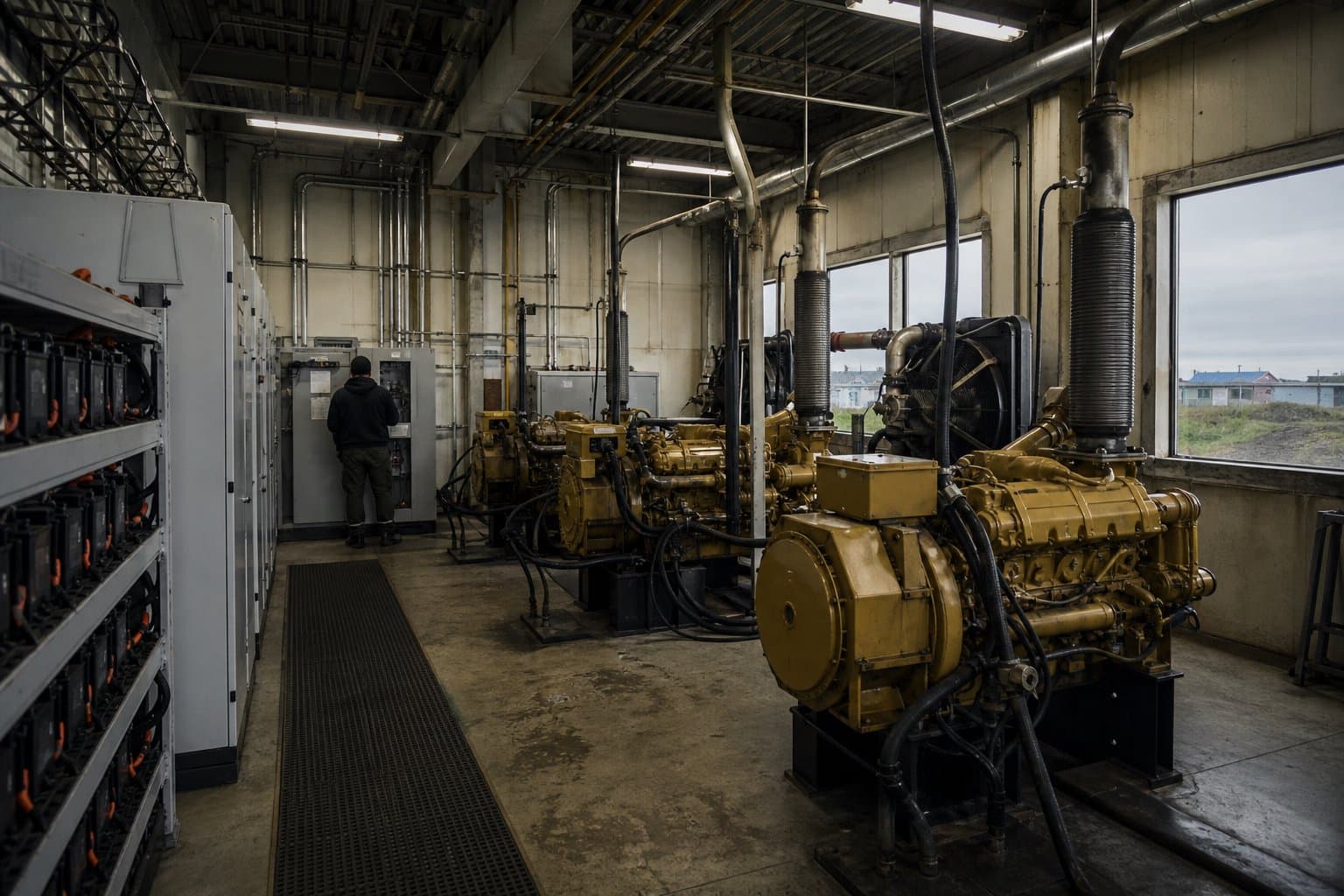
When a remote Alaska village tries to bolt a battery onto its diesel power plant, something surprising can go wrong — the battery and the generator start to fight.
The battery connects through a grid-forming inverter, a device that sets the grid's voltage and frequency. In a village powerhouse, that inverter often sits right next to a diesel generator of similar size, and under those cramped conditions the two can interact and set off sustained electrical oscillations — a kind of feedback that destabilizes the grid. The usual fix, developed for continent-spanning transmission systems where such equipment sits far apart, doesn't translate to a low-voltage village grid, where the pieces are close together and no one has accurate models of how the aging generators behave.
That control problem is a quiet barrier to something rural Alaska badly needs. Villages off the road system often pay more than 50 cents a kilowatt-hour for diesel power — sometimes more than a dollar, among the highest rates in the country — and every kilowatt a battery can store is diesel that doesn't get burned. But most of these utilities can't afford the specialized interconnection studies that would tame the oscillations.
Mariko Shirazi thinks the battery can solve its own problem. Shirazi, who leads the Power Systems Integration program at the University of Alaska Fairbanks' Alaska Center for Energy and Power, plans to use the battery's inverter to probe the grid — sending signals to learn how each machine responds — then tune the battery's controls to actively cancel the oscillations and hold the system steady. A three-year, $325,000 National Science Foundation grant funds the work, which she will validate on a 500-kilowatt lab rig wired with real inverters and diesel generators.
Operators know this one firsthand. At the Alaska Sustainable Energy Conference in May, AVEC engineer Bailey Gamble said of one hybrid system, "inevitably there will be a need for adjustments to programming, and we found that here."
The grant covers the lab work, not a village installation. Whether the fix ever reaches a powerhouse depends on work it doesn't pay for.
Source: National Science Foundation, National Science Foundation: NSF Award [EPCL: Energy, Power, Control,] → University of Alaska Fairbanks Campus: Collaborative Research: In-field, GFM-enabled, Data-driven, and Stability-certified Tuning of Hybrid Diesel Generator ().
AI-assisted. How we use AI
Stay informed. Support what matters.
Free, permanent access to local news you can verify. Subscribe to support Melinda Communities.News and go ad-free.
Related Coverage
An Alaska village will own its solar power — and sell it back to the utility
Alaska News · 2mo ago
In Ouzinkie, one lake is water and power, so the village is building solar
Alaska News · 1mo ago
Rural Alaska Electricity Costs Run Three to Five Times Urban Rates
Alaska News · 5mo ago
A $1.6 million grant to help Alaska burn on purpose, before wildfire does
Alaska News · 1mo ago
Fifty-nine rural Alaska villages get federal money to defend their power systems from hackers
Alaska News · 1mo ago
Comments
Sign in to leave a comment.
No comments yet. Be the first to share your thoughts.