A Haida class spends two years recovering a 74-line migration story
Ten students representing all three major Haida dialects spent two terms working through a single story — a 1901 account of how Haida people came to what is now Prince of Wales Island. It runs just 74 lines. Retranscribing it out of old phonetic notation into modern Haida orthography took about two years.
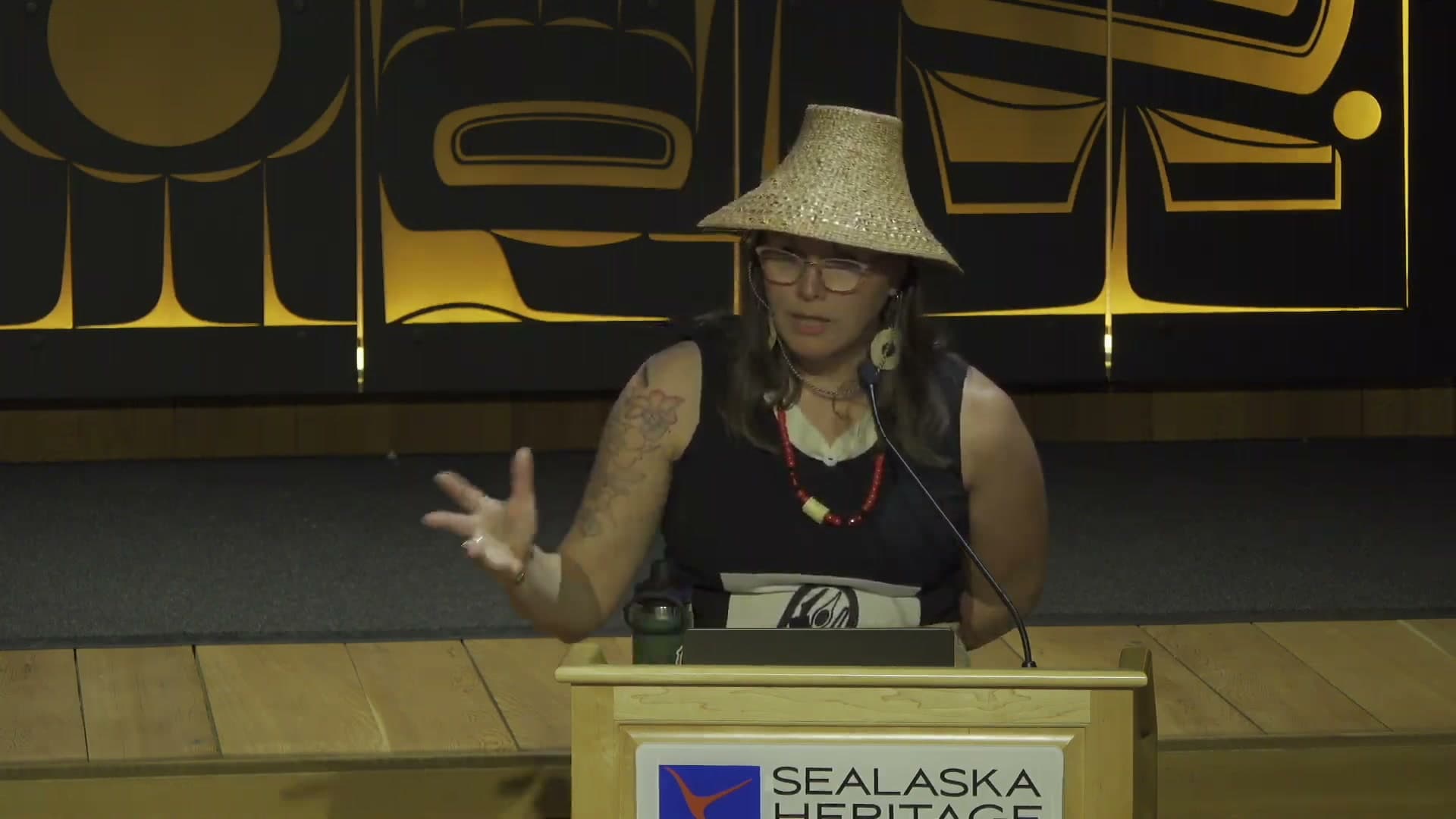
Jasḵwaan Bedard, an assistant professor in the Indigenous Languages Program at Simon Fraser University, described that painstaking work Monday at Sealaska Heritage Institute's Clan House in Juneau. She is Haida, from G̱aw Tlagée, and specializes in X̱aad Kíl.
The slow work surfaced meaning the English translation had smoothed away. In one passage, a nephew asks his uncle for a bow, saying he wants it for an eagle sitting on the point. The class came to believe the line meant something else entirely. "We came to a conclusion in the class that the nephew was not going to hunt an eagle sitting on the point, but he was going after the chief of the Ch'othlanis, who is eagle," Bedard said. The revenge that follows is what sets off the conflict that ends in the migration north.
The story was recorded in 1901 by ethnologist John R. Swanton, written down by hand in a phonetic alphabet — the kind of century-old source that now takes years of careful work to make usable again for the people whose story it is.
That work has reached far beyond Haida Gwaii. Bedard said moving classes online during the pandemic, after elders in Old Masset died, opened them to Haida students in Alaska, the Lower 48, and as far east as Montreal. What began as a necessity became something more: a shared space for learners scattered across geography, dialect and time zone by what she called an unprecedented Haida diaspora, a legacy of colonization. Connecting Haida people through their language, she said, is an act of healing.
The class sat with the old story's war and conflict, too, and concluded it is not the Haida reality of today — a present in which Haida people share a life and culture across communities and borders. The stories, Bedard said, carry the histories that connect Haida people regardless of community, country or dialect.
This article is based on a public meeting of Sealaska Heritage Institute — Sealaska Heritage Institute: Lecture: CONNECTING HAIDA LANGUAGE LEARNERS ACROSS BORDERS THROUGH STORY | Sealaska Heritage ().
Drafted with AI. Edited by Cale Green (1 revision). No full editor review is on record. Who is accountable. Transcript byLucas Brown
Stay informed. Support what matters.
Free, permanent access to local news you can verify. Subscribe to support Maggie AlaskaNews and go ad-free.
Related Coverage
Haida class returns a 1901 migration story to its own language
Alaska News · 1mo ago
Yaadás clan historian says he only recently traced how his clan got the beaver crest
Alaska News · 1mo ago
A Tsimshian carver, accused of inventing clan stories, is affirmed by another clan
Alaska News · 1mo ago
Sealaska Heritage president says Tlingit-Russian War story belongs to all clans, not Kiks.ádi alone
Alaska News · 2w ago
A new book makes the case that saving the Haida language now means 'immerse or die'
Alaska News · 2mo ago
Comments
Sign in to leave a comment.
No comments yet. Be the first to share your thoughts.