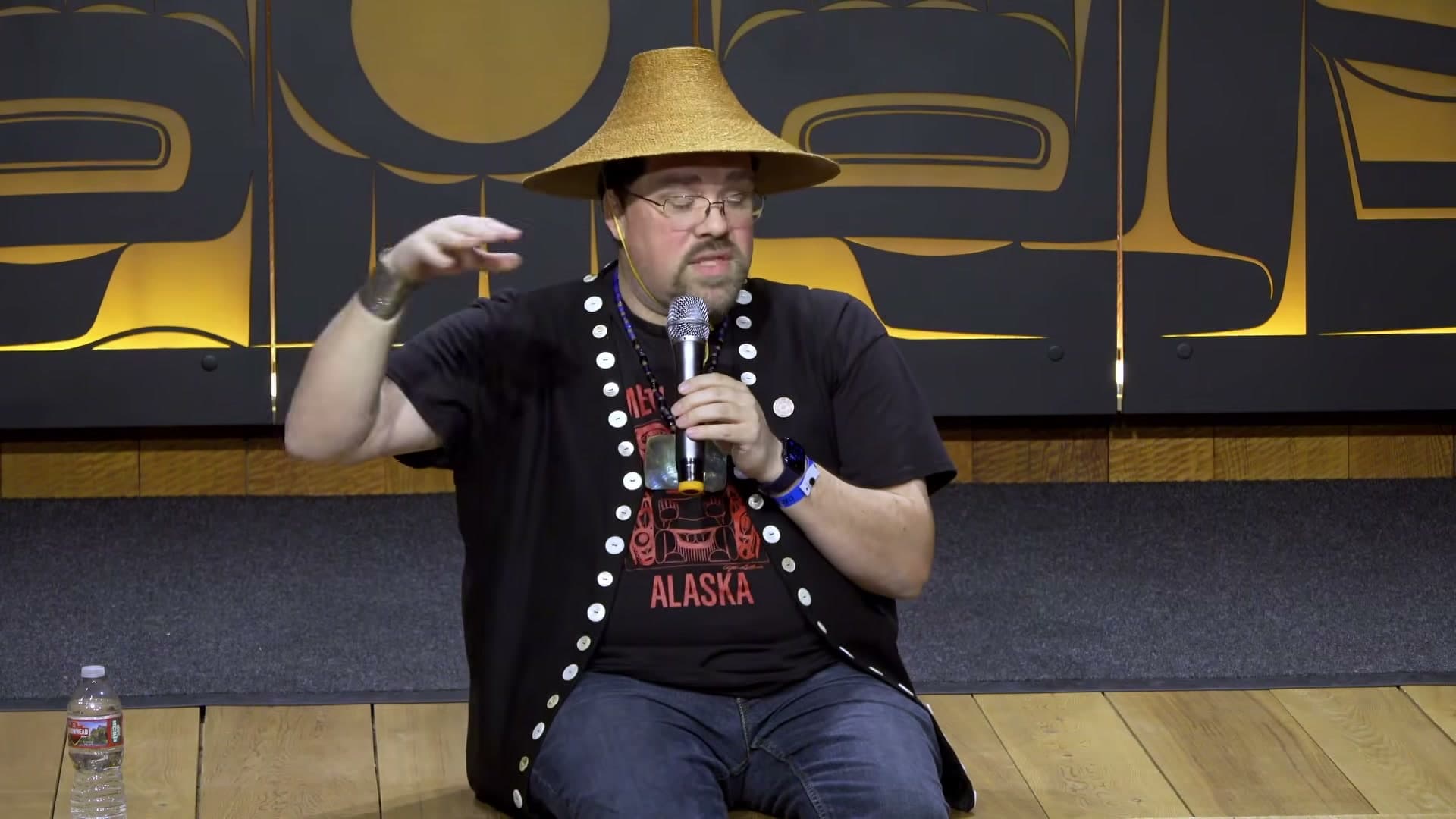
Frame from "Sealaska Heritage Institute: Laxgyibuu Clan Crest with David R. Boxley | Sealaska Heritage" · Source
A Tsimshian carver, accused of inventing clan stories, is affirmed by another clan
Tsimshian carver David Boxley says people in his own community have accused him of making up the clan migration stories he has begun telling in public. At a Sealaska Heritage Institute talk in Juneau, the answer came from another clan, in the same room.
A Wrangell Raven clan leader stood during the question period to respond, saying Tlingit protocol calls for the opposite clan to answer when something of that weight is shared. His clan tells the same stories, he said, and recordings in its archives, of elders who have since died, affirm the Stikine River connections Boxley described. His own clan name, he noted, is of Tsimshian origin.
To Boxley, the accusation is a measure of what was lost. Generations of Tsimshian people were taught a history that begins with the missionary William Duncan and the 1887 move to Metlakatla, Alaska. "We are defined by William Duncan and being colonized and moved to Alaska," he said. "And that's all most anybody knows, including our own people."
Boxley traced his own clan, the Laxgyibuu or wolf phratry, back to the interior of British Columbia and down the Stikine River in a migration its oldest stories describe, ending near the river's mouth, where he said a name still carried in those lineages will sound familiar to anyone who knows Wrangell. Shared crests, he explained, establish kinship across the peoples now called Tsimshian, Tlingit and Haida, which is what makes the Wrangell response a claim of relation rather than a courtesy: separated wolf lineages meeting again recognize one another as relatives on the strength of the crest alone.
The suppression that followed the move was thorough. Tsimshian people signed paperwork barring potlatching, dances and face painting, and gave up the chief system that organizes their houses, though Boxley was careful to call that a choice made under uncertain pressure rather than a single imposed order. "We voluntarily gave up our chief system, which is how our house system runs," he said. "We gave up potlatching. That is devastating to try to maintain these kinds of stories."
One generation was enough to break the chain. Descendants told him their grandparents spoke Sm'algyax but refused to teach it, or laughed when children tried, because they were shielding them from what they had endured.
The record Boxley works from survived because Tsimshian people helped document it, and because an anthropologist organized those handwritten materials in the 1970s into a form he can now search. What he wants, he said, is not just to recover the stories but for his people to speak the language, know the histories and potlatch in their own communities. "We are not some foreign transplants that never saw Southeast Alaska before 1887," he said. "It's just not true." He figures he has about 40 years left to do the work.
This article is based on a public meeting of Sealaska Heritage Institute — Sealaska Heritage Institute: Laxgyibuu Clan Crest with David R. Boxley | Sealaska Heritage ().
AI-assisted. How we use AI Transcript byLucas Brown
Watch key moments from the source meeting. Click to expand.
Stay informed. Support what matters.
Free, permanent access to local news you can verify. Subscribe to support Maggie AlaskaNews and go ad-free.
Related Coverage
Yaadás clan historian says he only recently traced how his clan got the beaver crest
Alaska News · 1mo ago
A Haida class spends two years recovering a 74-line migration story
Alaska News · 1mo ago
Sealaska Heritage president says Tlingit-Russian War story belongs to all clans, not Kiks.ádi alone
Alaska News · 1mo ago
Haida class returns a 1901 migration story to its own language
Alaska News · 2mo ago
A Juneau artist beads a warrior, a relative, and a record
Alaska News · 2mo ago
Comments
Sign in to leave a comment.
No comments yet. Be the first to share your thoughts.