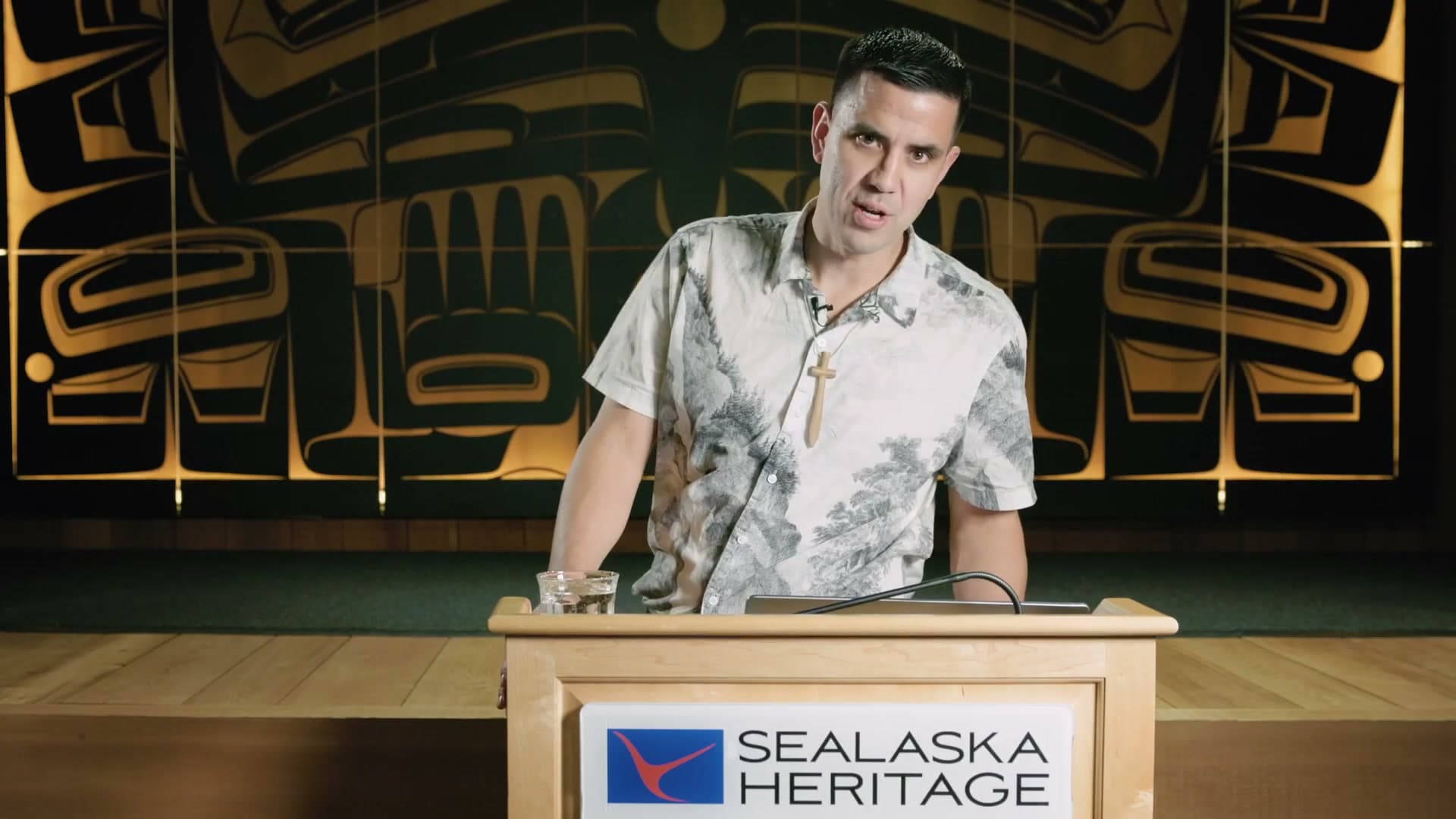
Frame from "Sealaska Heritage Institute: Yaadaas Clan Crest with Benjamin K’uyáang Young | Sealaska Heriatge" · Source
Yaadás clan historian says he only recently traced how his clan got the beaver crest
Benjamin Young, a Yaadás clan historian, spent years puzzled by a question he only recently answered: how a Haida Eagle clan came to hold the beaver as a crest. It's one of the most common crests among Haida Eagles, he said in a talk for Sealaska Heritage Institute, appearing among a dozen clans in the Haida Nation.
Young offered two accounts and didn't choose between them. In the first, recorded by ethnologist John Swanton, a Haida Eagle woman was captured by the Tsimshian and taken as a slave, married the chief's son, and some of her descendants later returned to their Haida relatives, bringing back the beaver crest. The second, from anthropologist Marius Barbeau, holds the Haida took up the beaver through the fur trade, where it was a trading company's emblem. Young said scholars treat Barbeau's work skeptically, and that he includes it anyway because more history is better than less.
Young traced his lineage through his mother, Joylyn Young, and her mother, Gladys Morrison, describing the Yaadás as the Alaskan branch of a larger Haida Gwaii clan whose name he translates as "the honorable people."
His push to recover this history began with a 2018 giveaway potlatch organized by the artist Robert Davidson, who commissioned a banner for each living Haida clan to carry at gatherings. Young said that effort drove a wave of identity work among Haida in Kasaan, Ketchikan, Juneau and Anchorage, prompting people to ask who their mother's mother's mother was as a way into their own histories.
His clan's migration story came down through a recording of his great-grandfather's account: blown east by hard weather, the Yaadás landed on Prince of Wales Island and moved repeatedly until a raven led men to a creek thick with dog salmon, where they settled at what became Old Kasaan, a village the Haida Nation describes as once holding up to 500 people. A recarving of an old Yaadás crest pole stands in present-day Kasaan today.
"It connects us with the land, it connects us with the people, it connects my clan with a lot of shared history," Young said. He said the work isn't finished, and closed by asking anyone who knows more to correct him.
This article is based on a public meeting of Sealaska Heritage Institute — Sealaska Heritage Institute: Yaadaas Clan Crest with Benjamin K’uyáang Young | Sealaska Heriatge ().
Drafted with AI. Edited by Cale Green (1 revision). No full editor review is on record. Who is accountable. Transcript byLucas Brown
Watch key moments from the source meeting. Click to expand.
Stay informed. Support what matters.
Free, permanent access to local news you can verify. Subscribe to support Maggie AlaskaNews and go ad-free.
Related Coverage
A Tsimshian carver, accused of inventing clan stories, is affirmed by another clan
Alaska News · 1mo ago
A Haida class spends two years recovering a 74-line migration story
Alaska News · 1mo ago
Haida class returns a 1901 migration story to its own language
Alaska News · 2mo ago
Sealaska Heritage president says Tlingit-Russian War story belongs to all clans, not Kiks.ádi alone
Alaska News · 1mo ago
A Juneau artist beads a warrior, a relative, and a record
Alaska News · 2mo ago
Comments
Sign in to leave a comment.
No comments yet. Be the first to share your thoughts.