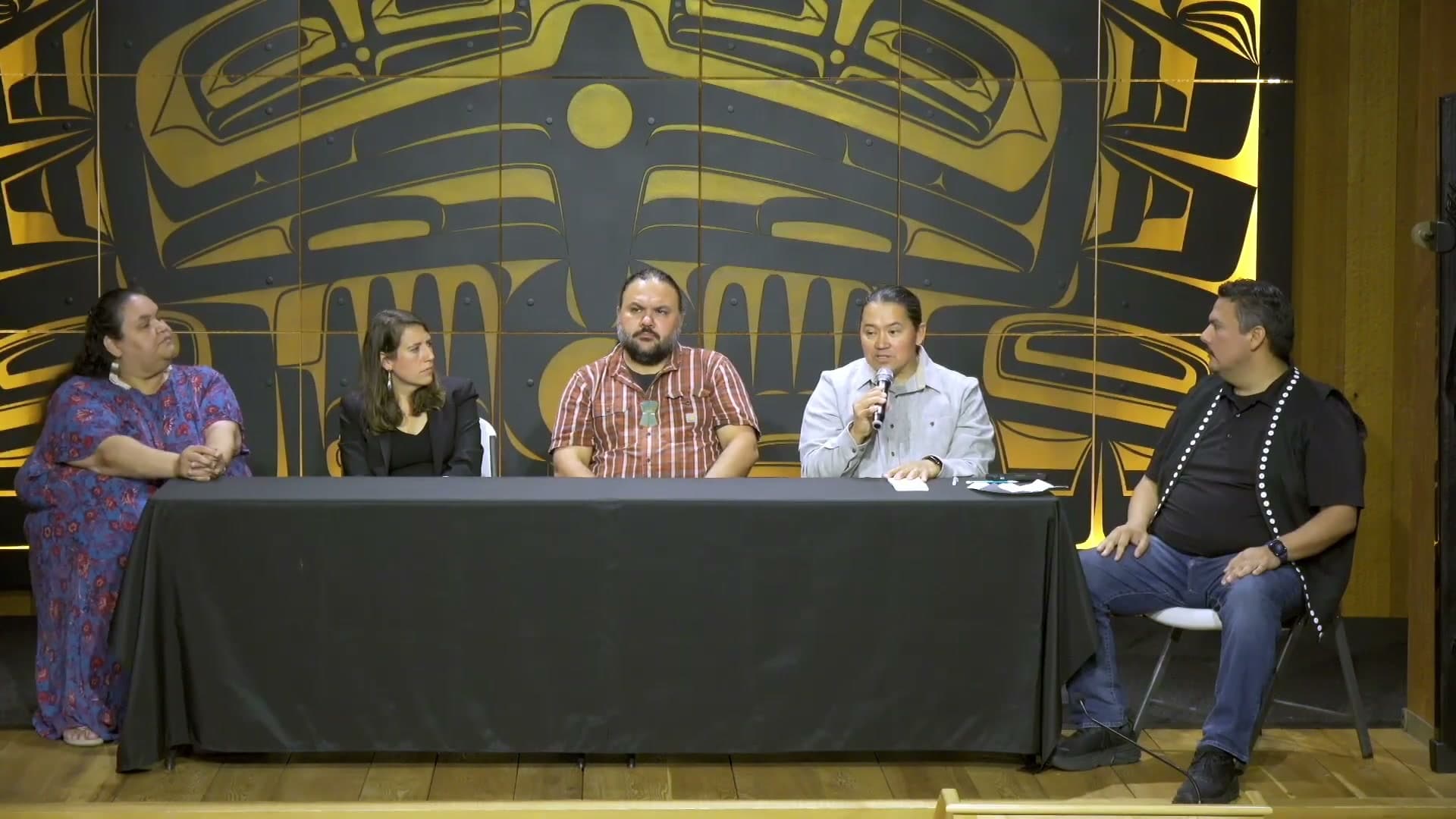
Sealaska Heritage president says Tlingit-Russian War story belongs to all clans, not Kiks.ádi alone
Sealaska Heritage Institute President Rosita Worl said the stories of the Tlingit-Russian War belong to all Tlingit clans and the Haidas, not the Kiks.ádi alone.
Jerick Lang, who said he is Kiks.ádi and spoke for himself, not his clan, put the question to the creative team Thursday at SHI's Clan House in downtown Juneau. "The choice to narrate a story that is clan-owned doesn't necessarily sit well with all people," Lang said. He added that he supports the production and asked what consultation and care would accompany clan-owned stories if the opera continues.
"Ḵutulagaaw: The Tlingit-Russian Battles," a Sealaska Heritage and Perseverance Theatre production performed entirely in Tlingit, draws on oral traditions of the 1802 and 1804 battles at Sitka. The panel came ahead of the Sept. 11 world premiere.
Worl said the institute has gone to court over intellectual property. "Sealaska Heritage Institute really believes in traditional ownership of clan-owned property. We have been willing to go to the courts," she said. She cited suits against corporations in the United States, England, Europe and Italy. The institute's Council of Traditional Scholars advises on protecting cultural norms, and its dance groups acknowledge clan ownership of songs.
The institute faced the same question previously, Worl said, when it published the Tlingit-Russian war accounts edited by Dick and Nora Dauenhauer and Lydia Black. Because all the clans and the Haidas united against the Russians in 1802, she said, "we believed that this story was owned by all of the clans and the Haidas." Sitka is the Kiks.ádi and Kaagwaantaan homeland, she said, and the Kiks.ádi lived alongside the Russians there. She said SHI means no disrespect and told the Kiks.ádi "we admire you." No panelist described a specific Kiks.ádi consultation process for the opera.
Khoné, the opera's translator, said perhaps six people can still fully speak Tlingit and that stories kept locked away cannot be passed on in the language. He described illustrated Tlingit books halted after objections to publishing one elder's story.
This article is based on a public meeting of Sealaska Heritage Institute — Sealaska Heritage Institute: A Panel Discussion with the Tlingit Opera Creative Team | Sealaska Heritage ().
Made by our human newsroom with AI. How humans and AI work here · Grow with our newsroom Transcript byLucas Brown
Watch key moments from the source meeting. Click to expand.
Stay informed. Support what matters.
Free, permanent access to local news you can verify. Subscribe to support Maggie AlaskaNews and go ad-free.
Related Coverage
Creators of first Tlingit opera take public questions Thursday in Juneau
Alaska News · 1mo ago
Tlingit opera adds program guide and pre-show storyteller for audiences who do not speak the language
Alaska News · 1mo ago
Juneau to host world premiere of first Tlingit opera
Alaska News · 3mo ago
The first Tlingit opera in recorded history opens in Juneau next month
Alaska News · 2mo ago
You can name your own price to see the Tlingit opera in Juneau
Alaska News · 1mo ago
Comments
Sign in to leave a comment.
No comments yet. Be the first to share your thoughts.