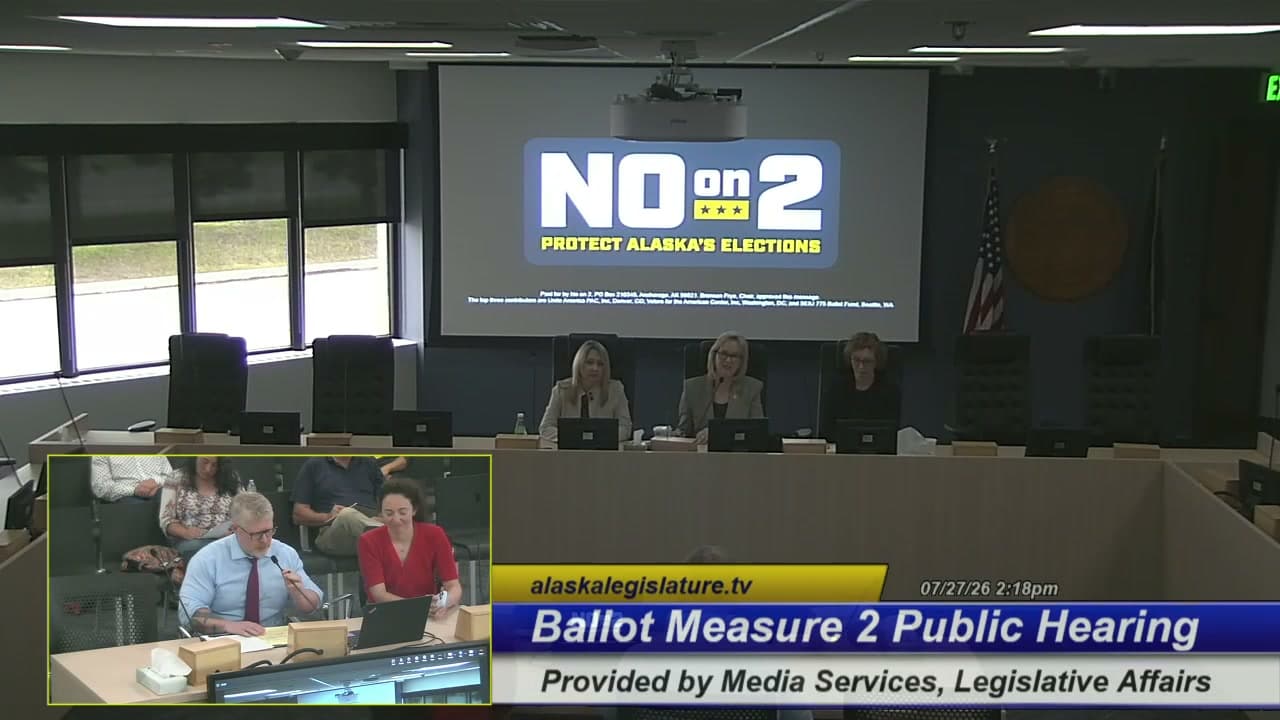
Frame from "Alaska Legislature: 2026 General Election - Ballot Measure No. 2 - 24ESEG - Initiative Hearings" · Photo source
Pro and Anti Ranked choice campaigns trade billionaire accusations at hearing
Alaska's ranked choice campaigns spent Monday accusing each other of running on out-of-state billionaire money, at a hearing on a measure that would also repeal the state's rules for tracing that money to its original source.
Ballot Measure 2 would end open primaries and ranked choice general elections and restore party primaries. It would also repeal 2020 rules requiring an entity that gives more than $2,000 out of money it received as donations to identify the true source behind it, and requiring ads to name top contributors. Alaska already required groups to report their contributors before 2020; the newer rules added the step of looking through intermediaries.
Outside money has driven this fight from the start. National groups bankrolled the 2020 initiative that created the system, and the 2024 repeal attempt was heavily outspent, by Judy Eledge's count $15 million to $150,000. Testifiers Monday brought their own tallies from state filings, which did not agree. One counted $5.5 million to the anti-repeal side from Denver-based Unite America PAC against roughly $10,000 from individual Alaskans. Another said the pro-repeal Aurora Action Network lists an Anchorage address but is organized in Wisconsin, with Pennsylvania investor Jeff Yass supplying more than 60 percent of its funding.
Scott Kendall, who wrote the 2020 initiative and now speaks for the No on 2 campaign, said more than half the repeal side's money comes from a single Pennsylvania billionaire. Eledge, who chairs Repeal Now, said a Colorado billionaire funds his. Both are describing the same landscape.
Bethany Markham, for the sponsors, said ranked choice produces exhausted ballots that stop being counted. Kendall said no ballot is discarded and each is recorded wherever it leaves off. Both descriptions are accurate: a ballot ranking only eliminated candidates is tallied but does not reach the final round. On primaries, Kendall said repeal would let parties decide who votes in contests the state pays for, in a state where two-thirds of voters register with neither party. Markham said repeal would restore primaries open to unaffiliated voters rather than closed ones.
Voters rejected repeal in 2024 by 50.1 percent to 49.9 percent, the narrowest ballot measure result in state history. A second hearing takes testimony Aug. 5.
This article is based on a public meeting of Alaska State Legislature — Alaska Legislature: 2026 General Election - Ballot Measure No. 2 - 24ESEG - Initiative Hearings ().
Made by our human newsroom with AI. How humans and AI work here · Grow with our newsroom Transcript byLucas Brown
Watch key moments from the source meeting. Click to expand.
Stay informed. Support what matters.
Free, permanent access to local news you can verify. Subscribe to support Walter AlaskaNews and go ad-free.
Related Coverage
Alaskans split over ranked choice repeal at state ballot measure hearing
Alaska News · 2mo ago
The money gap in Alaska's ranked choice fight is growing
Alaska News · 1mo ago
A fight over Alaska's elections, including over outside money, is itself funded almost entirely from outside Alaska
Alaska News · 2mo ago
No on 2 spends $2.1 million in about 10 days as the ranked choice vote nears
Alaska News · 16h ago
Murdoch gives $500,000 to No on 2 as repeal side reports $279,000 from Aurora
Alaska News · 1w ago
Comments
Sign in to leave a comment.
No comments yet. Be the first to share your thoughts.