Video Clips
Quoted moments from Alaska public meetings, hearings, and press conferences.
Clips from Alaska State LegislatureClear
0:47
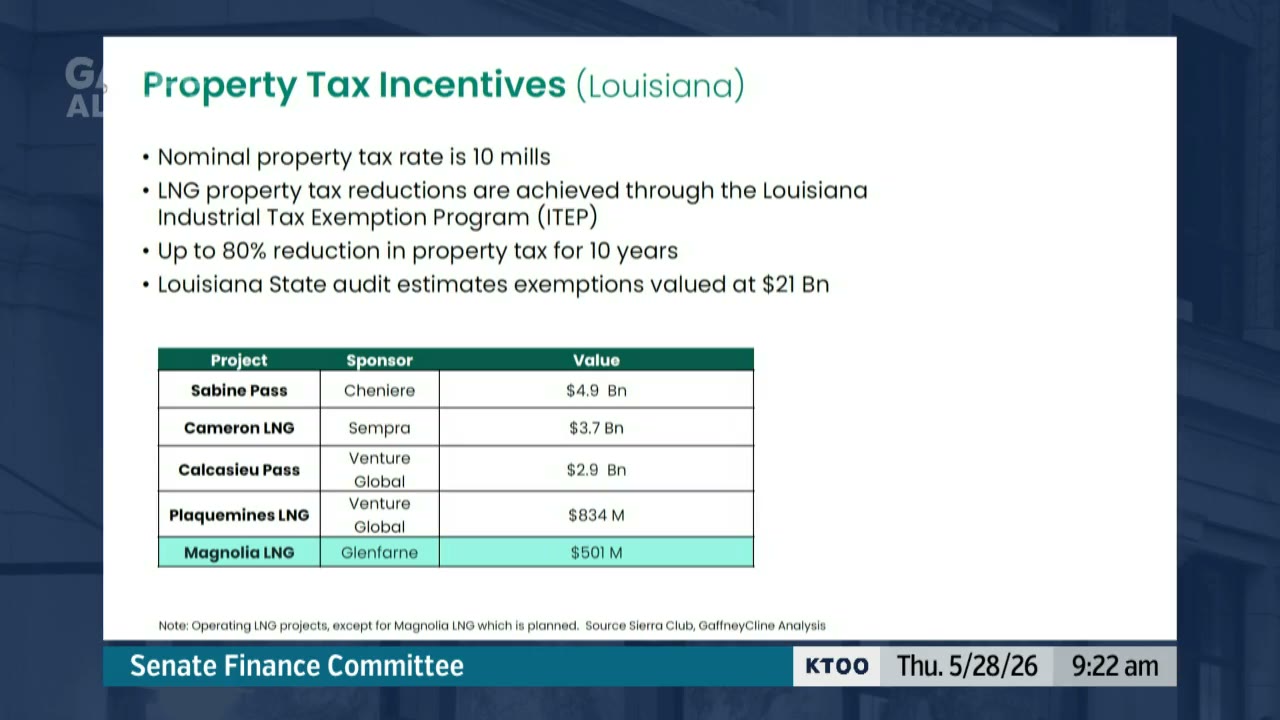
Nicholas Fulford“That's a good summary. What I would say is that that remaining 2 mils, from what I understand, And I don't have detailed numbers on this, but from what I understand, through various other tax exemptions and local arrangements, I think most of the rest of that 2 mils disappears as well. So I think you could almost regard Louisiana as being a full property tax holiday for 10 years”
SFIN-260528-0900 ·
0:42
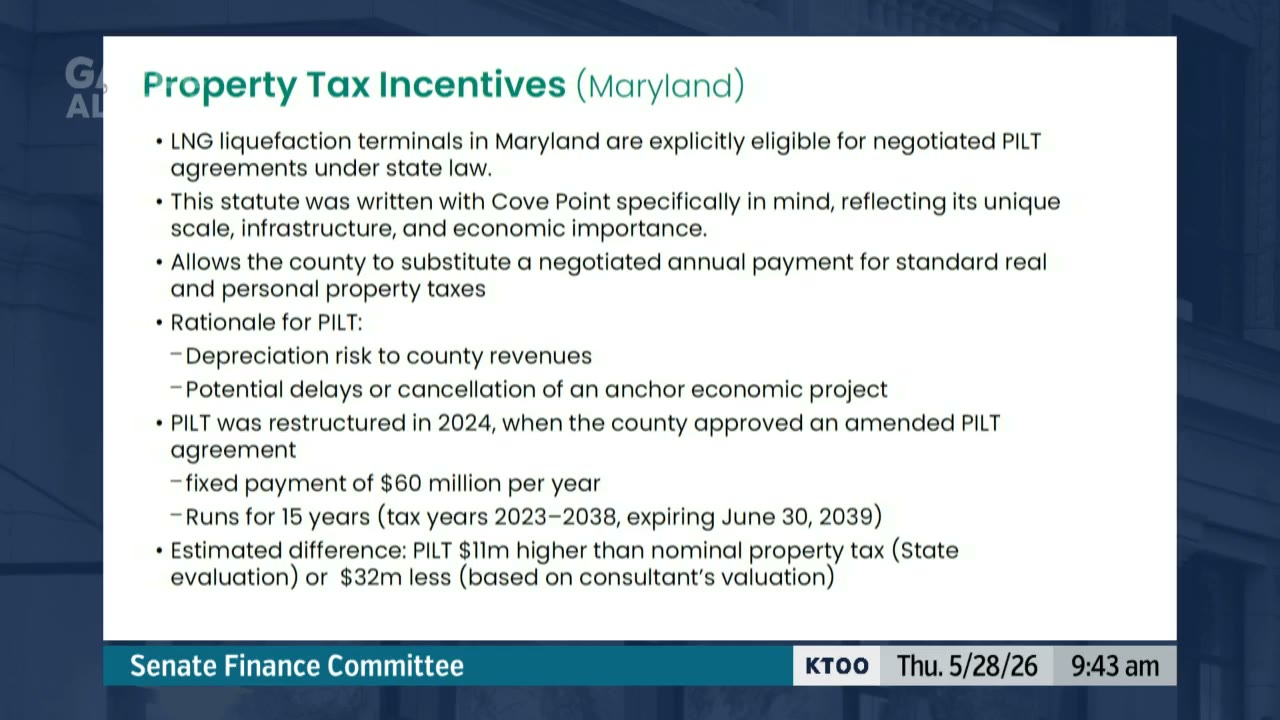
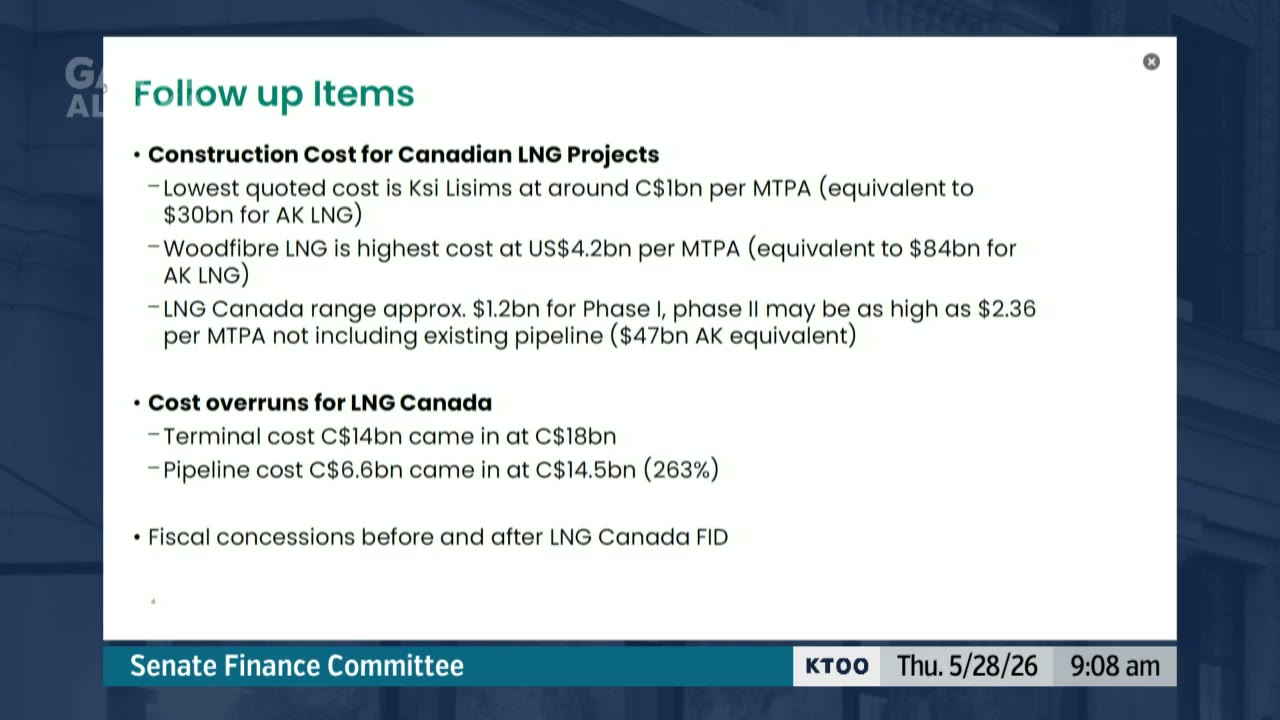
Nicholas Fulford“if they do achieve Phase 2 FID on a cost of $2.36 billion per MTPA, then that suggests that Alaska potentially has a lot more headroom than previously believed, because if they can invest that and sell LNG profitably into Asia, with a $47 billion equivalent just for the LNG, that suggests that the economics of Alaska might be stronger than previously believed.”
SFIN-260528-0900 ·
0:58
James Kaufman“one of the huge differences is the source of the gas. And so, I mean, there's things that make it such an apples and oranges comparison where I'm sure most of the gas that's being transported in these lines is not coming from state ownership with any kind of royalty or maybe very little.”
SFIN-260528-0900 ·
0:45
Lyman Hoffman“these people are out, you know, are getting some breaks, yet we're sitting here arguing, should we give breaks to building our pipeline in the harshest conditions and, you know, maybe very limited building seasons of time when they have to put that pipeline in the ground.”
SFIN-260528-0900 ·
0:50
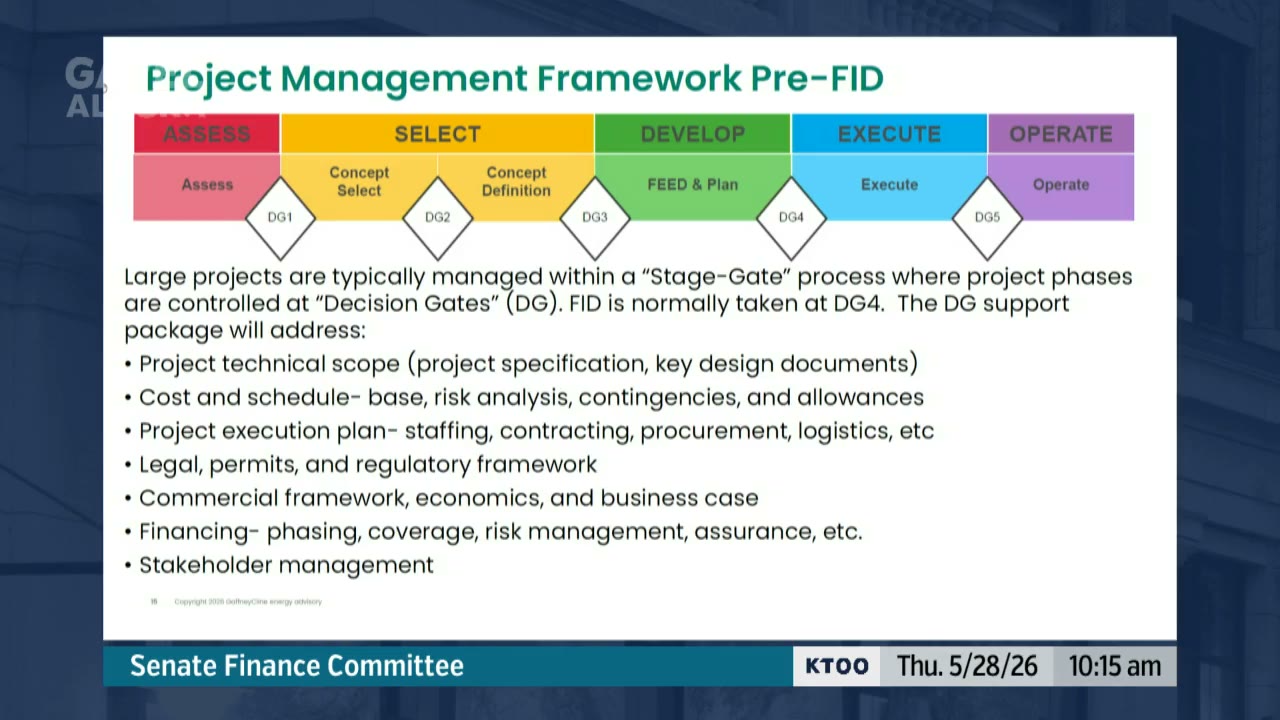
Nicholas Fulford“one of the key challenges for this project when you're probably looking at $30 billion or so of debt, is between now and FID, the people providing that $30 billion have to go through this project with a fine-tooth comb and consider every kind of scenario to make sure their money is safe. So in some ways, if the project can secure $30 billion of debt, then right there, there's a relatively high degree of confidence in the project's ability to go forward.”
SFIN-260528-0900 ·
1:14
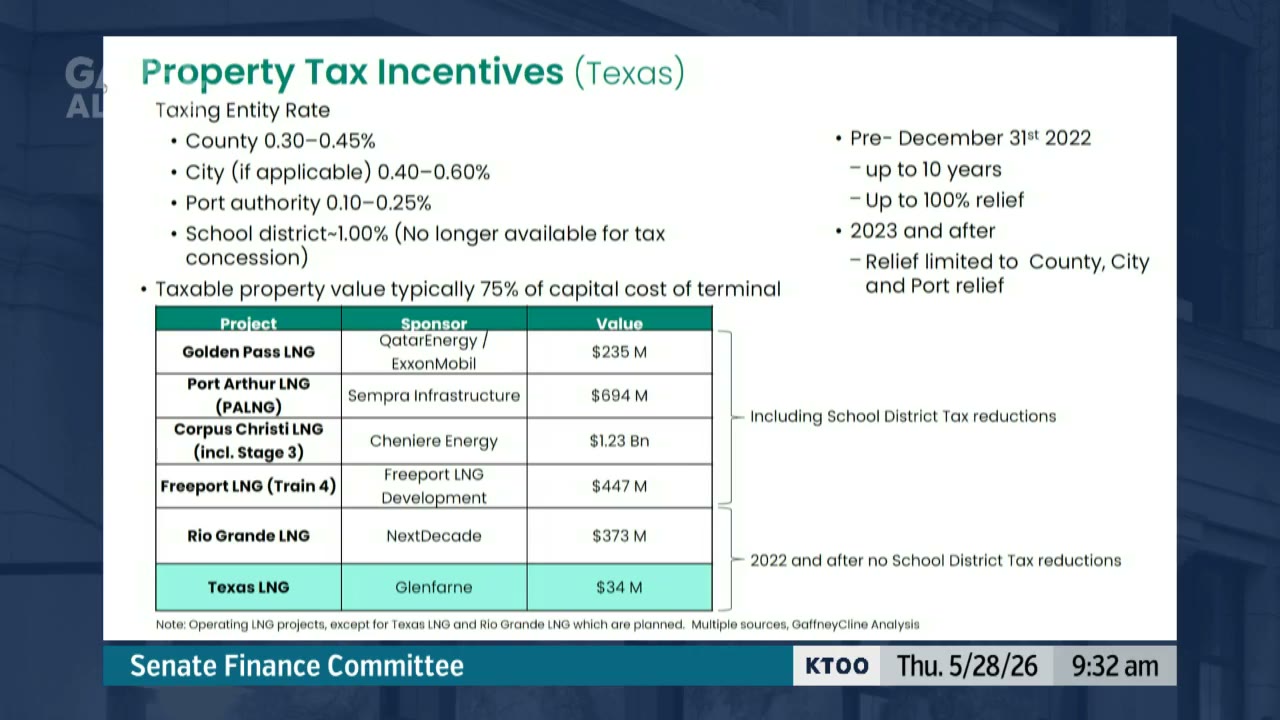
Nicholas Fulford“the property tax rate is 10 mils rather than 20, and there are differences in the way in which the taxable value of the facility is calculated. But you can see there, um, you know, Sabine, which is being expanded, Cameron, Calcasieu, and Plaquemine, they're all existing LNG projects. And you can see there on the chart the value of the property tax concession for those companies is, is quite substantial.”
SFIN-260528-0900 ·
1:02
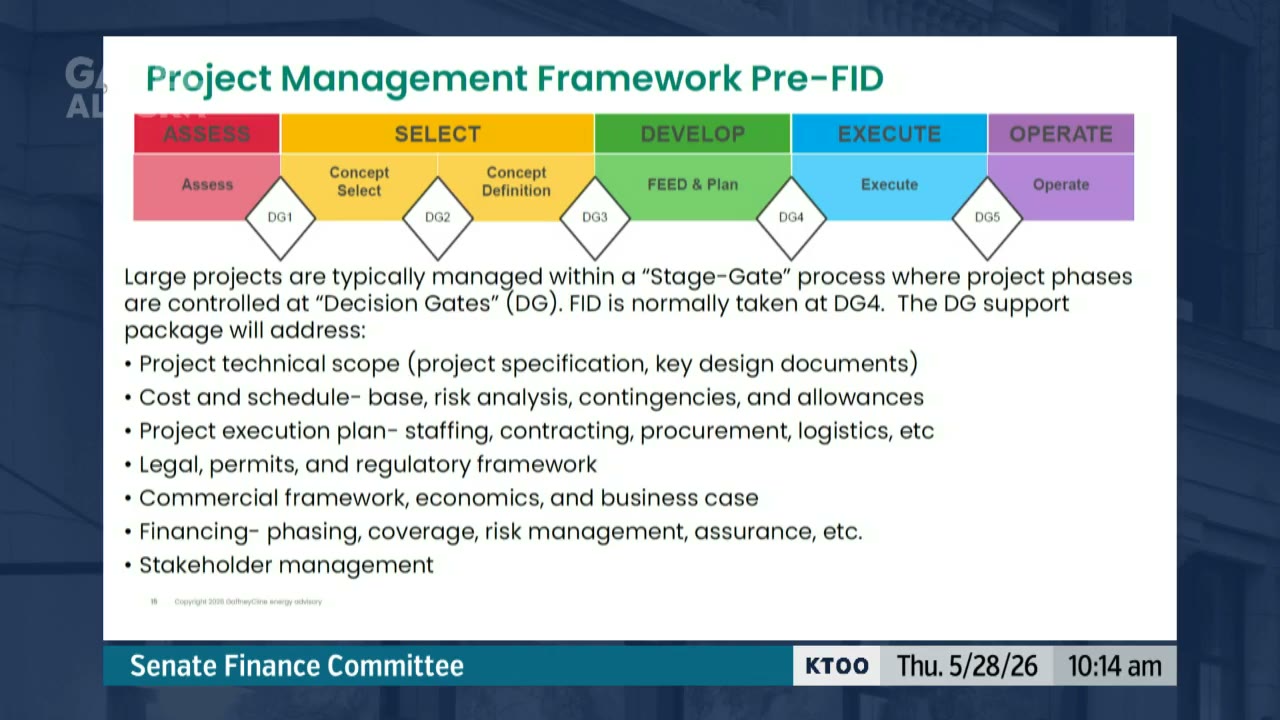
Nicholas Fulford“given the scale of the project, is debt funding. As we've discussed, in a project of this sort, probably be 60, 70% maybe even more, financed on what they call a non-recourse basis. So this would be off balance sheet, so companies would contract with a consortium of banks that would lend the money and would take some degree of risk themselves.”
SFIN-260528-0900 ·
0:31
Matthew Kissinger“We had them come in and compare it with every other jurisdiction, especially around the U.S., Canada, but also some overseas jurisdictions. And what they found was that our property tax in Alaska, the way it's structured, assured would result in property taxes a whole order of magnitude, so kind of 10 times higher than the next highest.”
HFIN-260527-1330 ·
1:19
Frank Richards“the cost estimate level for the gas treatment plant and the liquefaction are currently a Class 4. And so, as I started off, you know, we were at $44 billion, we reduced it to $38 billion in 2020. And what AGDC did is we had engaged with Fluor as essentially our owner's engineer over the years, and we asked Fluor to keep up with the cost and we would recast that cost estimate”
HFIN-260527-1330 ·
0:36
Will Stapp“Obviously, kind of begs the question, if you have 3 studies identifying that property taxes were a big issue in the project, the bill to restructure property taxes in Alaska in the project didn't come before the legislature, I want to say, until nearly the end of March. So obviously here we are in special session given the time constraints. And I'm just curious if you guys knew about this for so long, why wasn't at least a skeleton structure presented for us last year or year before or year before that?”
HFIN-260527-1330 ·
0:27
Matthew Kissinger“If you look at Canada versus Alaska, they have It's a fairly well-known resource, but it's an undeveloped resource that requires drilling and development through the life of those projects. It's the Montney and the Horn Rivers, tight, tight oil and gas up in northern BC and Alberta. They have the pipeline that had to go over the coastal range. We get to avoid the coastal range.”
HFIN-260527-1330 ·
0:38
Matthew Kissinger“3 of them really stood out. The first one was what we called state and federal support, such as the loan guarantees, but really it was focused on the loan guarantees. The second one was an even lower gas price, which we have continued to negotiate a lower and lower gas price with the producers. And then finally, even back then, we identified that property taxes were one of the biggest triggers that you could pull.”
HFIN-260527-1330 ·
0:26
Matthew Kissinger“I would suspect— I would expect that any contract going in front of the RCA for utility sales in Alaska would look very different with or without the changes to property tax. Simply because it's more than— it's well over $2 impact per MMBTU, which is the unit of measure that is normally sold in. And so I don't believe that they could just simply absorb it.”
HFIN-260527-1330 ·
0:27
Frank Richards“it's really around the property property tax and how we are, you know, far out of our field compared to our competition in other portions of the world. So we wanted to bring this back just to really identify that property tax is an issue within the state of Alaska for this project because, again, it's not an oil project. This is a natural gas project. And so the margins are much smaller than an oil project.”
HFIN-260527-1330 ·
0:37
Andy Josephson“when we talked to our consultant, Mr. Fulford, yesterday, he didn't suggest that, that, uh, the contract covered price. That was an imperative feature on his slide deck, I think taken from DOR, showing these heat charts where we had to be in the top left corner to reach or come under that $10.41 cost at delivery.”
HFIN-260527-1330 ·
0:42
Matthew Kissinger“In 2016, they brought in Wood Mackenzie, and they asked Wood Mackenzie to do a competitiveness analysis of the project. And Wood Mackenzie said that the project ranked poorly in terms of competitiveness. And they recommended that we adopt a debt-funded third-party tolling structure rather than what would normally be your IOC, your International Oil Company balance sheet financed project.”
HFIN-260527-1330 ·


0:49
Nicholas Fulford“the first thing that happened was that the LNG project tax was revealed— repealed. Then in the run-up to FID, the depreciation mechanisms were accelerated by the federal government. There was a complete deferment of sales tax on the project while it was being built. So it wasn't a tax holiday, but it was a deferment of the nominal tax for 20 years.”
SFIN-20260527-1330 ·
1:05
Nicholas Fulford“the CO2 tax was also reduced quite substantially. It wasn't eliminated, but ultimately, as you can see on this slide, the, the final part in that kind of fiscal package was a natural gas credit which was applied to corporate income tax, provincial corporate income tax. So that, that reduced the provincial corporate income tax effectively from 12% to 9%, leaving a net 24% tax rate. So obviously if you compare that with the corporate and— sorry, the, the federal and state corporate income tax here, because federal tax is allowable, it comes to 28.4%”
SFIN-20260527-1330 ·


1:25
Nicholas Fulford“the legislature at the time, they were kind of looking at landed LNG prices in Japan, which probably about $15, $18 at the time, and they were looking at the wholesale gas value in British Columbia, which might have been a couple of dollars, and, and they're looking at that arbitrage and thinking, well, my goodness, that there's a huge amount of profit here to be captured, so we need to make sure that's taxed. So they introduced, um, an LNG project tax”
SFIN-20260527-1330 ·
1:04
Nicholas Fulford“it was really when the federal government decided that exports of LNG into the Pacific were a kind of a national— were of national importance, that they collaborated with the provincial government at a level which I think has never been seen before. So it became a kind of a three-way negotiation between the project developers, the provincial government, and the federal government. And that all came to a head in March 2018, and I would describe it as the last piece in the jigsaw which then enabled FID to be taken in October 2018.”
SFIN-20260527-1330 ·

0:31
Nicholas Fulford“My favorite one to start with in the context of AK LNG is the Xyla Shims project, which is potentially a 12 million ton floating LNG project. Literally just a few hundred yards from the Alaskan border. And as it says on the slide there, as the crow flies, it's about 60 miles from Ketchikan.”
SFIN-20260527-1330 ·
0:53
Bert Stedman“one of the things, Mr. Chairman, we might want to think about is this issue of the rapid depreciation of the infrastructure and the incentive that brings to the table. And as I recall, Ronald Reagan did that to the real estate markets back when he was president and lit the real estate market, turned it around, lit it on fire”
SFIN-20260527-1330 ·

1:11
Nicholas Fulford“unlike the Gulf Coast projects, which involve smaller capital investment but higher operating costs, for example, gas purchase and shipping, Alaska's quite the opposite. And although it's a gas project, it's almost easier to look at it as if it were a toll road or an airport or some kind of infrastructure project because most of the value for AKLNG is going to be in that midstream”
SFIN-260527-0900 ·


0:36
Bert Stedman“In this case, Clunth Farm doesn't. They couldn't finance this thing if they had to by themselves. So I think we're— the scale difference between the previous three participants under 138, including the state with its financial assets and its taxing authority, far eclipses the structure of Glenfarm.”
SFIN-260527-0900 ·