Trawl groups ask fishery council to shrink Steller sea lion closures; conservation groups object
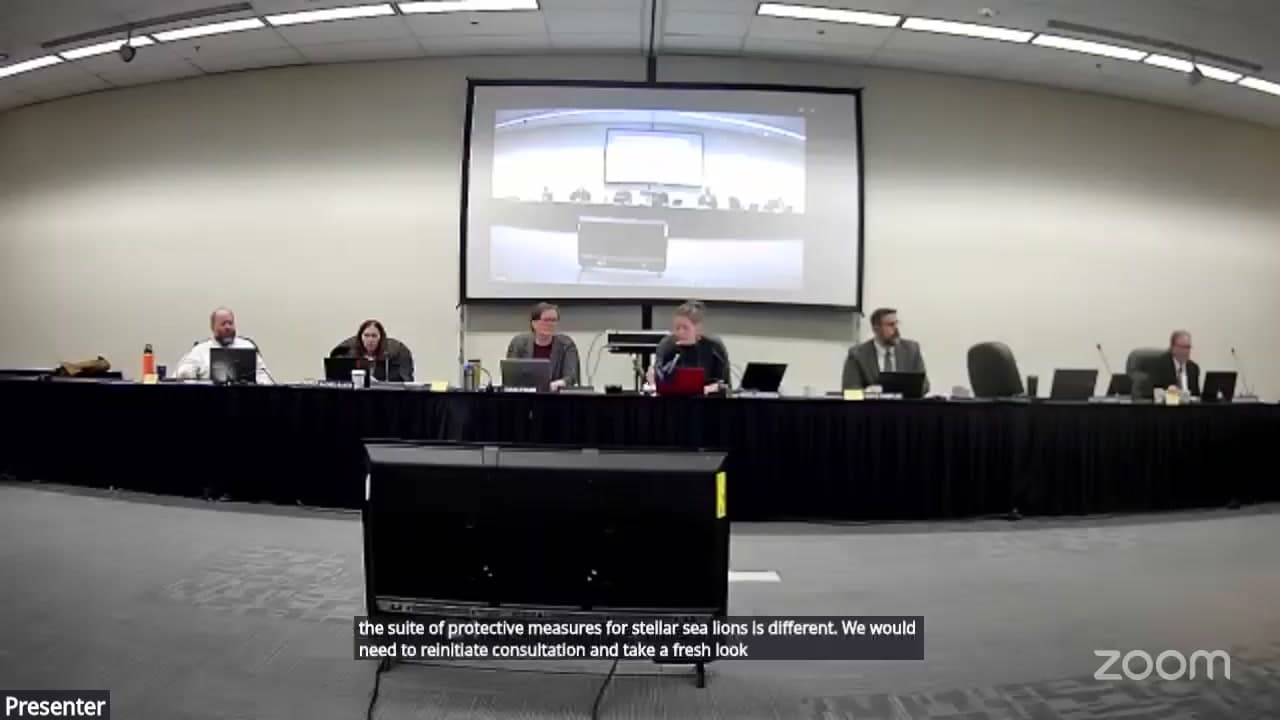
Three trawl groups asked the North Pacific Fishery Management Council on Thursday to analyze shrinking Steller sea lion closures in the Aleutians, the Bering Sea and around Kodiak. Two conservation groups opposed a review, and a Kuskokwim tribal fish commission warned against rolling back protections. The council took no vote.
The closures keep some trawl fishing away from areas around sea lion rookeries and haulouts, where the animals breed and rest. The western population of Steller sea lions is listed as endangered.
The trawl groups cited a July 2 NOAA Fisheries letter asking the council to consider a framework to "modify and shrink closures where appropriate." Council Executive Director Diana Evans wrote that the work could take substantial staff and agenda time unless the council is "very surgical." A NOAA official said changing protections for the western population would require renewed Endangered Species Act consultation and substantial agency resources.
What the trawlers want
Ruth Christiansen of Groundfish Forum asked for "a targeted action on 8 identified closure locations in the Aleutian Islands" for Atka mackerel only. She said more than 95% of the Aleutians would stay closed to non-pelagic, or bottom, trawl gear.
Andrea Keikkala of United Catcher Boats asked for an analysis of the Sea Lion Conservation Area and nearby pollock restrictions. Most catcher vessels must take about 40% of their A-season quota outside the area, she said, which can mean running 90 to 160 nautical miles or more each way and costs the fleet an estimated $1 million to $2.5 million in extra fuel each A season.
Rebecca Skinner of the Kodiak-based Alaska Whitefish Trawlers Association asked the council to remove four closures that she said block trawling in Shelikof Strait and push boats into areas with much worse winter icing.
What the opponents said
Nicholas Jacuk of Ocean Conservancy said the benefits of shrinking the closures to fisheries "are limited at best," and noted the council's June 2025 list of 20 recommendations included no sea lion changes. Lauren Hynes of Oceana said growth of western juveniles and adults has slowed from 0.96% a year to 0.62%, a rate NOAA classifies as stable. NOAA's 2025 survey estimated 38,911 western non-pups, and the agency says the population is still declining in the central and western Aleutians, an area that overlaps the central Aleutians in Groundfish Forum's request.
Terese Vicente of the Kuskokwim River Intertribal Fish Commission said the commission is "alarmed" by NOAA's plans to review and potentially roll back the closures. She said the commission is not against adaptive management, but it shouldn't replace fixed closures that reduce salmon bycatch and protect critical areas for salmon and other species.
The council chair proposed that members try to agree on three or four priorities for staff during staff tasking later in the meeting.
This article is based on a public meeting of NPFMC - Council & SSC Meetings — NPFMC 280 Day 1 - October 8, 2026 ().
Made by our human newsroom with AI. How humans and AI work here · Grow with our newsroom Transcript byLucas Brown
Stay informed. Support what matters.
Free, permanent access to local news you can verify. Subscribe to support Bill AlaskaNews and go ad-free.
Related Coverage
Council sends Kodiak Tanner crab closure to second initial review with preliminary preferred alternative
Alaska News · 4mo ago
Board considers trawl gear restrictions in Aleutian Islands state waters
Alaska News · 6mo ago
Pollock fleet asked to repeat voluntary crab closures in 2027 after proof-of-concept season
Alaska News · 4mo ago
NOAA will stop briefing Alaska tribes before every council meeting
Alaska News · 1mo ago
North Pacific council moves toward enforceable pelagic trawl gear standards
Alaska News · 4mo ago
Comments
Sign in to leave a comment.
No comments yet. Be the first to share your thoughts.