Pollock fleet asked to repeat voluntary crab closures in 2027 after proof-of-concept season
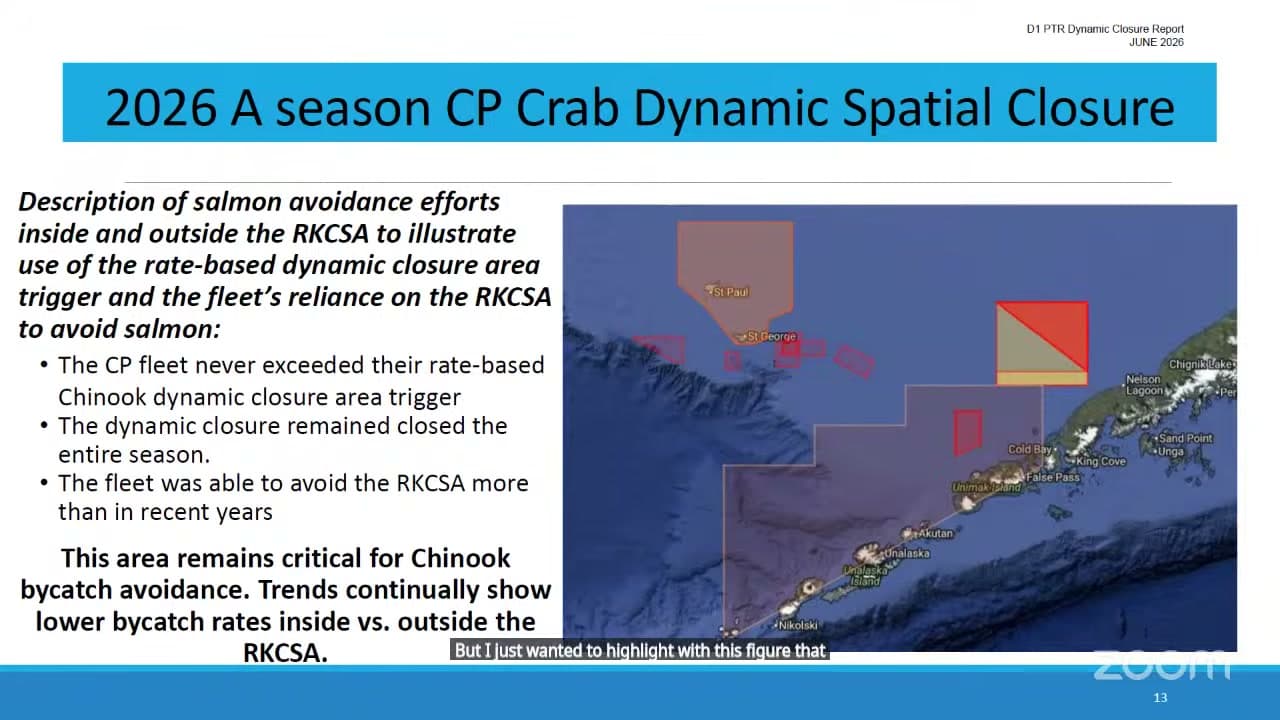
The North Pacific Fishery Management Council voted without objection on June 8 to request that the pollock industry continue its voluntary dynamic closure program in the Red King Crab Savings Area during the 2027 A season. The motion, adopted during deliberations, asks that closures be based on recent winter pot survey data and best available information. It specifies that salmon bycatch should be the highest priority for avoidance and would override identified closures. A post-season report is to be provided to the council at a subsequent meeting.
The 2026 results provided the council with initial data on the program. The inshore sector reported 25 red king crab bycatch inside the savings area and subsavings area combined, and 7 outside the RKCSA, with the majority coming from the same week when the fleet was actively avoiding Chinook and herring outside the RKCSA. As soon as any bycatch was known, it was immediately communicated across the fleet for additional avoidance, and the following week recorded zero. "No catcher vessels had fished inside the closure area even if it was open," the inshore IPA representative told the council. The mothership sector similarly reported zero red king crab bycatch inside or outside the RKCSA. The catcher-processor fleet also reported no crab bycatch; its representative told the council that "our fleet fortunately caught zero red king crab both inside or outside the red king crab savings area this A season."
For the inshore sector, the dynamic closure area was triggered open for 7 weeks and closed for 7 weeks across approximately 14 weeks of fishing. No catcher vessels fished inside the closure area even during open weeks.
Next Steps
The 2026 effort was described throughout the meeting as a first-year proof of concept. Extensive sea ice this season made much of the savings area unfishable starting in early to mid-March and significantly altered fishing dynamics. Council members and industry representatives noted that the program's design, including the use of winter pot survey data to identify where crab are located before setting closure boundaries, is intended to adapt as new scientific information becomes available. Council members raised questions about whether the dynamic closure boundaries could be adjusted annually based on where crab may move in cold versus warm years. The council's adopted motion requests a postseason report at a subsequent meeting to inform those ongoing discussions.
This article is based on a public meeting of NPFMC - Council & SSC Meetings — NPFMC 279 Day 5 - June 8, 2026 ().
Made by our human newsroom with AI. How humans and AI work here · Grow with our newsroom Transcript byLucas Brown
Stay informed. Support what matters.
Free, permanent access to local news you can verify. Subscribe to support Bill AlaskaNews and go ad-free.
Related Coverage
North Pacific council moves toward enforceable pelagic trawl gear standards
Alaska News · 4mo ago
NPFMC directs NOAA to update pollock roe rules after seizure highlighted regulatory gap
Alaska News · 4mo ago
North Pacific Fisheries Management Council limit golden king crab catch limits
Alaska News · 3mo ago
Pollock fleet's groundfish bycatch fell below 1% in 2025, but salmon bycatch rose as warm water pushed fish onto the shelf
Alaska News · 4mo ago
Council sends Kodiak Tanner crab closure to second initial review with preliminary preferred alternative
Alaska News · 4mo ago
Comments
Sign in to leave a comment.
No comments yet. Be the first to share your thoughts.