North Pacific council moves toward enforceable pelagic trawl gear standards
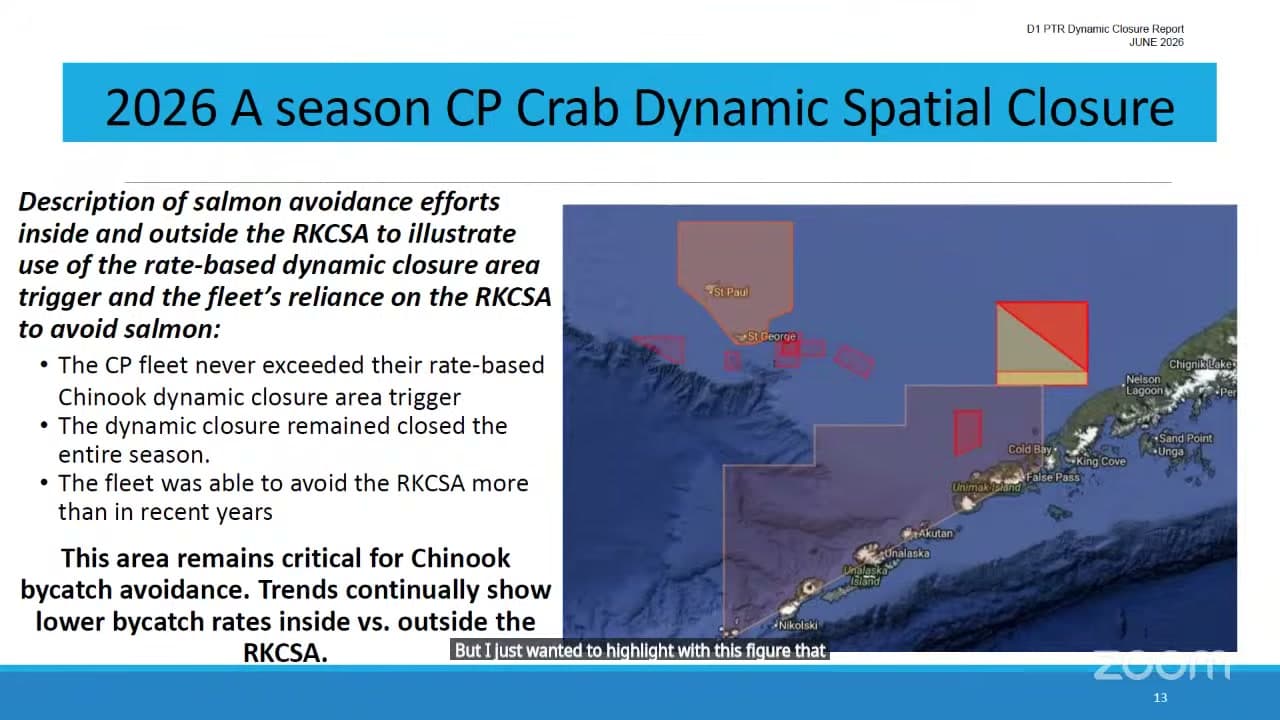
The North Pacific Fishery Management Council voted without objection to request a discussion paper examining enforceable performance standards for pelagic trawl gear bottom contact, moving toward potential regulatory action on an issue that has divided Bering Sea fishing sectors for years. The council is not yet writing rules, but it has formally directed staff to map out what rules could look like and whether the technology exists to enforce them. In a separate motion, the council also requested the pollock industry continue implementing dynamic spatial measures for crab avoidance in the Red King Crab Savings Area during the 2027 pollock A season.
What the Motion Directs
The motion directs staff to identify areas closed to non-pelagic trawl gear but open to pelagic trawl gear in both the Bering Sea and Gulf of Alaska, summarize ten years of pelagic trawl effort in those areas, and explore three potential mechanisms for reducing contact: a vessel- or sector-level contact rate cap, a swept area cap, and verifiable gear modification or technology standards. An amendment added language requiring the paper to address monitoring technology already in use or practicable within two to three years. The adopted motion frames the objective as reducing uncertainty around unobserved crab mortality and reaffirms that zero bottom contact is not the goal. The motion also reaffirms the Fishing Effects Model as the peer-reviewed best available tool to assess fishing effects on benthic habitats, while recognizing it does not by itself estimate unobserved crab mortality. The paper is also directed to consider trade-offs including catch per unit of effort, fishing time, effort displacement, total impact per unit of target catch, and potential changes in prohibited species catch.
A Reluctant Vote
The Advisory Panel had recommended continued research, support for the dynamic closure measures, and public summaries of gear innovation and sensor technology, without calling for a discussion paper on performance standards at this time. Council members who supported the Advisory Panel's approach noted that Gear Innovation Initiative results are expected in early 2027 and that waiting for those results would produce a more informed paper. Council member Anne Vanderhoeven said she would reluctantly support the motion but remained skeptical: "I have doubts about how helpful the information in the discussion paper might be coming back, and so I'm not gonna oppose the motion, but I guess I'm just really skeptical how helpful this is going to be when it comes back until we have some of those research updates that we're expecting in the spring."
The Stakes
Public testimony over the course of the day reflected deep disagreement about the gear. Industry representatives and vessel operators argued that some degree of bottom contact is operationally necessary to target pollock efficiently and that restricting it could increase salmon bycatch and fishing time. Tribal representatives, environmental groups, fixed-gear fishermen, and crab harvesters called for enforceable standards and argued that areas closed to bottom trawling should not allow pelagic trawl bottom contact. A central tension throughout the testimony was over what level of contact is acceptable and what monitoring tools could verify compliance. Speakers on multiple sides acknowledged that current sensor technology has significant limitations for enforcement purposes, though several disputed the characterization of the gear's impacts and the equivalence between contact and harm.
This article is based on a public meeting of NPFMC - Council & SSC Meetings — NPFMC 279 Day 5 - June 8, 2026 ().
Made by our human newsroom with AI. How humans and AI work here · Grow with our newsroom Transcript byLucas Brown
Stay informed. Support what matters.
Free, permanent access to local news you can verify. Subscribe to support Bill AlaskaNews and go ad-free.
Related Coverage
Pollock fleet asked to repeat voluntary crab closures in 2027 after proof-of-concept season
Alaska News · 4mo ago
NPFMC directs NOAA to update pollock roe rules after seizure highlighted regulatory gap
Alaska News · 4mo ago
Pollock fleet builds empirical database of trawl seafloor contact as Congress weighs gear restrictions
Alaska News · 4mo ago
Council votes 8-3 to study halibut bycatch rules for Golden Fleece replacement vessel
Alaska News · 4mo ago
North Pacific council directs Ecosystem Committee to revise 2004 groundfish policy goals
Alaska News · 4mo ago
Comments
Sign in to leave a comment.
No comments yet. Be the first to share your thoughts.