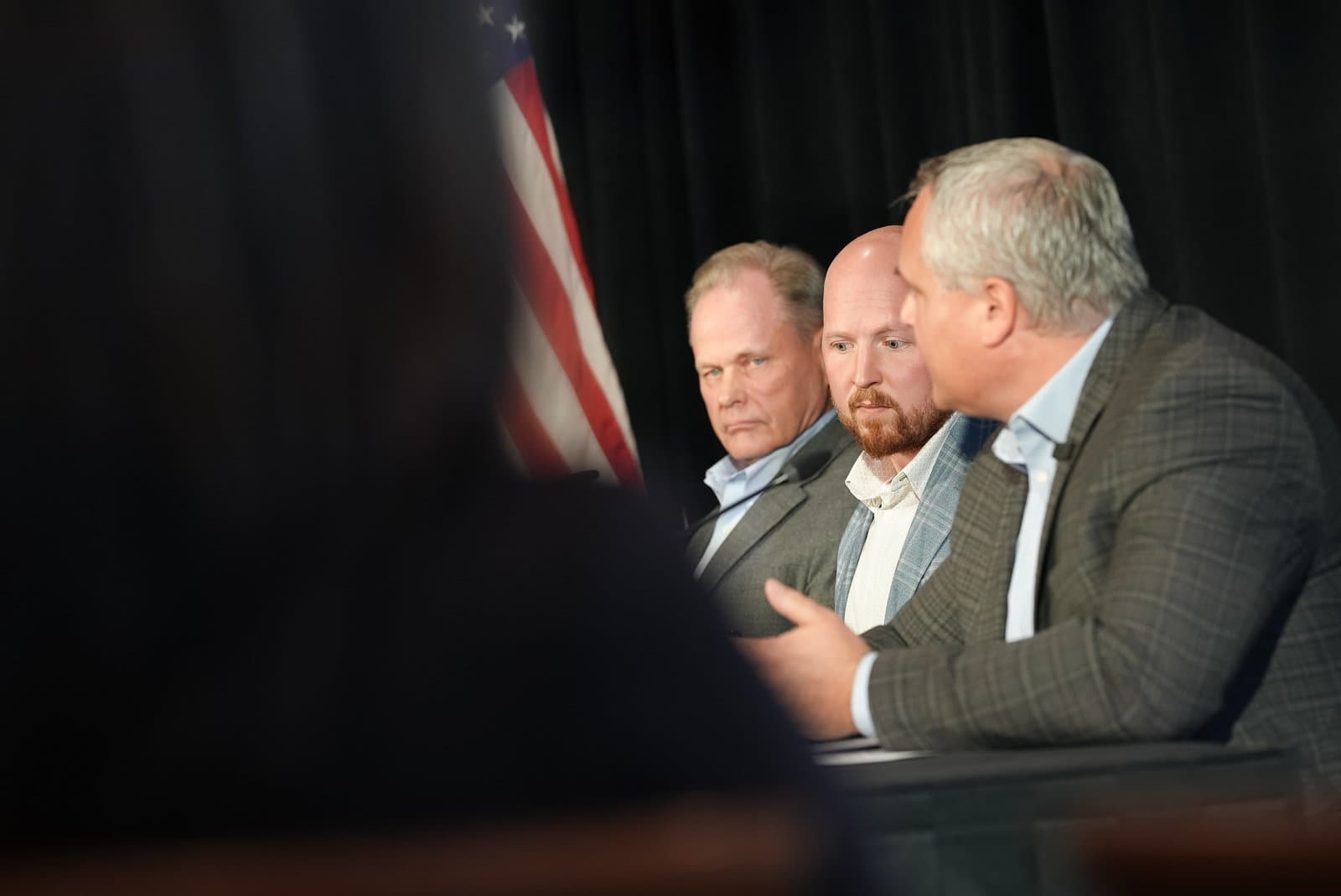
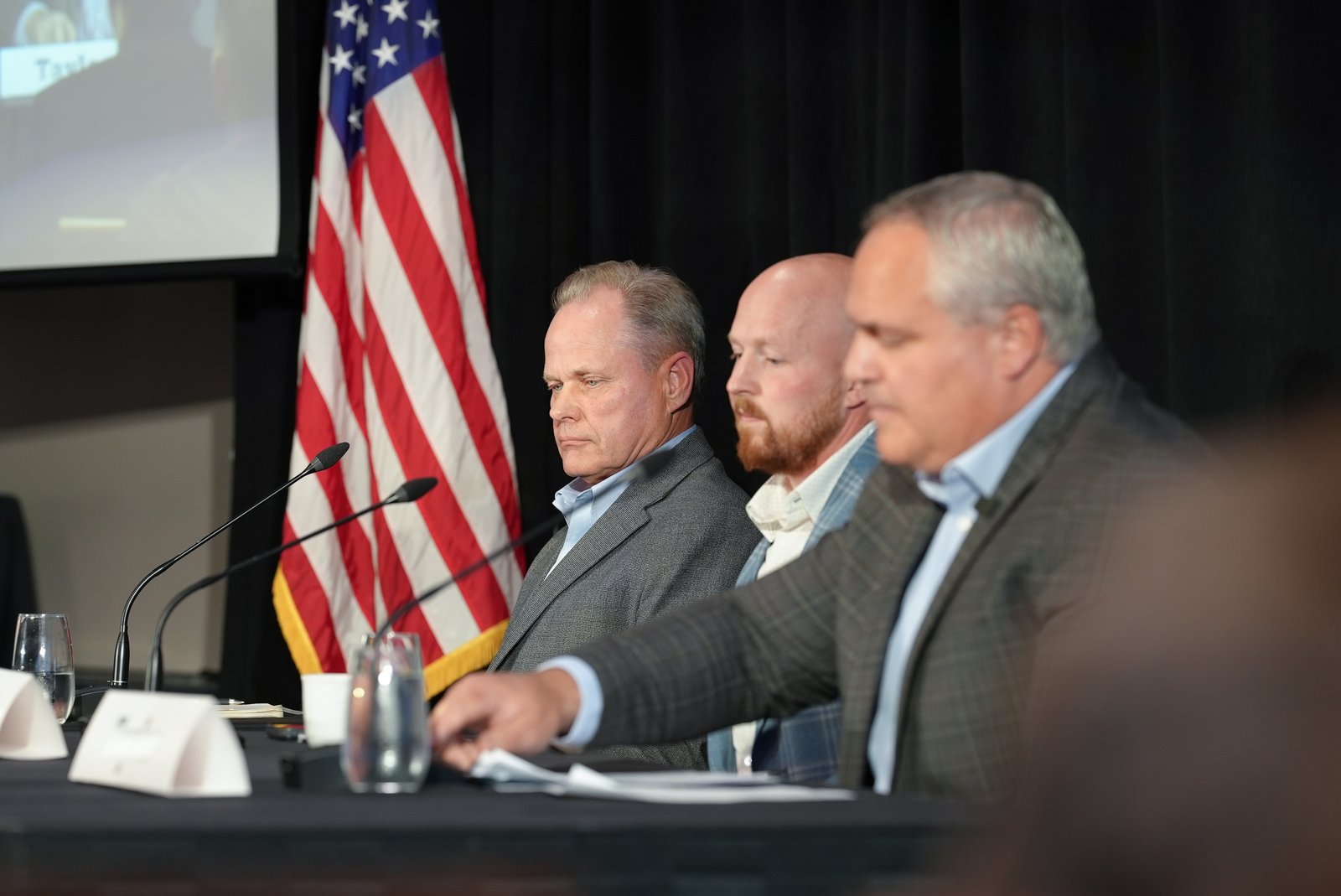
Dave Bronson, Jonathan Kreiss-Tomkins, and Treg Taylor at the Last Frontier Republican Club Forum
Three Alaska governor candidates agree on the problems, diverge on government's role
Three candidates for Alaska governor spent nearly two hours Tuesday agreeing that the state is in trouble, then disagreeing about what government should do about it.
At the Last Frontier Republican Club forum, held before a sold-out room at the Petroleum Club of Anchorage, moderators put eleven questions to Jonathan Kreiss-Tomkins, Treg Taylor and Dave Bronson, on energy, education, the economy, fisheries and the Permanent Fund. The three seldom took each other on directly. Their differences showed instead in how they answered a recurring question beneath the specifics: when should government compel action, when should it pay to encourage it, and when should it get out of the way.
Bernadette Wilson, the fourth candidate certified for the November ballot, did not attend, and the forum went ahead with three. Kreiss-Tomkins is the only Democrat in the field; the others are Republicans.
The sharpest disagreements came on pensions and school choice, where the candidates gave opposite answers to a single question.
On pensions, the Legislature this year passed House Bill 78, which would have restored a guaranteed-benefit retirement option for public workers, and the governor vetoed it. Asked whether they would have let it become law, the three split cleanly. Kreiss-Tomkins said he would have signed it, arguing the current system cannot hold onto the teachers the state depends on; he put teacher turnover between 18 and 21 percent. Taylor and Bronson said they would have vetoed it too.
Where their reasoning divided was over what a pension does to a worker. Taylor and Bronson called it a trap. Bronson, who lost an airline pension at 48, described a defined-contribution account he could carry between jobs as the thing that saved his retirement, and said the state should not obligate its treasury to guaranteed benefits for decades. Taylor argued pensions penalize workers who move and leave nothing to their children.
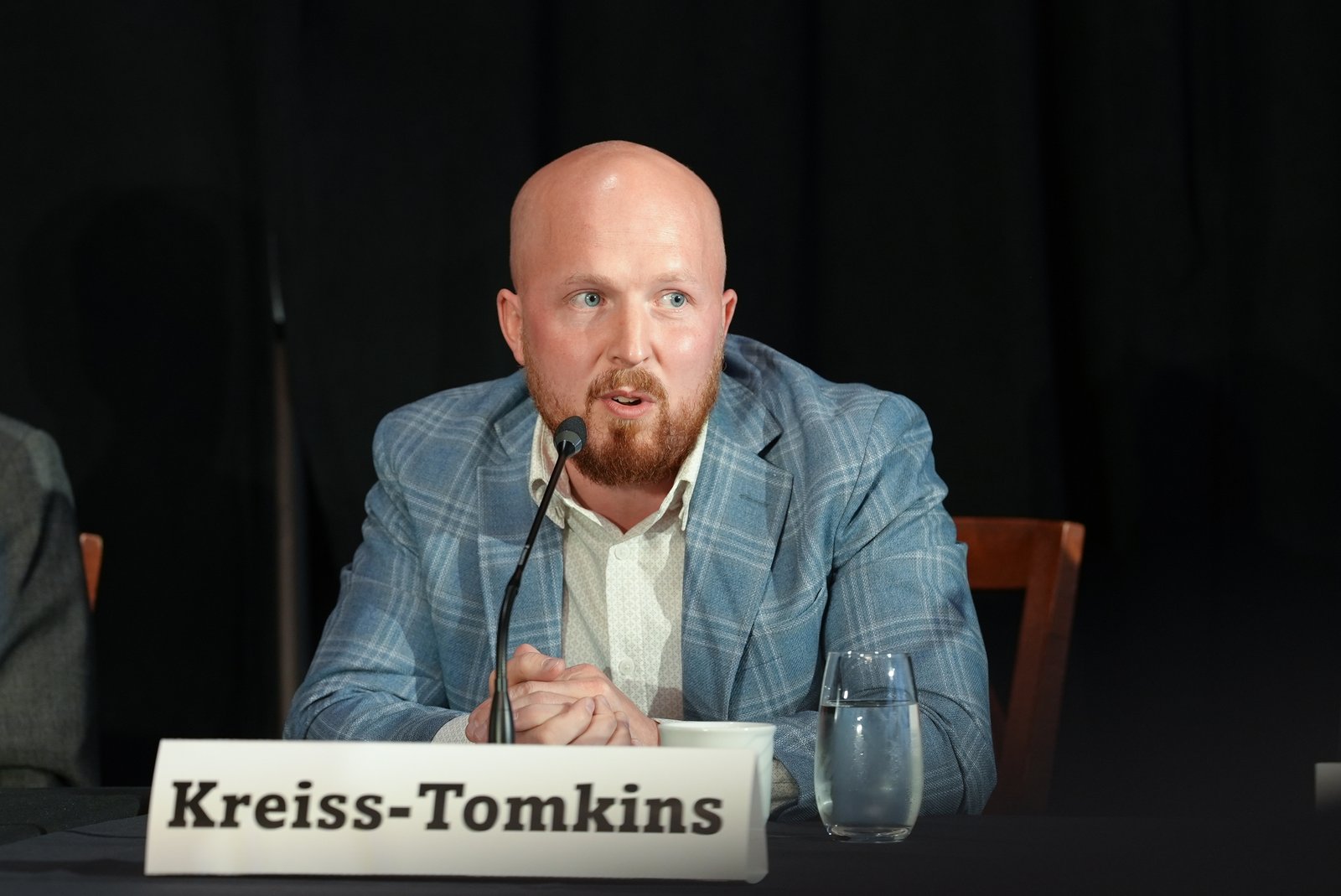
Kreiss-Tomkins framed it the opposite way, as a tool the state needs to compete for workers, but added a caveat he did not spell out: any new system would have to be "actuarially honest" and "net out to zero." He recalled voting, as a young legislator, to cover the unfunded liabilities of the old pension system. "As a young person who's appropriating billions of dollars into the retirement system to benefit people generations above me," he said, "that does not feel fair."
The question had a second half none of the three fully answered. It asked the vetoers how they would otherwise keep teachers and public-safety workers in the state, and asked Kreiss-Tomkins how he would contain the cost. He did not name the assumptions or safeguards behind "net out to zero," and Taylor and Bronson, having rejected the pension, did not say what they would put in its place to improve retention. A 2025 University of Alaska study found no statistically significant difference in teacher retention between the state's two retirement systems over 14 years, and a state fiscal analysis of HB 78 projected $467 million in added contributions through 2039.
School choice divided them the same way. Both Taylor and Bronson back a constitutional amendment to let public money follow a student, including to private or religious schools; Kreiss-Tomkins opposes it.
Taylor spoke from direct experience: while he was attorney general, his department defended Alaska's correspondence-school allotment law through a successful state Supreme Court appeal. He argued the current framework lets families buy individual courses and services with public allotments but not wholesale private tuition, and he wants the constitution changed to go further. "If you live in an area where you're forced to put your kid in a school that's failing, how is that as a parent?" he said. "I can't even imagine that as a parent."
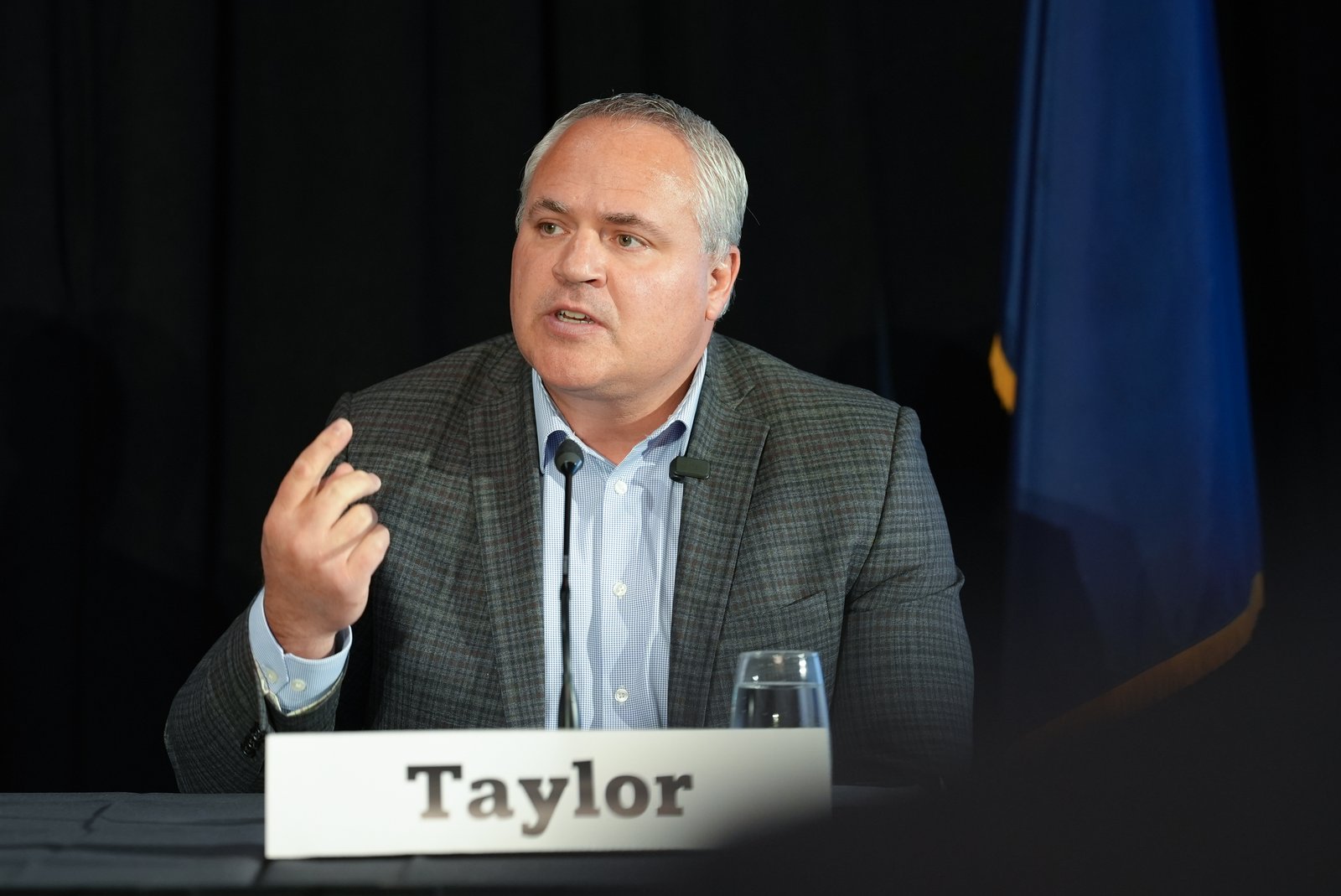
Kreiss-Tomkins, again the dissent, supports a range of public options, including charters and homeschooling, but opposes vouchers and any amendment that would send public money to private schools.
On the economy, the divide was over the minimum wage, and it ran along the same line. Alaska voters in 2024 approved raising the wage to $15 an hour by July 2027 and requiring paid sick leave, 183,744 to 133,162. Taylor called the move an error and said government should defer to the market. Bronson turned it into a broader case against regulation: "You've just got to get government out of the way."
Kreiss-Tomkins was the only one to start from the policy voters passed, defending the wage and the sick-leave requirement. Asked specifically what he would do to help the small businesses that say the law is hard to absorb, he said the Legislature should revisit it if it proves unreasonable, but named no change he would make and no business he had in mind.
Energy was the night's most technical subject. On the near-term gas shortage in Cook Inlet, Taylor and Bronson both reached for incentives. Taylor called importing liquefied natural gas "probably inevitable" before a North Slope pipeline could deliver, and said the state should sweeten the terms to pull more gas out of the inlet in the meantime. Bronson rejected the idea that the basin is running low at all, arguing the problem is political rather than geological: a Legislature that keeps changing the tax structure, he said, has scared off investment. He put the basin's total gas at 19 trillion cubic feet and its proven reserves at 3 trillion. The 19 trillion figure tracks a 2011 federal estimate of undiscovered, technically recoverable gas. His reserves number is higher than the state's: the most recent Alaska forecast put proved reserves at 820 billion cubic feet, less than a third of what Bronson cited.
Kreiss-Tomkins once again went in the other direction. Rather than new incentives to produce more gas, he emphasized burning less of it, by bringing other power online, and named two hydroelectric projects, the Dixon Diversion expansion at Bradley Lake and the proposed Godwin Creek project near Seward. He was not against state support as such; he called for pursuing the hydro projects "with urgency and vigor." But on the gas producers themselves, he favored requirement over reward, crediting the state for pressing Cook Inlet leaseholders to develop their acreage or give it up. Requiring a company to produce or relinquish a lease can force output. It does not by itself make an expensive basin worth the capital, which was the gap Taylor had pointed to.
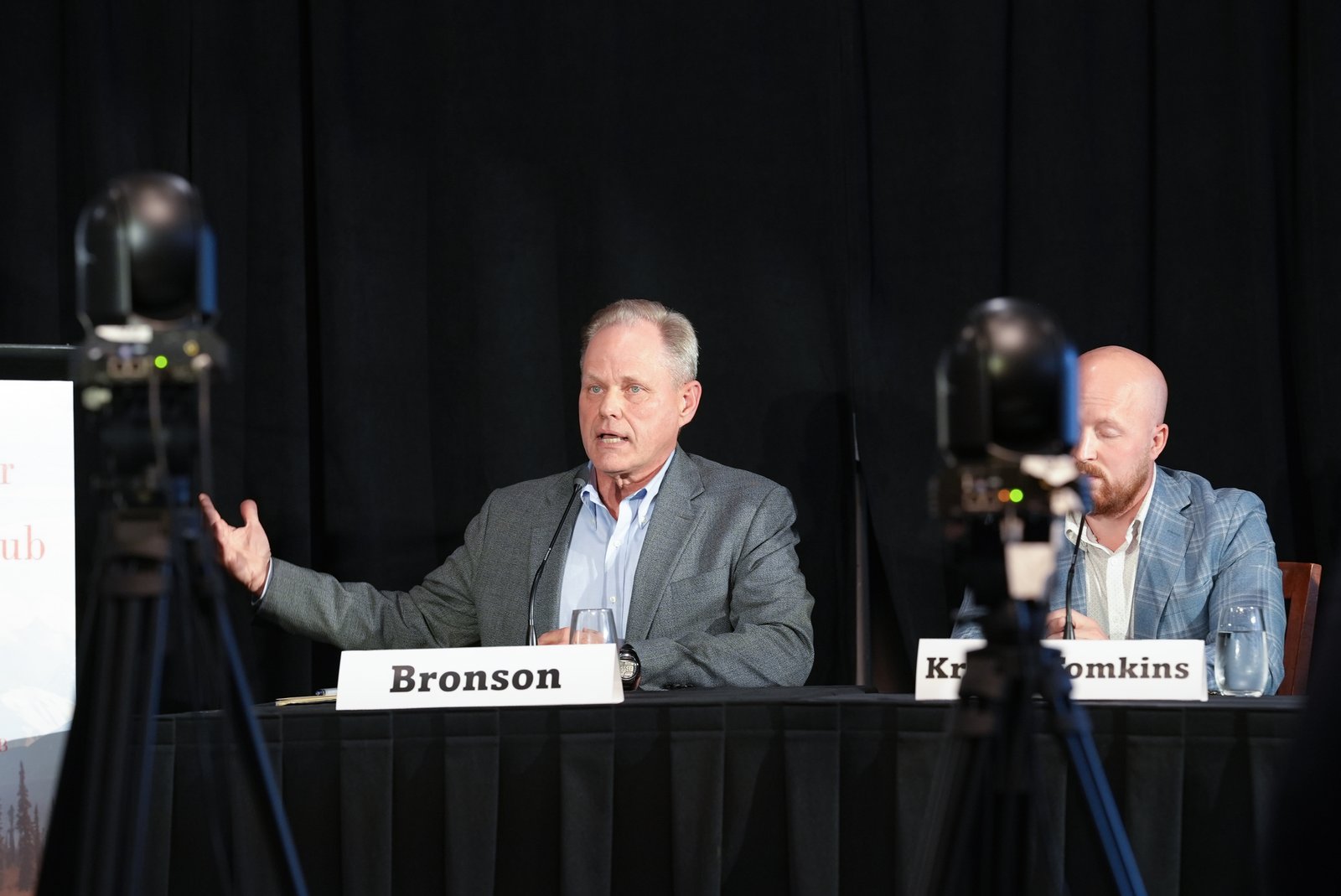
Data centers drew the sharpest role reversal. Bronson, the night's most consistent deregulation voice, gave a detailed answer on how to constrain the industry, describing a negotiated deal in which developers would reserve part of their power demand to sell back to the grid, meet the industry's "five nines" reliability standard, and convert cooling water to potable use. Taylor said Alaska should welcome the industry and let developers bring their own power. Kreiss-Tomkins was the outlier, calling for a moratorium on data-center development until the Legislature writes a full regulatory framework.
Kreiss-Tomkins has held the moratorium position since July, when he first unveiled it. He announced it a few days after his campaign finance filings became public, showing that six employees of the AI company Anthropic had given his campaign $372,000.
On fisheries, the three agreed bycatch is a problem and split on how hard to hit it. Kreiss-Tomkins cited a decade of legislative work on Chinook, chum and halibut bycatch and raised bottom contact from midwater trawl gear as a specific concern. Taylor framed it as "Alaska fish, Alaska first" and said he would take no money from the trawl industry, a pledge Bronson had also made. Bronson went furthest, calling for trawling to be sharply cut or eliminated across much of the state and citing what he said were 388,000 crabs taken as bycatch in the year's first five months. All three noted the governor's real leverage is nominating candidates for Alaska's non-governmental seats on the North Pacific Fishery Management Council, though the U.S. secretary of commerce makes the appointments.
Where the candidates converged most was the Permanent Fund. All three want it constitutionally protected as an endowment. Kreiss-Tomkins had the longest record on the question, having sponsored percent-of-market-value amendments in 2019 and 2021 and worked on a committee version in 2020. Protecting the fund permanently, he said, would let the Legislature "take that cookie jar off the table" and "balance our budget the old-fashioned way."
Their closing statements played to type. Taylor cast himself as a fighter who also works across the aisle, citing crime reductions and an opioid settlement from his time as attorney general. Kreiss-Tomkins promised bipartisan problem-solving and repair of institutions he says have frayed. Bronson asked voters to count his combative term as mayor as experience. "I learned a lot of hard lessons," he said. "Those lessons everyone is gonna have to learn. I don't have to relearn them."
A pattern ran through the night. On questions with a clear cost attached, Taylor and Bronson tended to name a mechanism, sometimes a contested one: cut regulation, sweeten terms for producers, move public money to private schools, replace guaranteed pensions with portable accounts. Kreiss-Tomkins more often named a goal and a process, defending the policy or the institution and calling for the Legislature to work out the details.
Four candidates are on the November ballot. Only three were in the room.
This article is based on a public meeting of Vimeo — Last Frontier Republican Club Alaska Governor Debate 2026 ().
AI-assisted. No editor review is on record for this article. Who is accountable. Transcript byLucas Brown
Watch key moments from the source meeting. Click to expand.
Stay informed. Support what matters.
Free, permanent access to local news you can verify. Subscribe to support Walter AlaskaNews and go ad-free.
Watch the short version
Related Coverage
One Democrat, three Republicans, and two months to go
Alaska News · 5d ago
Bronson calls for bottom trawling ban in state waters at Kodiak fisheries debate
Alaska News · just now
Gubernatorial candidates split on Board of Fisheries overhaul
Alaska News · 3m ago
Bronson takes the last spot on Alaska's four-way November governor ballot
Alaska News · 1w ago
Alaska's governor race upended in a day: a disqualification, a last-minute filing, and a lone Democrat
Alaska News · 1w ago
Comments
Sign in to leave a comment.
No comments yet. Be the first to share your thoughts.