AI image
The state's analysis of Alaska's first crab hatchery says it would add little
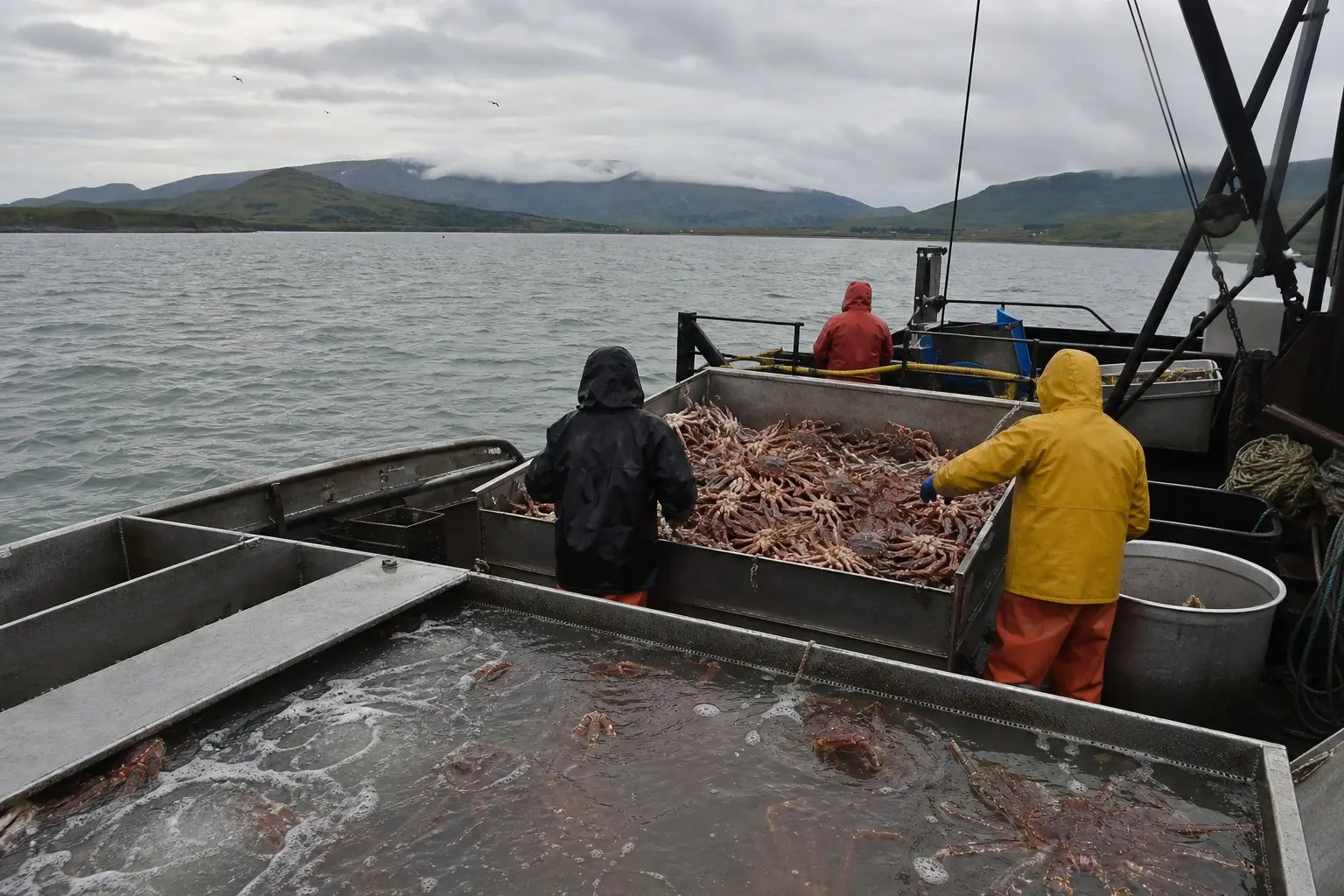
A hatchery on Saint Paul Island has applied for the first shellfish enhancement permit Alaska has ever been asked to issue. It is raising red king crab and releasing them into Bristol Bay, where the fishery has been closed or severely limited for years.
The state's own analysis of the project, completed in July, estimates the releases would eventually produce somewhere between 6,000 and 25,000 mature crab. "This contribution," it says, "is likely negligible on a population-level and commercial fishery scale."
That estimate sits against the standard the commissioner of Fish and Game has to apply. State law bars him from issuing a shellfish enhancement permit unless he finds the project "would result in substantial public benefits and would not jeopardize natural stocks." The governing regulation requires that the release site be capable of making a reasonable contribution to the fishery.
What the hatchery does
The operation occupies a room of tanks on the ground floor of the Trident Seafoods plant in Saint Paul. It has been growing crab since April.
Each spring, crews take 30 to 50 egg-bearing female red king crab from Bristol Bay and hold them until their larvae release. The larvae are reared through two stages, and the survivors, about two millimeters across, are released onto juvenile crab habitat in eastern Bristol Bay near Port Moller. At full capacity, the application describes 45 females producing two million larvae and ending with 640,000 juveniles. The females are not returned to the water; they are killed at the end of the cycle, sampled for genetics and discarded.
The numbers
King crab larvae in the wild are believed to survive from release to settlement at a rate of 1 to 2 percent. The hatchery targets 50 percent.
From there the analysis assumes 5 percent survival to maturity, which turns releases of 250,000 to a million juveniles into 12,500 to 50,000 mature animals, or roughly 6,000 to 25,000 mature females and harvestable males.
The analysis, by Kodiak regional management coordinator Mark Stichert, sets out two conditions under which numbers that small could still matter. When crab abundance sits near the regulatory thresholds that determine whether the fishery opens at all, small increases in mature females carry disproportionate weight. And at recent dockside prices near $25 a pound, even modest additions to the harvestable surplus have value. The effort, Stichert writes, could have real conservation value if female abundance ever falls to a point where the population's ability to reproduce is at risk.
Whether anyone could tell
The application does not propose a way to identify released crab later, and explains why: crustaceans molt, so external tags come off; internal tags need an animal bigger than two millimeters; and genetic marking for red king crab has not been developed. Its stated method of evaluation is that unexpected increases in juvenile recruitment in the annual federal trawl survey may suggest the releases had an effect. The application also notes that red king crab are not caught in that survey gear until they reach 20 to 30 millimeters, two or more years after release.
The state's analysis says a more basic question comes first. Before anyone can judge whether releasing crab works, it has to be established that the population is limited by recruitment at all, and where in the life cycle the bottleneck is. The analysis recommends pilot releases in small enclosed bays to measure how many survive and how far they move. Neither has been done.
The two documents also differ on genetics. The state's analysis says maintaining genetic diversity is important and that reducing it puts the population at risk, and recommends future research to guide how many broodstock are taken. The application says in one sentence that "genetic contamination is not a concern because of the nature of this project," a mass release at the juvenile stage. The department's own genetic guidelines for invertebrate mariculture, which the application cites in a footnote, call for an effective population size of 400 or more per generation before outplanting. Nothing in the file addresses whether 45 females meet that.
The fishery
Bristol Bay red king crab peaked in 1980 at nearly 130 million pounds. The directed fishery closed entirely in 2021 and 2022 for lack of mature females, reopened with 2.12 million pounds in 2023, and has taken slightly more each year since. Recruitment has been low for 15 years. The stock assessment expects mature biomass to keep declining.
This year's survey did estimate immature abundance up roughly 180 percent, though the survey's authors caution that most of those crab came from a single station, leaving it unclear whether it represents a real pulse.
Construction and the first production cycle were paid for by a $4 million congressional grant administered through NOAA. Funding covers a second cycle starting in late winter 2027, and the applicant has asked Congress for more.
What happens next
The Bering Sea Fisheries Research Foundation, which filed the application Aug. 17, says it does not anticipate any effect on natural stocks. Its executive director, Scott Goodman, signed it.
Written comment on the technical review closed Sept. 13 with nothing filed. No harvester, vessel owner, cooperative or quota holder has submitted anything on the application, and no conservation group or outside scientist has either. The Aleut Community of St. Paul Island, the tribal government, appears in the file once, as the source of a salinity dataset; its position is not recorded, nor is that of the corporation that owns the building or of Trident, whose seawater systems the hatchery uses.
Department staff present the application to the federal Crab Plan Team on Tuesday in Seattle. Before a permit can be issued, the department and the applicant must complete a management plan, and the state must hold a public hearing at least 30 days beforehand, in a central location near the proposed release. The release sites are near Port Moller; the department says the hearing will be in Anchorage. No date has been set. After the hearing the commissioner has 75 days to decide, and must answer any specific objection in writing within 30 days. A permit, once issued, does not expire.
Source: Alaska's first crab hatchery permit is before the commissioner, and his own department says what it would add to the fishery is likely negligible ().
Drafted with AI. Edited by Cale Green (1 revision). Reviewed by Cale Green. Who is accountable.
Stay informed. Support what matters.
Free, permanent access to local news you can verify. Subscribe to support Walter AlaskaNews and go ad-free.
Related Coverage
Southeast Alaska's king crab fishery will open, barely clearing the bar
Alaska News · 1w ago
Southeast king crab quota rests on a figure the state's own report gives two ways
Alaska News · 2d ago
Alaska's one-boat state crab fishery reopens as offshore quota rises
Alaska News · 1mo ago
Hatchery groups cite NOAA Chinook decision as validation
Alaska News · 3mo ago
Southeast king crab reopens for a second year after a long drought
Alaska News · 1w ago
Comments
Sign in to leave a comment.
No comments yet. Be the first to share your thoughts.