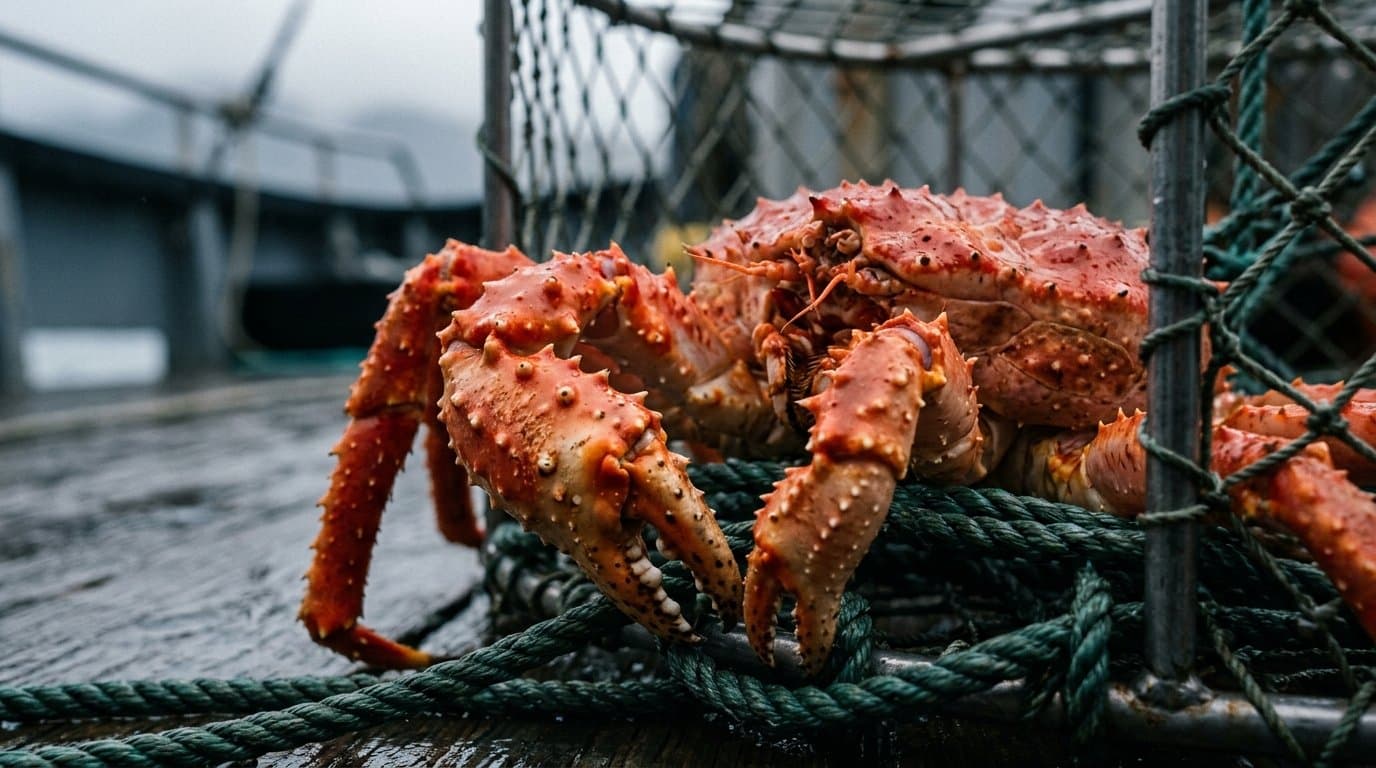
AI image
Southeast king crab quota rests on a figure the state's own report gives two ways
Southeast Alaska's commercial red and blue king crab fishery opens Nov. 1 on a quota of 213,076 pounds, about two-thirds of it set in water the Alaska Department of Fish and Game did not survey. The department's own assessment of last season's opening, the first since 2017, contains two different harvest rates for that unsurveyed water. By one of them, the fishery cleared the threshold that let it open. By the other, it fell 852 pounds short.
The rule is that the fishery may run as a competitive opening only if the weight of legal-size male crab available for harvest reaches 200,000 pounds. Last season's figure was 211,573 pounds, clearing the line by 11,573. This season's is 213,076, clearing it by 13,076. Both are about 6 percent over the minimum.
The state's assessment estimates the harvestable surplus in seven unsurveyed areas by applying a harvest rate to an expanded biomass estimate. The report's narrative applies a 10 percent rate and arrives at 123,254 pounds. Its summary table, working from the same biomass, applies 11 percent and arrives at 135,679. The gap between them is 12,425 pounds, and the regulatory line sits inside it: the table's figure puts the 2025 total at 211,573, above the threshold, while the narrative's puts it at 199,148, below. The report states that the fishery opened "because there was a harvestable surplus above the regulatory 200,000 lb threshold." It does not address the difference.
Unsurveyed water carries most of the quota. The seven unsurveyed areas account for 139,748 pounds this season, 65.6 percent, against 73,329 pounds in the three surveyed areas. The share assigned to unsurveyed water is derived from landings between the 1974 and 1985 seasons. The biomass expansion uses data from 1979 to 2004. The median that decides whether the fishery may open at all draws on 1995 through 2007.
Some of the surveyed water was not surveyed either. Peril Strait was moved to a biennial schedule and skipped in 2025. Holkham Bay has not been surveyed since 2015 because of survey funding cuts.
When the fishery reopened last year, the fleet took a small fraction of what it was allowed. Eight of nine permits fished 29,866 pounds worth $776,523, about 14 percent of the 211,573-pound level. Before that the fishery had been closed every year from 2008 through 2024 except 2011 and 2017.
This season the Juneau area opens for 24 hours on 22,085 pounds, Gambier Bay for 28 hours on 8,687, and Seymour Canal for 56 hours on 42,557. Adam Messmer, the region's lead crab biologist and one of the assessment's authors, said those surpluses are too small to allow in-season management toward the targets. The seven unsurveyed areas run on daily call-ins and can close on as little as eight hours' notice. Peril Strait, Excursion Inlet, Pybus Bay and Lynn Sisters are closed. Registration closes Oct. 2.
Source: adfg.alaska.gov, Alaska reopened Southeast's king crab fishery on a quota that cleared its legal threshold by 11,573 pounds. The department's own report gives two different figures for the number that got it there, and one of them falls short ().
AI-assisted, reviewed by Cale Green. Who is accountable.
Stay informed. Support what matters.
Free, permanent access to local news you can verify. Subscribe to support Walter AlaskaNews and go ad-free.
Related Coverage
Southeast Alaska's king crab fishery will open, barely clearing the bar
Alaska News · 1w ago
Southeast king crab reopens for a second year after a long drought
Alaska News · 5d ago
Southeast king crab registration closes Oct. 2 ahead of a Nov. 1 opening
Alaska News · 15h ago
Alaska's one-boat state crab fishery reopens as offshore quota rises
Alaska News · 1mo ago
Aleutian Islands golden king crab quota rises 13% for 2026/27
Alaska News · 2mo ago
Comments
Sign in to leave a comment.
No comments yet. Be the first to share your thoughts.