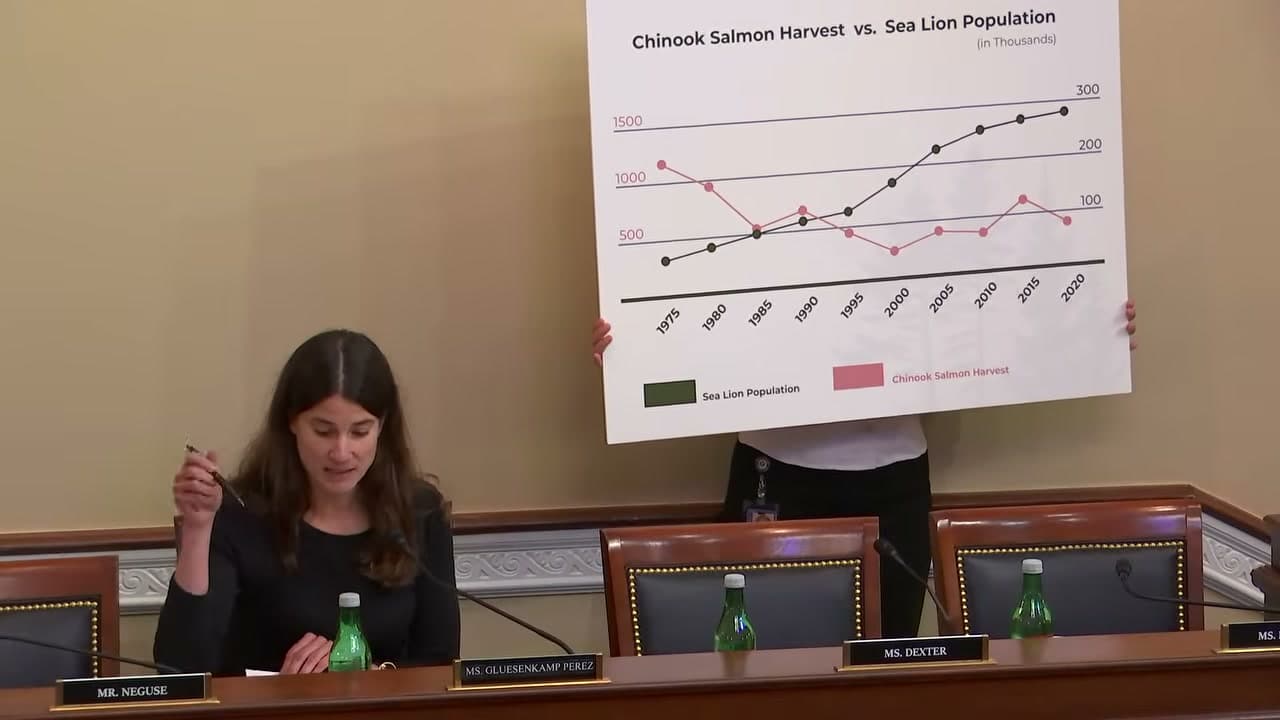
Frame from "House Natural Resources Subcommittee on Water, Wildlife and Fisheries (Begich): Legislative Hearing" · Photo source
The sea lions in Congress's salmon bill breed in Southeast Alaska
A House subcommittee took up a bill Tuesday that would expand federal authority to conduct lethal removals of sea lions preying on salmon in the Columbia River and Washington waters. The Steller sea lions involved are partly Alaska's animals: they belong to the eastern stock, which breeds on rookeries running from Southeast Alaska through British Columbia to California.
That stock has recovered. Roughly 31,000 animals strong, it came off the endangered species list in 2013 after growing about 4 percent a year for three decades. Supporters of the bill treat that as the point — a recovered, expanding population preying on listed salmon runs should be managed the way other recovered wildlife is managed.
They also point to results. "Prior to lethal removal, listed winter steelhead faced an 89% risk of extinction," said Nate Pamplin of Washington's fish and wildlife department. "After 2 years of targeted removals, the risk of extinction fell to 11%."
The bill builds on a 2018 law that first allowed Columbia River removals. It would lift the geographic limit at river mile 112, drop the requirement that animals be euthanized chemically, and let Washington and covered tribes carry out removals. Takes would be capped at 10 percent of potential biological removal, the federal calculation of how many animals a stock can lose and stay healthy.
Not everyone is persuaded it works. "I'm concerned that this well-intentioned act will really do little to recover West Coast salmon," said Richard Merrick, testifying for the minority. Rep. Val Hoyle of Oregon objected that her state's tribes were left out of the bill's development.
One Alaska wrinkle sits underneath the science. Federal researchers have documented a mixing zone in northern Southeast Alaska, where new rookeries were founded partly by females from the still-endangered western population — a complication for a framework built on treating the two stocks as separate.
This article is based on a public meeting of House Natural Resources Subcommittee on Water, Wildlife and Fisheries (Begich) — House Natural Resources Subcommittee on Water, Wildlife and Fisheries (Begich): Legislative Hearing ().
Made by our human newsroom with AI. How humans and AI work here · Grow with our newsroom Transcript byLucas Brown
Watch key moments from the source meeting. Click to expand.
Stay informed. Support what matters.
Free, permanent access to local news you can verify. Subscribe to support Maggie AlaskaNews and go ad-free.
Related Coverage
House committee advances bill treating hatchery fish as wild under Endangered Species Act
Alaska News · 1mo ago
NOAA pays $1.57 million for samples from subsistence-harvested seals
Alaska News · 2mo ago
Begich bill to expand commerce in Alaska sea otter handicrafts gets first congressional hearing
Alaska News · 4mo ago
Trawl groups ask fishery council to shrink Steller sea lion closures; conservation groups object
Alaska News · 1w ago
EPA Rule Would Drop Discharge Permits for 65 Alaska Trawlers
Alaska News · 4w ago
Comments
Sign in to leave a comment.
No comments yet. Be the first to share your thoughts.