AI image
EPA Rule Would Drop Discharge Permits for 65 Alaska Trawlers
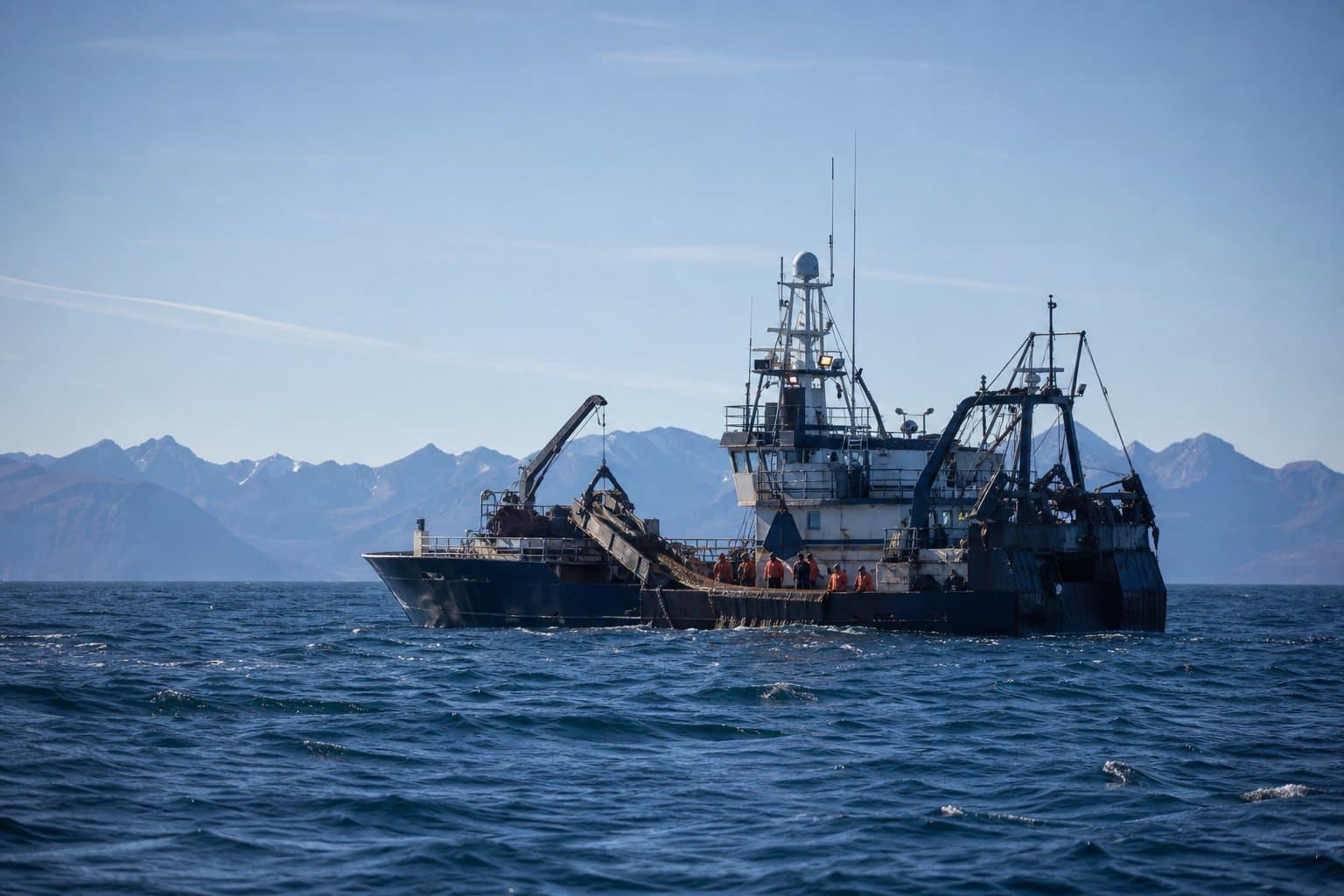
Sixty-five Alaska offshore seafood processing vessels would no longer need a Clean Water Act permit to put fish waste into federal waters under a rule the Environmental Protection Agency proposed on Sept. 4. Their permit keeps them away from Steller sea lion rookeries, eider critical habitat and refuge waters. Those conditions would end with it.
The change itself is six words. EPA proposed deleting the phrase "which is being used as a means of transportation" from the definition of "discharge of a pollutant" at 40 CFR 122.2. That phrase is why a factory trawler working the Bering Sea needs a discharge permit and a passing ship does not.
The proposal offers one worked example: "NPDES permit authorization would no longer be required for discharges into the contiguous zone or ocean from offshore seafood processor trawlers because these facilities are not secured to the seabed." NPDES, the National Pollutant Discharge Elimination System, is the Clean Water Act's permit program. The contiguous zone runs from three miles offshore to twelve, and the rule reaches the ocean beyond it.
The word Alaska does not appear in the rule text.
What the Alaska permit currently requires
The Alaska share is not in the rule but in EPA's draft economic analysis, which counts 79 permitted offshore seafood processing operators nationally under two general permits issued by EPA Region 10. Fourteen are under the Washington and Oregon permit. Sixty-five are under the Alaska permit, AKG524000.
That permit covers waters more than three nautical miles from the Alaska shoreline, and its conditions are written around Alaska animals. Vessels may not discharge within three nautical miles of a Steller sea lion rookery or major haul-out, or within one nautical mile of designated critical habitat for the Steller's eider or the spectacled eider. The same one-mile buffer applies around national parks, refuges, wilderness areas, state game sanctuaries and state critical habitat areas.
A vessel discharging more than 10 million pounds a year inside Steller sea lion critical habitat must grind its solids. The permit requires that "the grinding system must be designed and operated to grind solids to 0.5 inch or smaller prior to discharge." West of 144 degrees west longitude, unground discharge must stop when a sea lion comes within 250 meters. Crews run a daily sea surface watch for short-tailed albatross, spectacled eider, Steller's eider and Steller sea lion, and the sea lion counts go to the National Marine Fisheries Service each year.
The 2019 fact sheet for AKG524000 reports that of 91 vessels reporting for 2015, the median discharged 6.2 million pounds and the largest 88.2 million, and that total reported discharge that year came to roughly 1.1 billion pounds. Those figures exist because the permit requires annual reporting.
The tradeoff EPA cites
The rule "would also eliminate permit-required monitoring and reporting, potentially reducing the information available for public review," the agency wrote. Foregone benefits "could include the current management of localized seafood processing discharges to ocean waters beyond three miles, with possible effects on marine species and receiving-water quality." Against that, EPA estimates about $1.7 million a year in industry savings and $50,000 for the agency, about $22,000 per operator.
EPA frames the action as a legal correction rather than a policy choice. The agency says its 1979 regulation narrowed a carve-out Congress wrote in 1972, and that the earlier preamble "failed to acknowledge or address why Congress treated additions of pollutants differently based upon geographic location of the receiving water." It cites the Supreme Court's 2024 decision in Loper Bright Enterprises v. Raimondo. Ocean dumping, oil pollution and vessel incidental discharge statutes are unaffected.
The proposal contains no Endangered Species Act analysis. Its text does not mention the Act, the National Marine Fisheries Service, Steller sea lions or essential fish habitat. The Alaska permit it would moot was issued in 2019 after a Section 7(a)(2) consultation, the Endangered Species Act review that produced a Biological Opinion on its effects. The rule's only consultation section addresses tribes, where EPA states the action has no tribal implications and that "the agency plans to consult with Tribal officials upon publication of the proposed rulemaking."
The Alaska permit took effect July 17, 2019, was modified in 2021, expired July 16, 2024, and has been administratively continued since.
No Alaska agency, tribal government, permit holder, fishery management body or the National Marine Fisheries Service had filed a comment as of Sept. 24. Forty-four members of the public had. One, filed Sept. 15, argues that a test based on seabed attachment "could create a broad loophole for mobile industrial facilities." The National Federation of Independent Business filed a letter dated Sept. 21. The Alaska Department of Environmental Conservation certified the permit under Section 401, the state sign-off that a federal permit meets state water quality standards. Whether operators would keep running grinders and monitoring without a rule requiring them is not addressed in the record.
How to comment
Written comments are due Oct. 19. They may be submitted through the federal rulemaking portal under docket EPA-HQ-OW-2026-6965. The notice directs readers to its supplementary information for details on a public hearing, and that section lists only written comments. The rule's contact is Kenda Conley of EPA's Water Permits Division, 202-564-0306.
Source: A proposed EPA rule would end the discharge permit for 79 offshore seafood processors. Sixty-five of them are Alaska's, and the rule never uses the word Alaska. ().
AI-assisted. No editor review is on record for this article. Who is accountable.
Stay informed. Support what matters.
Free, permanent access to local news you can verify. Subscribe to support Walter AlaskaNews and go ad-free.
Related Coverage
Cook Inlet's oil and gas discharge rules expired in 2021, and EPA is finally rewriting them
Alaska News · 1mo ago
Kodiak seafood permit bars waste deposits on seafloor
Alaska News · 3mo ago
Juneau's wastewater permit would be renewed despite a record of violations
Alaska News · 2w ago
EPA proposes a $5,859 penalty over Dutch Harbor discharges
Alaska News · 2mo ago
EPA proposes $5,859 UniSea settlement over Dutch Harbor stormwater
Alaska News · 1mo ago
Comments
Sign in to leave a comment.
No comments yet. Be the first to share your thoughts.