Senate panel examines price controls, federal authority on gas pipeline
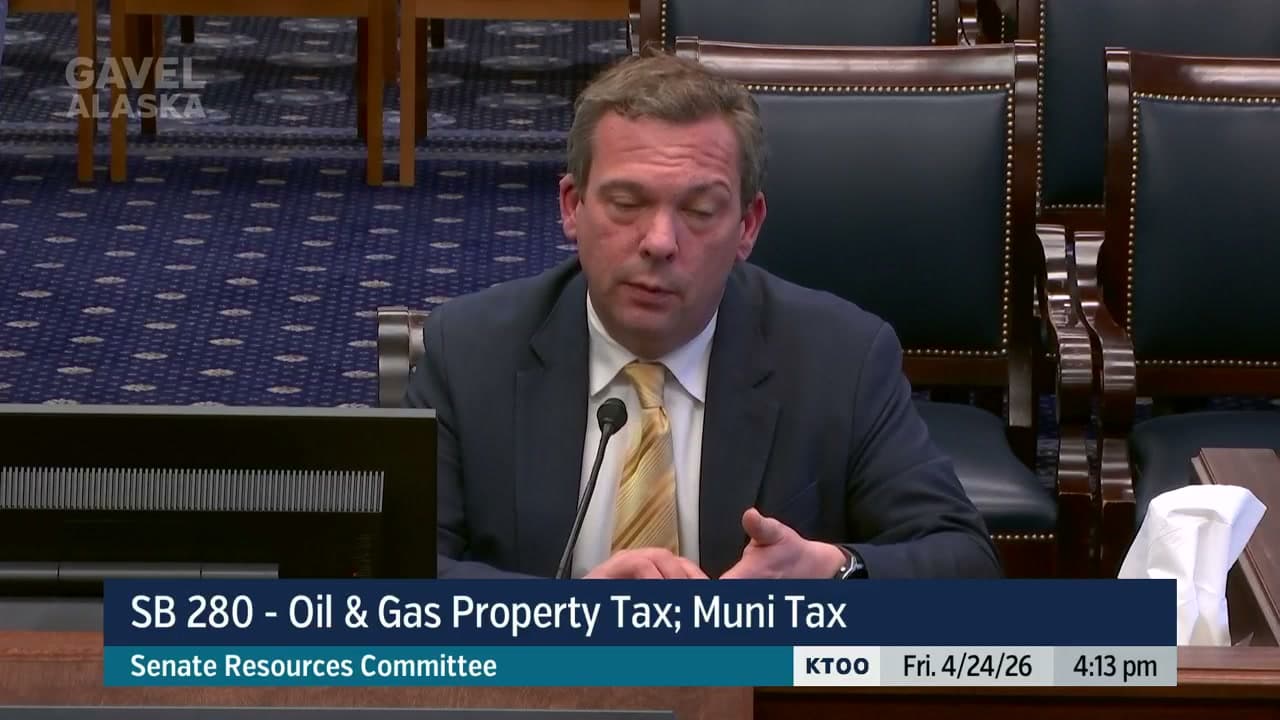
The Alaska Senate Resources Committee examined legal questions Friday about proposed price controls on natural gas and federal regulatory jurisdiction over a pipeline project, with lawmakers weighing whether legislative oversight could conflict with federal authority.
The Alaska LNG project has pursued a phased development approach to address the Cook Inlet energy crisis. Frank Richards, testifying on behalf of the project, explained that developers engaged with the Federal Energy Regulatory Commission about moving forward with authorizations and implementation plans for a phased approach to provide gas to Alaskans because of the Cook Inlet energy crisis. The Cook Inlet basin, which has supplied natural gas to Southcentral Alaska for decades, faces declining production from aging fields, creating supply concerns that have driven interest in bringing North Slope gas to the region. FERC approved the integrated Alaska LNG project in 2020 under its Section 3 authority for export facilities, treating the 807-mile pipeline and liquefaction plant as a single project designed for phased construction.
Federal law grants FERC authority over natural gas exports and interstate commerce, but the Natural Gas Act also preserves state authority in areas not directly conflicting with federal wholesale rate authority, according to committee counsel. State antitrust lawsuits targeting excessive retail rates are not preempted even when underlying conduct affects wholesale pricing. In April 2015, the U.S. Supreme Court affirmed by a 7-2 vote that state law antitrust claims are not preempted by the Natural Gas Act, establishing precedent for state regulatory authority in natural gas matters.
Committee counsel warned that price caps in the current committee substitute of Senate Bill 280 limiting utilities to charging no more than $12 per thousand cubic feet before an LNG export plant opens and $5 after it begins operation may conflict with federal authority over interstate commerce. The Federal Energy Regulatory Commission maintains jurisdiction over natural gas pricing under the Natural Gas Act, raising questions about whether state-imposed price controls would survive legal challenge.
The price targets originated from public statements by state officials about expected costs for Alaska consumers. Southcentral Alaska currently pays $10 to $13 per thousand cubic feet for natural gas. Phase 1 of the Alaska LNG project, a pipeline from the North Slope to Anchorage without the export facility, could increase costs to $16 to $18, representing a 60 percent to 80 percent price increase.
Richards said the price controls could discourage information sharing between the state and project developer Glenfarn. Reading the bill and seeing that there are price structures in place, it does not allow the market to respond, Richards said.
Committee members raised concerns about worst-case scenarios if Phase 2, the export facility, is never built. With inflation factors built into gas supply contracts, lawmakers questioned whether Southcentral Alaska could face $50 gas within 30 years if locked into long-term agreements without the cost reductions expected from LNG exports. One committee member emphasized the legislature's obligation to protect consumers, saying the state has an obligation to protect the consumers, the people of Alaska, and constituents across the state. The member added that lawmakers do not want to get locked in.
The committee also examined whether the legislature has authority to approve foreign sales contracts, a provision included in the current committee substitute. Richards said he believed that the Natural Gas Act grants FERC authority to authorize the export of gas to foreign countries, whether they be free trade or non-free trade countries. Committee counsel acknowledged the provision could be severed if challenged as exceeding state authority over international commerce.
Legal questions extended to which regulatory body, federal or state, holds jurisdiction over the pipeline itself if only Phase 1 is constructed. The Regulatory Commission of Alaska submitted written responses after a scheduling conflict prevented live testimony. RCA staff wrote that FERC typically cedes jurisdiction over intrastate portions of pipelines to state regulators, generally retaining authority only within 1,000 feet of border crossings. However, RCA staff noted that FERC had not considered the scenario of Phase 1 operating independently without the export facility.
The Alaska Municipal League testified that local governments want the ability to negotiate directly with project developers, though some of that negotiation authority would require legislation. Nils Andresen, representing the league, said communities along the pipeline corridor would experience impacts during construction and potentially afterward for some project components where the return did not compensate them effectively.
Local governments also expressed concern about insufficient information regarding end costs for electricity and other energy needs. Communities want more robust development of cost projections to understand what the final energy costs will look like for their residents.
The current committee substitute includes provisions discussed by the committee for boroughs with oil and gas property to negotiate optional exemptions while creating a community impact fee structure administered through the Department of Commerce, Community and Economic Development.
The committee will continue discussion of Senate Bill 280 at its next meeting Monday, April 27, when the Department of Revenue is scheduled to testify. The legislature has fewer than 30 days remaining in the regular session to address the complex regulatory and jurisdictional questions surrounding the project.
This article is based on a public meeting — Senate Resources Committee ().
AI-assisted. How we use AI Transcript byLucas Brown
Stay informed. Support what matters.
Free, permanent access to local news you can verify. Subscribe to support Matt and go ad-free.
Related Coverage
Senate panel examines regulatory questions on gas pipeline tax plan
Alaska News · 5mo ago
Alaska regulators say gas-line oversight hinges on federal decision
Alaska News · 3mo ago
Senate panel examines LNG project economics, megaproject risks
Alaska News · 5mo ago
Senate panel weighs municipal concerns over Alaska LNG tax structure
Alaska News · 4mo ago
The $16 Gas Promise Comes With Fine Print
Alaska News · 3mo ago
Comments
Sign in to leave a comment.
No comments yet. Be the first to share your thoughts.