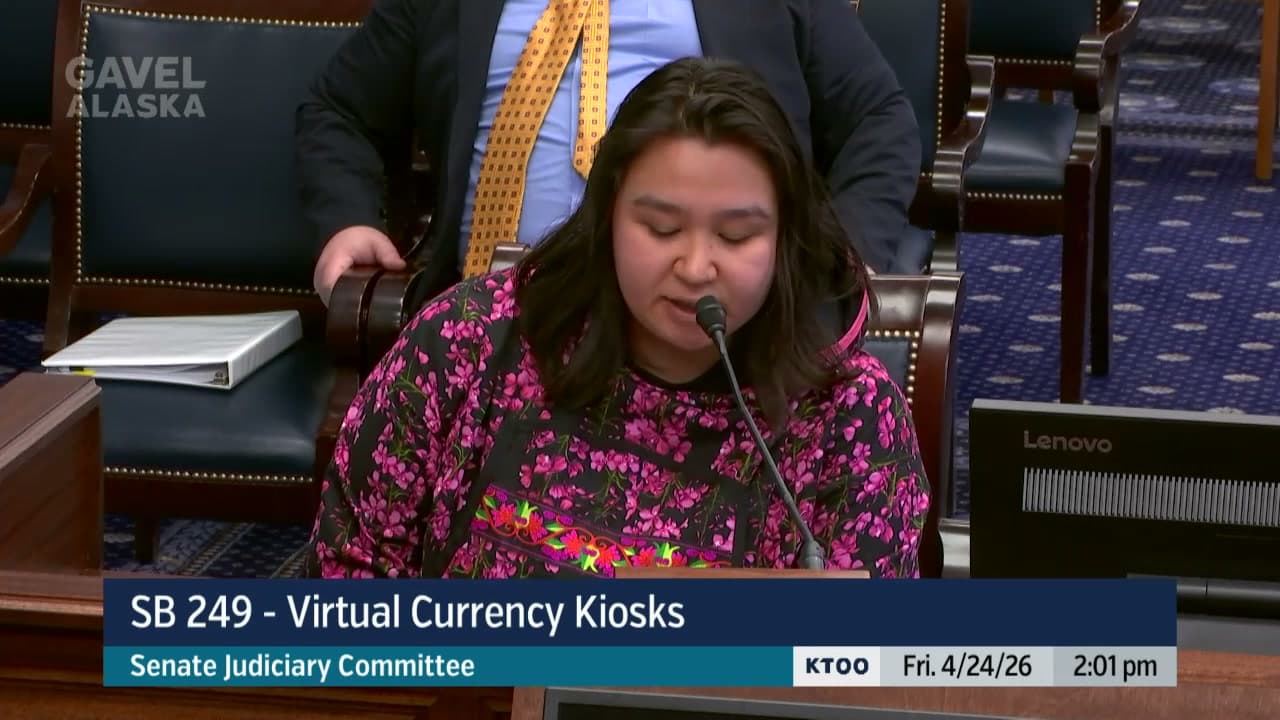
Senate Judiciary hears testimony on crime omnibus combining five bills
The Alaska Senate Judiciary Committee heard public testimony Friday on a crime bill that combines provisions on domestic violence, sexual assault, hit-and-run crashes, and AI-generated child abuse images.
House Bill 239, known as the Omnibus Crime Bill, packages five separate measures into one piece of legislation. These include House Bill 101 establishing a new age of consent for minors with a close-in-age exception, Senate Bill 247 on AI-generated child abuse materials, House Bill 242 on healthcare provider sexual assault, House Bill 62 on sexual assault forensic examination kit tracking, and House Bill 84 extending confidentiality protections to tribal victim service advocates. The committee took no action Friday but set an amendment deadline of 5 p.m. that day, with a goal of moving the bill out of committee Wednesday.
The bill would hold offenders accountable for using artificial intelligence to generate child sexual abuse materials. It would ensure healthcare providers who sexually assault patients during treatment face criminal charges. The bill also would establish a tracking system for sexual assault forensic examination kits.
Brenda Stanfield, executive director of the Alaska Network on Domestic Violence and Sexual Assault, testified in support of the combined package. She said the bill would create additional protections for victims and increase safety for all Alaskans.
"We appreciate the Judiciary Committee for bringing the many crime bills that were going through their process into one bill so we could ensure they make it through the steps necessary to become law at the end of this legislative session," Stanfield said.
One provision would close a loophole in hit-and-run cases, according to supporters. Multiple members of Chase Ballerson's family, who lost him in a January 2021 hit-and-run when he was struck by a vehicle and left on the roadside for four hours before being found, urged the committee to pass the bill. Kelly Trent, Jeff Trent, Maxine Fakhiti and Way Bowerson all testified in support.
"To hit someone with their vehicle and then make the choice to leave them alongside the road cannot be tolerated," Kelly Trent said. "That choice has to have real consequences."
Jeff Trent said the current law allows concurrent sentencing that absorbs the failure-to-render-aid charge into the sentence for killing someone, negating any meaningful impact.
The bill also addresses sexual assault by healthcare providers, a provision prompted by a Juneau case where charges were dropped against a doctor because the patient knew they were being sexually assaulted. Jamie Ann Zechtin, a Juneau resident who testified she was sexually assaulted by her healthcare provider, said the current law requires victims to be unaware the harm is happening for it to be considered sexual assault.
"Knowing that something is happening to your body does not mean you agree to it," Zechtin said. "Awareness is not consent. Silence is not consent."
Zechtin noted that the legal change would not affect the ongoing case but would protect future patients.
The provision on AI-generated child sexual abuse materials drew opposition from Renee Spring, who argued that images not involving real children should not be prosecuted as child sexual abuse materials. Spring cited Supreme Court cases protecting virtual images under the First Amendment when no real minor is involved.
"Punishing someone for a completely fake image is not justice," Spring said. "Who is being justified? There is no victim."
Zee Van Dyke, testifying as an independent citizen, expressed concerns about the bill's impact on the criminal justice system and victims of sexual assault. As a survivor of sexual assault who never received justice, Van Dyke questioned whether the bill would address the root causes of these issues or simply increase incarceration rates.
"I'm concerned with whether we are going to act, the bill will actually address the root cause of these issues versus just putting more people in prison," Van Dyke said.
Michael Garvey, policy director at the ACLU of Alaska, said the organization does not have a position on the omnibus overall but expressed concern about insufficient time to assess its impact on the criminal legal system. He said the package is likely to increase incarceration rates and strain state resources.
Garvey urged the committee to add Senate Bill 62, which would reform the state's parole system by requiring the parole board to include members with expertise in addiction and a representative of Alaska Native communities. He noted that enacting such reforms would allow the state to save money by ensuring Alaska is not needlessly incarcerating people who can be supervised on parole.
The bill also includes a section on airbag fraud. Craig Orlin, director of government affairs with Honda Motor Company, testified that scammers primarily from China are selling counterfeit airbags online filled with debris or nothing at all. He said 10 fatalities and dozens of injuries nationwide have resulted from these products.
"The goal of this legislation is to be proactive, to try to stop these products from getting into the customers' vehicles in the first place," Orlin said. Forty other states have passed similar legislation.
Rick Haskins Garcia of the Alaska Native Women's Resource Center testified in support of a provision that would extend confidentiality protections to tribal victim advocates. Current law protects communications between survivors and victim counselors who work for private organizations, military programs, or local government agencies, but excludes tribal governments.
"This is a legal gap that directly harms survivors in our communities," Haskins Garcia said. The amendment would add two words, "or tribal," to the definition of victim counseling center.
Lauren Orton Cruz, a concerned Alaska resident and mother, said she supports many provisions in the bill but expressed concern about some provisions that had received less public review. These include Senate Bill 233, which would move the Controlled Substances Advisory Committee from the Department of Labor to the Department of Commerce, Community, and Economic Development. Orton Cruz also raised concern that including Senate Bill 233 could violate the single-subject law because it does not appear to be about crime, potentially putting the entire omnibus at risk.
"The longer that we wait on things like raising the age of consent or the AI/CSAM bill, the more victims there are," Orton Cruz said.
Alaskans can submit written testimony through the Alaska Legislature's website or contact committee members directly.
This article is based on a public meeting — Alaska Legislature: Senate Judiciary, 4/24/26, 1:30pm ().
AI-assisted. How we use AI Transcript byLucas Brown
Stay informed. Support what matters.
Free, permanent access to local news you can verify. Subscribe to support Alaska News and go ad-free.
Related Coverage
Senate Finance hears omnibus crime bill targeting AI child porn, raising age of consent
Alaska News · 4mo ago
Alaska Senate advances sweeping public safety bill with AI child abuse provisions
Alaska News · 4mo ago
Senate Committee Advances Bill to Raise Alaska's Age of Consent Amid Sexual Violence Crisis
Alaska News · 6mo ago
Alaska Passes Age of Consent Bill After Weeks-Long Senate Delay
Alaska News · 4mo ago
Alaska Senate Panel Weighs Tougher Hit-and-Run Penalties
Alaska News · 5mo ago
Comments
Sign in to leave a comment.
No comments yet. Be the first to share your thoughts.