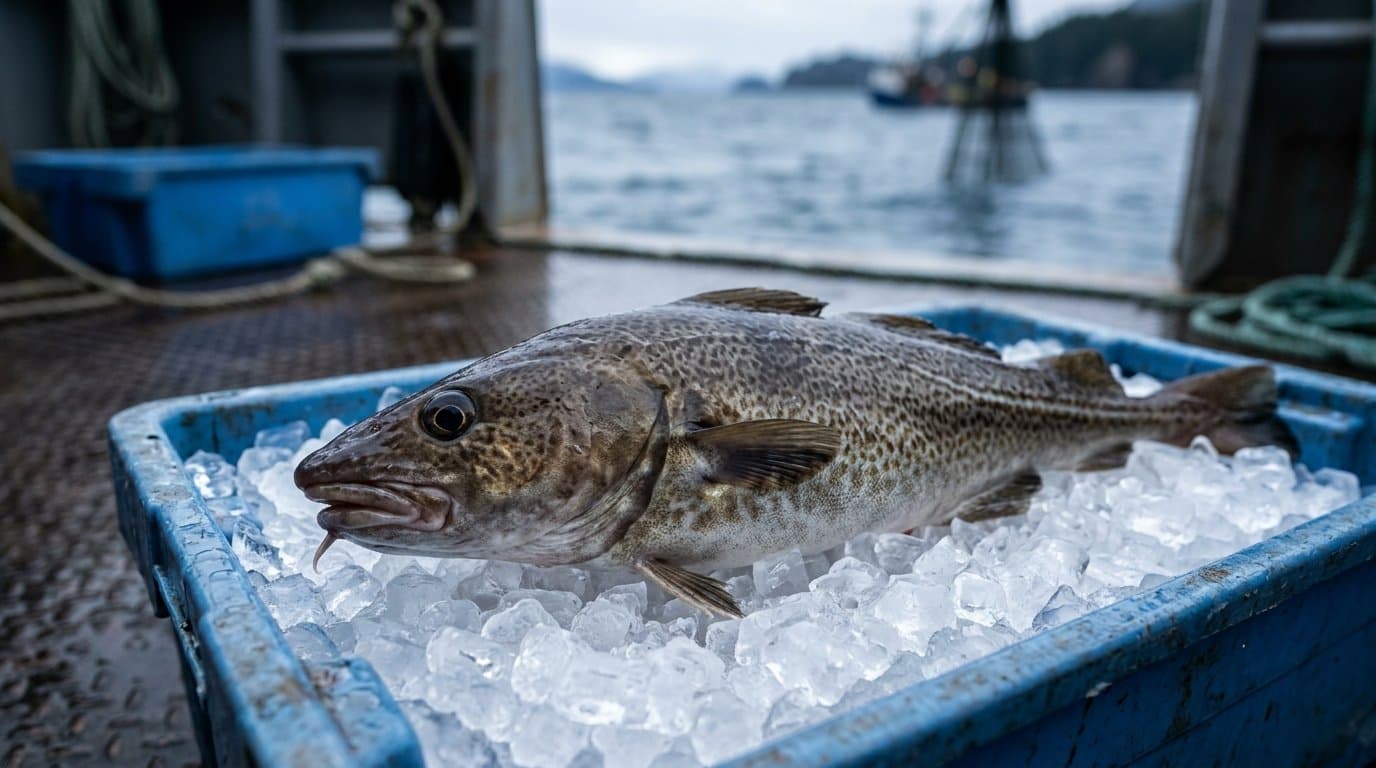
AI image
Scientists recommend keeping the Gulf of Alaska cod limit near this year's level in 2027
Federal scientists recommend a Gulf of Alaska Pacific cod catch limit for next year close to this year's level, and above the lower number already written into federal rules.
The limit caps how much cod pot, trawl, longline and jig boats can take from the Gulf, combining state and federal waters. Scientists put the 2027 figure at 41,937 metric tons, 1% above this year's 41,520 tons. The Gulf of Alaska Groundfish Plan Team adopted the number unchanged in recommendations posted Sunday. The North Pacific Fishery Management Council takes it up next month in Anchorage.
That 41,937-ton figure is the acceptable biological catch, the most scientists advise taking from the stock in a year. The federal total allowable catch is set lower, to leave room for state-waters fisheries. This year's federal limit is 30,053 tons.
The 2027 numbers now in a federal rule, projected from last year's assessment, had set the ceiling at 32,209 tons and the federal limit at 23,359 tons. The new recommendation runs 30% above that earlier projection, which the authors attribute to "updated data and an increase in the estimated stock status."
This year's federal limit was proposed at 22,235 tons in December 2025, and the final rule in March raised it to 30,053 tons because of the 2025 assessment, according to the rule.
For 2028, the authors recommend a lower limit of 35,866 tons. They project the spawning stock, the weight of mature female cod, falling from 51,423 tons in 2027 to 46,230 tons in 2028, assuming fleets catch the full 2027 limit.
Federal fisheries had caught 27,403 tons of their 30,053-ton limit by Nov. 12, according to the Plan Team's table, and state-waters fisheries had taken 98% of theirs by Oct. 26, according to the assessment. In the Western Gulf, federal managers closed the pot boats' directed cod fishery Oct. 23, two days after moving more cod to them. They had caught 3,147 tons by Nov. 1, 102% of their share, according to the National Marine Fisheries Service's year-end report. In the Central Gulf, 152 catcher vessels targeted cod this year, nearly twice the 79 in 2022, the report shows.
The stock assessment's authors, led by Peter-John F. Hulson, write that "the stock appears to be recovering from low levels." They project the 2027 spawning stock at 32% of its estimated unfished level, below the 40% target below which the harvest rule lowers the allowed fishing rate. The stock is not overfished and not subject to overfishing, but it "remains in an undesirable stock status," they write.
The authors rate every risk category normal but flag two cautions. Forecast El Nino warmth in 2027 "may impact population productivity." And recruitment, the young fish entering the stock, has run below average since 2014, so projected spawning biomass is "likely" overly optimistic, though they say that matters little to the two-year limits.
This year's assessment made no model changes and had no new survey index. The 2025 federal trawl survey found cod biomass 39.2% above 2023, though it completed only 431 stations, the fewest since 1990. The 2026 beach seine index of age-0 cod, fish in their first year, was the second highest on record.
The Gulf's cod limit fell from 88,342 tons in 2017 to 18,000 tons in 2018, after the 2014 to 2016 marine heatwave, and the federal directed fishery closed in 2020.
By area, the recommendation would give the Central Gulf 29,020 tons, the Western Gulf 10,401 and the Eastern Gulf 2,516, each about 1% above this year's.
The council's Scientific and Statistical Committee is scheduled to review the Gulf limits Wednesday, Dec. 2, and the council to take them up Dec. 7 and 8, according to its draft schedule. Written comments close at noon Friday, Nov. 27. A final rule due in early 2027 will replace the 2027 numbers now in regulation, the council's October newsletter says.
What did you make of this story? (no account needed)
Made by our human newsroom with AI. How humans and AI work here · Grow with our newsroom ·
Keep Alaska News free for everyone.
No paywall, ever. Members pay so everyone can read the meetings and records Alaska News covers.
Get Alaska News in your inbox
Create your free account and get the day’s top stories around 6 each morning, in a few minutes’ read.
Top stories, around 6 each morning.
Stories on what you follow, on Sundays.
Source: North Pacific Fishery Management Council, Final Gulf cod assessment recommends a 2027 limit of 41,937 tons, 30% above the number now on the books, with a cut to follow in 2028.





Comments
Sign in to leave a comment.
No comments yet. Be the first to share your thoughts.