NSF awards UAF $1.6 million to build Alaska prescribed-burn forecasting tools
Grant Targets Alaska's Missing Fire-Weather Tool
Alaska fire managers lack a forecasting tool built for the state's weather, and a $1,588,147 National Science Foundation grant awarded to the University of Alaska Fairbanks on Friday is aimed at closing that gap. The award, number 2536745, funds work from Sept. 1, 2026, through Aug. 31, 2030.
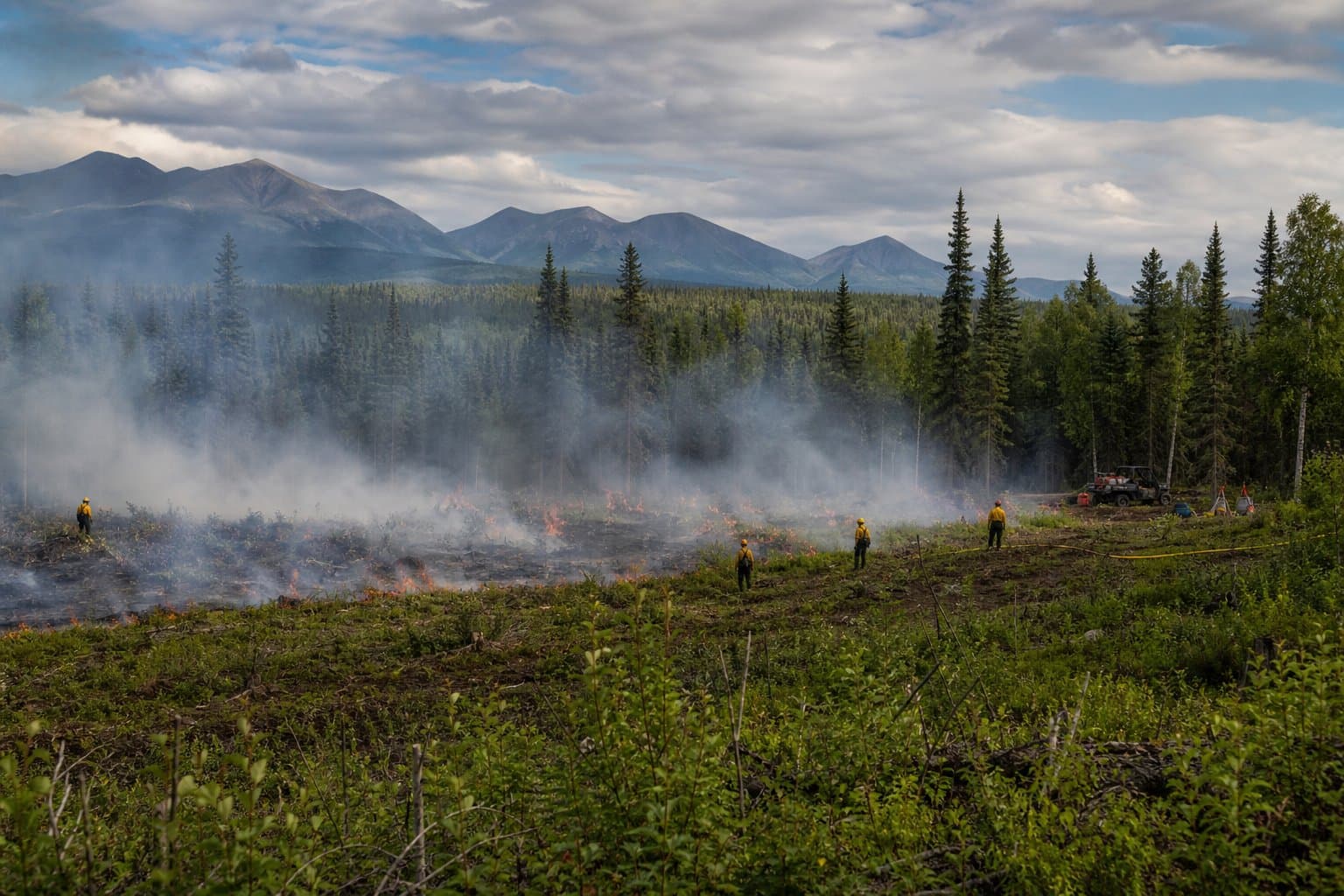
The project takes aim at prescribed burning: the intentional setting and controlled management of fire to reduce accumulated fuels before a wildfire finds them. According to the award abstract, the practice remains underused in Alaska because the state lacks forecasting tools and community partnerships suited to its environment, even though most Alaskans live within or near the wildland-urban interface, the zone where homes and infrastructure meet fire-carrying vegetation.
Christine F. Waigl of UAF is principal investigator. The grant was made through the NSF program in fire science innovations under the Directorate for Geosciences, where Yurena Yanes serves as program officer.
Adapting a Lower 48 Tool to Alaska's Fire Danger System
The technical core is an adaptation problem. The Prescribed Fire and Smoke Planner, a decision-support tool already in use across the Lower 48, will be modified to incorporate the Canadian Forest Fire Weather Index system, the fire danger rating framework Alaska's managers already rely on. Drawing on historical weather reanalysis and on statistical and machine-learning methods, the team will map seasonal and geographic patterns of hazardous fire weather and identify windows favorable for safe burning across Alaska and the wider Northern Pacific Boreal-Arctic region. Community partners are to co-develop maps, GIS datasets, and risk assessments; the abstract notes that governance in many of these places involves municipal, federal, tribal, and nonprofit entities.
The project will also survey fire managers and members of the public to quantify differences in preferences and values regarding prescribed burning, with the results intended to inform outreach and decision-making.
The appetite among users is not new. An earlier Joint Fire Science Program proposal written by fire researchers including UAF collaborators said the team would "use the quality assured dataset to develop tools for land managers interested in prescribed fire windows," including "a web-based tool that compares the likelihood of finding prescription windows based on ranges of weather variables and CFFDRS and NFDRS components." Federal managers elsewhere are pursuing the same capability: the USDA Forest Service Pacific Northwest Research Station says on its research site that its scientists are "working with other federal and university scientists to develop a prescribed fire and smoke dispersion, months- to season-long, forecasting system to help the Forest Service confront the wildfire crisis."
AI-assisted, reviewed by editors. Spot an error?
Related Coverage
NSF awards UAF $1.77 million to build AI geohazard forecasting tools
Alaska News · 2w ago · 84% match
NSF awards UAF $877,501 for mass spectrometer to support fisheries and minerals research
Alaska News · 2w ago · 80% match
UAA chemist wins $365,000 NSF grant to study oil spill byproducts in cold water
Alaska News · 1h ago · 79% match
UAF scientist gets $300K to unlock permafrost's carbon time bomb
Alaska News · 2mo ago · 78% match
UAF grant aims to read what a volcano is doing while it does it
Alaska News · 3d ago · 77% match
Comments
Sign in to leave a comment.
No comments yet. Be the first to share your thoughts.